












![5,10-Dihydroindeno[2,1-a]indene structure](https://static.chemtradehub.com/structs/654/6543-29-9-71ca.webp "5,10-Dihydroindeno[2,1-a]indene structure")
Tunable amphiphilic graft copolymers bearing fatty chains and polyoxazoline: synthesis and self-assembly behavior in solution
Literature Information
Publication Date
2017-06-26
DOI
10.1039/C7PY00632B
Impact Factor
5.582
Authors
David Rayeroux, Vincent Lapinte, Jean-Jacques Robin, Cécile Bouilhac
View Original
Abstract
Amphiphilic graft copolymers composed of a methacrylate-based hydrophobic backbone with C11 pending chains end-capped by hydrophilic polyoxazoline (POx) blocks were successfully synthesized using the grafting-onto method by associating reverse addition fragmentation chain transfer (RAFT) polymerization with azide–alkyne Huisgen's cycloaddition (CuAAC). Pure and well-characterized copolymers with different molecular weights and without traces of starting polymers were obtained. The hydrophilic character of the copolymers was controlled by copolymerizing the azido-terminated monomer 11-azido-undecanoyl methacrylate (AzUMA) with lauryl methacrylate (LM), the corresponding (co)polymers being then coupled with α-alkyne-POx. Using dynamic light scattering (DLS) and transmission electronic microscopy (TEM) techniques, their self-assembling behavior was studied by direct dissolution in water without further filtration. Depending on the systems, two or three particle size distributions co-exist in solution. However, the smallest objects, with DH-values around 6, 42 and 255 nm, were obtained with the most hydrophilic copolymers (∼90% of hydrophilic group per molecule). Moreover, the influence of the starting copolymer architecture on its self-organization behavior was emphasized by comparing the self-assembly of the graft copolymers with that of an amphiphilic macromonomer, in situ polymerized, and whose structure mimics that of the repeating unit of the graft copolymers.
Related Literature
The reaction of ‘GaI’ with a 1,3-diyne: synthesis, characterisation and reactivity of a novel C–C coupled ene–diyne–bis(gem-organodigallium(iii)) complex
Robert J. Baker, Cameron Jones
2003-01-14
Communication
DOI: 10.1039/B210868M
Domino ‘Staudinger–aza-Wittig–1,5-phosphonium-rearrangement–fragmentation’ reactions of 1-azido-2-hydroxy-4,6-dioxohexanes
Peter Langer, Heydar Shojaei
2003-10-31
Communication
DOI: 10.1039/B310701A
Cell-permeable small molecule probes for site-specific labeling of proteins
Dawn S. Y. Yeo, Rajavel Srinivasan, Mahesh Uttamchandani, Qing Zhu
2003-10-29
Communication
DOI: 10.1039/B309196A
Stoichiometric synthesis of a pure ferrite from a tailored layered double hydroxide (hydrotalcite-like) precursor
Junjie Liu, Feng Li, David G. Evans, Xue Duan
2003-01-27
Communication
DOI: 10.1039/B212233B
A reagentless electrochemical biosensor based on a protein scaffold
Sulay D. Jhaveri, J. Matthew Mauro, Harold M. Goldston, Caroline L. Schauer, Leonard M. Tender, Scott A. Trammell
2003-01-02
Communication
DOI: 10.1039/B209452E
A bilayer to monolayer phase transition in liquid crystal glycolipids
Valérie Molinier, Paul H. J. Kouwer, Yves Queneau, Juliette Fitremann, Grahame Mackenzie, John W. Goodby
2003-10-23
Communication
DOI: 10.1039/B308880D
Unusual structure of the dimeric 4-bromocalcimycin–Zn2+ complex
Stéphane Vila, Isabelle Canet, Jacques Guyot, Georges Jeminet, Loïc Toupet
2003-01-21
Communication
DOI: 10.1039/B210280N
The Suzuki coupling of aryl chlorides in TBAB–water mixtures
Robin B. Bedford, Michael E. Blake, Craig P. Butts, Debbie Holder
2003-01-24
Communication
DOI: 10.1039/B211329E
Directed regio- and stereoselective hydroformylation of mono- and 1,3-disubstituted allylic alcohols: a catalytic approach to the anti-aldol-retron
Bernhard Breit, Peter Demel, Antje Gebert
2003-11-11
Communication
DOI: 10.1039/B311378G
Reusable photonucleases: plasmid scission by a uranyl ion impregnated adenine homopolymer in the presence of visible light and sunlight
C. Madhavaiah, Sandeep Verma
2003-02-25
Communication
DOI: 10.1039/B300134B
You might also like
Compound Q&A
What precautions should be taken when handling lithium chloride hydrate (1:1:1) (CAS: 16712-20-2)?
When handling lithium chloride hydrate (1:1:1) (CAS: 16712-20-2), it is importan...
16712-20-2Lithium chloride hyd...
Compound Q&A
Is 4-(4H-1,2,4-Triazol-4-yl)piperidine (CAS: 690261-92-8) safe?
4-(4H-1,2,4-Triazol-4-yl)piperidine is generally considered safe for use in phar...
690261-92-84-(4H-1,2,4-Triazol-...
Compound Q&A
How should waste containing 1,3-Thiazole-2-carboxamide (CAS: 16733-85-0) be handled?
Waste containing 1,3-Thiazole-2-carboxamide (CAS: 16733-85-0) should be collecte...
16733-85-01,3-Thiazole-2-carbo...
Compound Q&A
What regulatory guidelines apply to 5-(Difluoromethyl)-2-fluorobenzonitrile (CAS: 934175-58-3)?
5-(Difluoromethyl)-2-fluorobenzonitrile (CAS: 934175-58-3) is subject to regulat...
934175-58-35-(Difluoromethyl)-2...
Compound Q&A
How is Methyl 3-acetamido-2-thiophenecarboxylate (CAS: 22288-79-5) typically synthesized?
Methyl 3-acetamido-2-thiophenecarboxylate can be synthesized by the reaction of ...
22288-79-5Methyl 3-acetamido-2...
Compound Q&A
What is 4-Isoquinolinecarbonitrile (CAS: 34846-65-6)?
4-Isoquinolinecarbonitrile is a chemical compound with the CAS number 34846-65-6...
34846-65-64-Isoquinolinecarbon...
Compound Q&A
How should Methyl 1H-1,2,3-triazole-4-carboxylate (CAS: 877309-59-6) be stored?
Store Methyl 1H-1,2,3-triazole-4-carboxylate (CAS: 877309-59-6) in a cool, dry p...
877309-59-6Methyl 1H-1,2,3-tria...
Compound Q&A
What regulatory guidelines apply to 6-Bromo[1,3]thiazolo[5,4-b]pyridin-2-amine (CAS: 1160791-13-8)?
6-Bromo[1,3]thiazolo[5,4-b]pyridin-2-amine (CAS: 1160791-13-8) is subject to the...
1160791-13-86-Bromo[1,3]thiazolo...
Compound Q&A
Is (2S,3S)-2-Ammonio-3-(3,4-dihydroxyphenyl)-3-hydroxypropanoate (CAS: 23651-95-8) safe?
(2S,3S)-2-Ammonio-3-(3,4-dihydroxyphenyl)-3-hydroxypropanoate (CAS: 23651-95-8) ...
23651-95-8(2S,3S)-2-Ammonio-3-...
Compound Q&A
What are the physical and chemical properties of 7-bromo-3-methyl-3,4-dihydroquinazolin-4-one (CAS: 1293987-84-4)?
7-Bromo-3-methyl-3,4-dihydroquinazolin-4-one is a solid with a crystalline form....
1293987-84-47-bromo-3-methyl-3,4...
Source Journal
Polymer Chemistry

CiteScore:
8.6
Self-citation Rate:
7.3%
Articles per Year:
457
Polymer Chemistry welcomes submissions in all areas of polymer science that have a strong focus on macromolecular chemistry. Manuscripts may cover a broad range of fields, yet no direct application focus is required.
Recommended Compounds
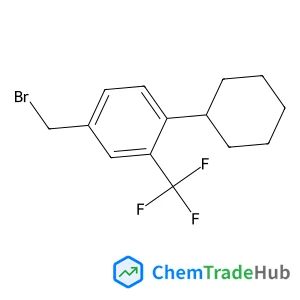
4-(Bromomethyl)-1-cyclohexyl-2-(trifluoromethyl)benzene
CAS Number:
800381-60-6
Molecular Formula:
C14H16BrF3
![(R)-N-[(S)-1-[2-(Diphenylphosphino)phenyl]ethyl]-2-methylpropane-2-sulfinamide structure](https://static.chemtradehub.com/structs/159/1595319-98-4-33e7.webp "(R)-N-[(S)-1-[2-(Diphenylphosphino)phenyl]ethyl]-2-methylpropane-2-sulfinamide structure")
(R)-N-[(S)-1-[2-(Diphenylphosphino)phenyl]ethyl]-2-methylpropane-2-sulfinamide
CAS Number:
1595319-98-4
Molecular Formula:
C24H28NOPS
Recommended Suppliers







Disclaimer
This page provides academic journal information for reference and research purposes only. We are not affiliated with any journal publishers and do not handle publication submissions. For publication-related inquiries, please contact the respective journal publishers directly.
If you notice any inaccuracies in the information displayed, please contact us at support@chemtradehub.com. We will promptly review and address your concerns.