












![[4-Amino-2-(methylsulfanyl)-5-pyrimidinyl]methanol structure](https://static.chemtradehub.com/structs/588/588-36-3-fc73.webp "[4-Amino-2-(methylsulfanyl)-5-pyrimidinyl]methanol structure")
Synthesis of conjugated copolymers by combining different coupling reactions
Literature Information
Publication Date
2017-06-19
DOI
10.1039/C7PY00624A
Impact Factor
5.582
Authors
T. Hardeman, G. Koeckelberghs
View Original
Abstract
Despite the significant progress in the controlled synthesis of conjugated polymers using a Catalyst Transfer Condensative Polymerization, the possibilities regarding random and gradient copolymers remain very limited. Therefore, a novel concept is introduced, in which different organometallic functions are placed on the monomers in a copolymerization, meaning that different types of coupling reactions are combined. By using combinations of Grignard, organozinc, organoboron, organotin and organogold functional groups, the goal is to tune the reactivity ratio of the monomers. As such, it enables to tune the polymer structure without having to intervene during the polymerization, something which was impossible up to now. In this study, two randomly copolymerizing thiophene monomers are considered, whose reactivity is varied by altering the organometallic function. Despite the significant difference in reactivity between the chosen functional groups, it is found that most combinations nevertheless result in the formation of a random copolymer. However, the combination of the organotin and organogold monomer shows a gradient in the monomer consumption, with a preferential incorporation of the organogold monomer at low conversion. Although the copolymerization is not controlled, it is an indication that the use of different organometallic functions is a viable strategy to tune the gradient in a copolymerization.
Related Literature
Solid-state NMR study of mesoporous phosphoro-vanado-aluminas
Régis D. Gougeon, Philippe R. Bodart, Robin K. Harris, Dina M. Kolonia, Dimitris E. Petrakis, Philippos J. Pomonis
2000-10-30
Paper
DOI: 10.1039/B005598K
Reaction mechanism in the photoreduction of CO2 with CH4 over ZrO2
2000-10-26
Paper
DOI: 10.1039/B005315P
Influence of water on the pillaring of montmorillonite with aminopropyltriethoxysilane
Paper
DOI: 10.1039/A901888C
Interactions of photosynthetic reaction center with 2,3-dimethoxy-5-methyl-1,4-benzoquinone in reverse micelles
Gerardo Palazzo, Antonia Mallardi, Mauro Giustini, Mario Della Monica, Giovanni Venturoli
2000-08-15
Paper
DOI: 10.1039/B003905P
The partial molar volumes of some tetra- and pentapeptides in aqueous solution: a test of amino acid side-chain group additivity for unfolded proteins
Marko Häckel, Hans-Jürgen Hinz, Gavin R. Hedwig
2000-07-06
Paper
DOI: 10.1039/B003034L
Friction and adhesion of mixed self-assembled monolayers studied by chemical force microscopy
Paper
DOI: 10.1039/A809994D
You might also like
Compound Q&A
What precautions should be taken when handling 4-(2-Furylmethyl)thiomorpholine 1,1-dioxide (CAS: 79206-94-3)?
When handling 4-(2-Furylmethyl)thiomorpholine 1,1-dioxide (CAS: 79206-94-3), it ...
79206-94-34-(2-Furylmethyl)thi...
Compound Q&A
What precautions should be taken when handling 4-Chloro-N-[2-(4-morpholinyl)ethyl]benzamide (CAS: 71320-77-9)?
When handling 4-Chloro-N-[2-(4-morpholinyl)ethyl]benzamide (CAS: 71320-77-9), it...
71320-77-94-Chloro-N-[2-(4-mor...
Compound Q&A
How should waste containing 2-[2-(2-Methoxyethoxy)ethoxy]ethyl 4-methylbenzenesulfonate (CAS: 62921-74-8) be handled?
Waste containing this compound (CAS: 62921-74-8) should be handled according to ...
62921-74-82-[2-(2-Methoxyethox...
Compound Q&A
How should waste containing (S)-Methyl 2-amino-3-cyclohexylpropanoate be handled?
Waste containing (S)-Methyl 2-amino-3-cyclohexylpropanoate should be collected i...
40056-18-6(S)-Methyl 2-amino-3...
Compound Q&A
How is 5-({4-[(2S,4R)-4-Hydroxy-2-methyltetrahydro-2H-pyran-4-yl]-2-thienyl}sulfanyl)-1-methyl-1,3-dihydro-2H-indol-2-one (CAS: 166882-70-8) typically synthesized?
This compound can be synthesized using a multi-step process involving the conjug...
166882-70-85-({4-[(2S,4R)-4-Hyd...
Compound Q&A
Are there alternatives to (2E)-3-(3,4-Dichlorophenyl)acrylic acid (CAS: 7312-27-8) in synthesis?
There are several alternatives to (2E)-3-(3,4-Dichlorophenyl)acrylic acid in syn...
7312-27-8(2E)-3-(3,4-Dichloro...
Compound Q&A
How should Ethyl 6-(2-nitrophenyl)imidazo[2,1-b][1,3]thiazole-3-carboxylate (CAS: 925437-84-9) be stored?
Ethyl 6-(2-nitrophenyl)imidazo[2,1-b][1,3]thiazole-3-carboxylate (CAS: 925437-84...
925437-84-9Ethyl 6-(2-nitrophen...
Compound Q&A
How should waste containing 2-(1,3-Thiazol-2-yl)ethanamine (CAS: 18453-07-1) be handled?
Waste containing 2-(1,3-Thiazol-2-yl)ethanamine (CAS: 18453-07-1) should be coll...
18453-07-12-(1,3-Thiazol-2-yl)...
Compound Q&A
How is Methyl 5-iodo-2-methylbenzoate (CAS: 103440-54-6) typically synthesized?
Methyl 5-iodo-2-methylbenzoate can be synthesized through the iodination of meth...
103440-54-6Methyl 5-iodo-2-meth...
Compound Q&A
How is 5-Chloro[1,2,4]triazolo[1,5-a]pyridine (CAS: 1427399-34-5) typically synthesized?
5-Chloro[1,2,4]triazolo[1,5-a]pyridine is commonly synthesized via the condensat...
1427399-34-55-Chloro[1,2,4]triaz...
Source Journal
Polymer Chemistry

CiteScore:
8.6
Self-citation Rate:
7.3%
Articles per Year:
457
Polymer Chemistry welcomes submissions in all areas of polymer science that have a strong focus on macromolecular chemistry. Manuscripts may cover a broad range of fields, yet no direct application focus is required.
Recommended Compounds

![[4-(Heptyloxy)phenyl]boronic acid structure](https://static.chemtradehub.com/structs/136/136370-19-9-ad33.webp "[4-(Heptyloxy)phenyl]boronic acid structure")
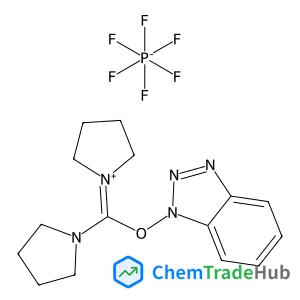
(1H-Benzotriazol-1-yloxy)(di-1-pyrrolidinyl)methylium hexafluorophosphate
CAS Number:
105379-24-6
Molecular Formula:
C15H21F6N5OP
Recommended Suppliers






Disclaimer
This page provides academic journal information for reference and research purposes only. We are not affiliated with any journal publishers and do not handle publication submissions. For publication-related inquiries, please contact the respective journal publishers directly.
If you notice any inaccuracies in the information displayed, please contact us at support@chemtradehub.com. We will promptly review and address your concerns.