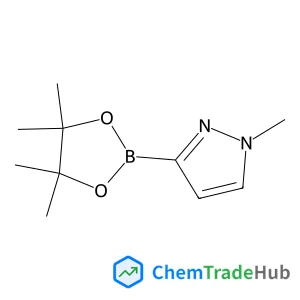
1-Methyl-3-(4,4,5,5-tetramethyl-1,3,2-dioxaborolan-2-yl)-1H-pyrazole
CAS Number:
1020174-04-2
Molecular Formula:
C10H17BN2O2
Xue Jiang, Chun Feng, Guolin Lu
Well-defined ferrocene-containing homopolymers were synthesized by RAFT homopolymerization of an acrylate monomer bearing a ferrocene (Fc) unit and an N,N-diethylamino ethyl (DEAE) group, i.e. 2-(3-(N-(2-(diethylamino)ethyl)-acrylamido)propanoyloxy)ethyl ferrocenecarboxylate (Fc-DEAE-AM). As an ideal redox-responsive group, hydrophobic Fc can be easily oxidized into hydrophilic Fc+ by certain oxidants, providing tremendous opportunities to produce various Fc-containing redox-responsive materials. On the other hand, the pH/CO2-responsive reversible nature of the DEAE group makes it possible to construct a smart system to adapt to the complex environment in practical application. The stimuli-responsive aggregation behavior of the well-defined poly(Fc-DEAE-AM) homopolymer is examined by the combination of a fluorescent probe, UV/vis transmittance, zeta potential, transmission electron microscopy (TEM), and dynamic light scattering (DLS). In fact, due to the redox and pH/CO2-responsive character provided by the Fc and DEAE groups, the poly(Fc-DEAE-AM) homopolymer exhibits distinct phase transition in aqueous solution. In addition, such a homopolymer could form typical spherical particles in acid aqueous solution, and the redox agent could lead to changes in the size and morphology of the aggregates. Thus, we provide a new and efficient way to prepare triple-stimuli-responsive Fc-containing homopolymers, which might be used as interesting building block for the fabrication of multiple stimuli-responsive functional materials.
Hao Jin, Jianwei Li, Ying Dai, Yadong Wei
DOI: 10.1039/C6CP08158D
P. Gast, D. Mance, E. Zurlo, M. Baldus, M. Huber
DOI: 10.1039/C6CP05864G
Yue Tong, Xiaowen Yu, Gaoquan Shi
DOI: 10.1039/C6CP08176B
Arunkumar Kathiravan, Rajadurai Vijay Solomon
DOI: 10.1039/C6CP07768D
DOI: 10.1039/C6CP07827C
Zhanli Cao, Zhendong Li, Fan Wang, Wenjian Liu
DOI: 10.1039/C6CP07588F
Lingyun Zhu, Hua Geng, Yuanping Yi, Zhixiang Wei
DOI: 10.1039/C6CP07417K
Ignacio Fdez. Galván, Daniel Roca-Sanjuán, Erick L. Bastos, Wilhelm J. Baader, Roland Lindh
DOI: 10.1039/C6CP08154A
Hua-Bin Sun, Ying-Xian Zhou, Lu-Lu Zhang, Xue-Lin Yang, Xing-Zhong Cao, Hanu Arave, Hui Fang, Gan Liang
DOI: 10.1039/C6CP07760A
Prasant Kumar Nayak, Judith Grinblat, Elena Levi, Mikhael Levi, Boris Markovsky, Doron Aurbach
DOI: 10.1039/C6CP07383B
When handling 4-(2-Furylmethyl)thiomorpholine 1,1-dioxide (CAS: 79206-94-3), it ...
When handling 4-Chloro-N-[2-(4-morpholinyl)ethyl]benzamide (CAS: 71320-77-9), it...
Waste containing this compound (CAS: 62921-74-8) should be handled according to ...
Waste containing (S)-Methyl 2-amino-3-cyclohexylpropanoate should be collected i...
This compound can be synthesized using a multi-step process involving the conjug...
There are several alternatives to (2E)-3-(3,4-Dichlorophenyl)acrylic acid in syn...
Ethyl 6-(2-nitrophenyl)imidazo[2,1-b][1,3]thiazole-3-carboxylate (CAS: 925437-84...
Waste containing 2-(1,3-Thiazol-2-yl)ethanamine (CAS: 18453-07-1) should be coll...
Methyl 5-iodo-2-methylbenzoate can be synthesized through the iodination of meth...
5-Chloro[1,2,4]triazolo[1,5-a]pyridine is commonly synthesized via the condensat...

Polymer Chemistry welcomes submissions in all areas of polymer science that have a strong focus on macromolecular chemistry. Manuscripts may cover a broad range of fields, yet no direct application focus is required.
![N-[(Benzyloxy)carbonyl]serine structure](https://static.chemtradehub.com/structs/276/2768-56-1-77f7.webp "N-[(Benzyloxy)carbonyl]serine structure")