












Structure–reactivity correlations of the abnormal Beckmann reaction of dihydrolevoglucosenone oxime
Literature Information
Publication Date
2017-11-14
DOI
10.1039/C7OB02499A
Impact Factor
3.876
Authors
Lars Goerigk
View Original
Abstract
A structural, spectroscopic and computational study of a series of oximes was undertaken to investigate how geometric and structural changes relevant to the reaction coordinate for the Beckmann reaction (normal Beckmann) and Beckmann fragmentation (abnormal Beckmann) manifest in the ground state. X-ray structures of a range of oximes derived from dihydrolevoglucosan (Cyrene™; which undergoes the abnormal Beckmann reaction), in which the oxygen substituent was systematically varied were determined. As the electron demand of the OR group increased, the major structural changes included lengthening of the N–OR bond distance, and a decrease in the magnitude of the C2N–O bond angle, consistent with the changes seen for cyclohexanone oximes, which undergo the normal Beckmann reaction. However, unique to the Cyrene oximes, an increase in the length of the fissile C1–C2 bond was observed, which correlated with a decrease in the 13C–13C 1-bond coupling constants as the electron demand of the OR substituent increased. Computational studies of Cyrene and cyclohexanone oximes using Natural Bond Orbital analysis support an electronic structure involving n(O) → σ*C1–C2 and σC1–C2 → σ*N–O localized orbital interactions.
Related Literature
Novel aggregation of [Ni(thiolato)2(amine)2]-type square planes assisted by silver(i) ions
Takumi Konno, Masafumi Usami, Masakazu Hirotsu, Takashi Yoshimura, Tatsuya Kawamoto
2004-09-01
Communication
DOI: 10.1039/B404512B
Crystal engineering of urea α-network via I⋯O2N synthon and design of SHG active crystal N-4-iodophenyl-N′-4′-nitrophenylurea
Sumod George, Ashwini Nangia, Chi-Keung Lam, Thomas C. W. Mak, Jean-François Nicoud
2004-04-20
Communication
DOI: 10.1039/B402050B
Iron-catalysed propylene epoxidation by nitrous oxide: dramatic shift of allylic oxidation to epoxidation by the modification with alkali metal salts
Xiaoxing Wang, Qinghong Zhang, Qian Guo, Yinchuan Lou, Lüjuan Yang, Ye Wang
2004-05-14
Communication
DOI: 10.1039/B402839B
Unprecedented copper-catalyzed asymmetric conjugate addition of organometallic reagents to α,β-unsaturated lactams
Mauro Pineschi, Federica Del Moro, Adriaan J. Minnaard, Ben L. Feringa
2004-04-28
Communication
DOI: 10.1039/B403793F
Soft nanotubes from amphiphilic ABA triblock macromonomers
Julie Grumelard, Andreas Taubert, Wolfgang Meier
2004-05-25
Communication
DOI: 10.1039/B405671J
Javaniside, a novel DNA cleavage agent from Alangium javanicum having an unusual oxindole skeleton
Ji Ma, Sidney M. Hecht
2004-04-14
Communication
DOI: 10.1039/B402925A
On the stability of furanopyrimidin-2-one bases in oligonucleotides
Guan-Sheng Jiao, Kevin Burgess
2004-05-07
Communication
DOI: 10.1039/B402559H
A novel fluoride sensor based on fluorescence enhancement
Guoxiang Xu, Matthew A. Tarr
2004-04-02
Communication
DOI: 10.1039/B316121H
Soluble μ-Fi bridged niobium clusters: synthesis and crystal structures of (Et4N)6[Nb6Fi6Bri6(NCS)a6]Br2 and Cs1.6K2.4[Nb6Fi6Ii6(NCS)a6]
Nikolaï G. Naumov, Stéphane Cordier, Christiane Perrin
2004-04-07
Communication
DOI: 10.1039/B400668B
Efficient synthesis of a nucleoside-diphospho-exo-glycal displaying time-dependent inactivation of UDP-galactopyranose mutase
Audrey Caravano, Stéphane P. Vincent, Pierre Sinaÿ
2004-04-23
Communication
DOI: 10.1039/B402469A
You might also like
Compound Q&A
What precautions should be taken when handling 2-Chloro-1,2-bis(4-methylphenyl)ethanone (CAS: 71193-32-3)?
When handling 2-Chloro-1,2-bis(4-methylphenyl)ethanone (CAS: 71193-32-3), it is ...
71193-32-32-Chloro-1,2-bis(4-m...
Compound Q&A
What industries use 4-Ethoxy-3-(5-methyl-4-oxo-7-propyl-1,4-dihydroimidazo[5,1-f][1,2,4]triazin-2-yl)benzenesulfonyl chloride (CAS: 224789-26-8)?
4-Ethoxy-3-(5-methyl-4-oxo-7-propyl-1,4-dihydroimidazo[5,1-f][1,2,4]triazin-2-yl...
224789-26-84-Ethoxy-3-(5-methyl...
Compound Q&A
How should Methyl 3-Oxo-4-Androsten-17-Carboxylate (CAS: 2681-55-2) be stored?
Methyl 3-Oxo-4-Androsten-17-Carboxylate (CAS: 2681-55-2) should be stored in a c...
2681-55-2Methyl 3-Oxo-4-Andro...
Compound Q&A
What are the main uses of (R)-3-Amino-4-(3-hexylphenylamino)-4-oxobutylphosphonic acid (CAS: 909725-61-7)?
(R)-3-Amino-4-(3-hexylphenylamino)-4-oxobutylphosphonic acid is primarily used i...
909725-61-7(R)-3-Amino-4-(3-hex...
Compound Q&A
What regulatory guidelines apply to 2-Methyl-2-propanyl 3-amino-3-carbamoyl-1-azetidinecarboxylate (CAS: 1254120-14-3)?
2-Methyl-2-propanyl 3-amino-3-carbamoyl-1-azetidinecarboxylate (CAS: 1254120-14-...
1254120-14-32-Methyl-2-propanyl ...
Compound Q&A
Are there alternatives to (E)-4-(tert-Butoxy)-4-oxobut-2-enoic acid (CAS: 135355-96-3) in synthesis?
There are alternative reagents that can be used in synthesis instead of (E)-4-(t...
135355-96-3(E)-4-(tert-Butoxy)-...
Compound Q&A
What are the physical and chemical properties of [2-(3-Chlorophenyl)-1,3-thiazol-4-yl]methanol (CAS: 121202-20-8)?
[2-(3-Chlorophenyl)-1,3-thiazol-4-yl]methanol (CAS: 121202-20-8) is a crystallin...
121202-20-8[2-(3-Chlorophenyl)-...
Compound Q&A
What is the market or research trend for Methyl (2S)-[(4S)-2,2-dimethyl-1,3-dioxolan-4-yl]{[(4-methylphenyl)sulfonyl]oxy}acetate (CAS: 166249-17-8)?
The market and research trends for Methyl (2S)-[(4S)-2,2-dimethyl-1,3-dioxolan-4...
166249-17-8Methyl (2S)-[(4S)-2,...
Compound Q&A
What is the market or research trend for 1-Bromo-2-isocyanatoethane (CAS: 42865-19-0)?
The market for 1-Bromo-2-isocyanatoethane (CAS: 42865-19-0) is driven by its use...
42865-19-01-Bromo-2-isocyanato...
Compound Q&A
What are the main uses of 4-Nitro-D-phenylalanine hydrochloride (CAS: 147065-06-3)?
4-Nitro-D-phenylalanine hydrochloride (CAS: 147065-06-3) is primarily used in re...
147065-06-34-Nitro-D-phenylalan...
Source Journal
Organic & Biomolecular Chemistry

CiteScore:
3.4
Self-citation Rate:
10.3%
Articles per Year:
1041
Organic & Biomolecular Chemistry (OBC) publishes original and high impact research and reviews in organic chemistry. We welcome research that shows new or significantly improved protocols or methodologies in total synthesis, synthetic methodology or physical and theoretical organic chemistry as well as research that shows a significant advance in the organic chemistry or molecular design aspects of chemical biology, catalysis, supramolecular and macromolecular chemistry, theoretical chemistry, mechanism-oriented physical organic chemistry, medicinal chemistry or natural products. Articles published in the journal should report new work which makes a highly-significant impact in the field. Routine and incremental work is generally not suitable for publication in the journal. More details about key areas of our scope are below. In all cases authors should include in their article clear rationale for why their research has been carried out.
Recommended Compounds
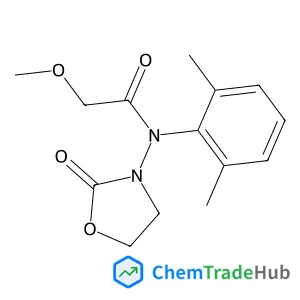
N-(2,6-Dimethylphenyl)-2-methoxy-N-(2-oxo-1,3-oxazolidin-3-yl)acetamide
CAS Number:
77732-09-3
Molecular Formula:
C14H18N2O4
Recommended Suppliers






Disclaimer
This page provides academic journal information for reference and research purposes only. We are not affiliated with any journal publishers and do not handle publication submissions. For publication-related inquiries, please contact the respective journal publishers directly.
If you notice any inaccuracies in the information displayed, please contact us at support@chemtradehub.com. We will promptly review and address your concerns.