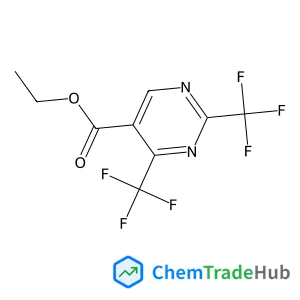
Ethyl 2,4-bis(trifluoromethyl)-5-pyrimidinecarboxylate
CAS Number:
188781-15-9
Molecular Formula:
C9H6F6N2O2
Xiaoxing Wang, Qinghong Zhang, Qian Guo, Yinchuan Lou, Lüjuan Yang, Ye Wang
A dramatic shift of allylic oxidation to epoxidation has been observed during the oxidation of propylene by N2O when the FeOx/SBA-15 catalyst is modified with alkali metal salts, and the roles of alkali metal salts are to suppress the reactivity of lattice oxygen and to induce an iron coordination structure effective for epoxidation with N2O.
Andreas Erbs Hillers-Bendtsen, Frederik Ørsted Kjeldal, Nicolai Machholdt Høyer, Kurt V. Mikkelsen
DOI: 10.1039/D2CP00226D
Ting Fang, Yangli Xie, Lirong Li, Yao He, Xu Yang, Linjie Zhang, Wenzhi Jia, Hengbo Huang, Junhui Li, Zhirong Zhu
DOI: 10.1039/D1CP05954H
Yuanyuan Sun, Ying Li, Xiaoyan Li, Yanli Zeng
DOI: 10.1039/D2CP00075J
Irina V. Beregovaya, Lyudmila N. Shchegoleva
DOI: 10.1039/D2CP01691E
DOI: 10.1039/D1CP05345K
Yuzhu Cui, Haifei Qin, Panlong Kong, Jiao Chen, Xinyong Cai
DOI: 10.1039/D2CP00111J
Tahereh Ghaed-Sharaf, Akbar Omidvar
DOI: 10.1039/D1CP05550J
Mohaddeseh Habibzadeh Mashatooki, Bahram Ghalami-Choobar
DOI: 10.1039/D1CP04006E
When handling lithium chloride hydrate (1:1:1) (CAS: 16712-20-2), it is importan...
4-(4H-1,2,4-Triazol-4-yl)piperidine is generally considered safe for use in phar...
Waste containing 1,3-Thiazole-2-carboxamide (CAS: 16733-85-0) should be collecte...
5-(Difluoromethyl)-2-fluorobenzonitrile (CAS: 934175-58-3) is subject to regulat...
Methyl 3-acetamido-2-thiophenecarboxylate can be synthesized by the reaction of ...
4-Isoquinolinecarbonitrile is a chemical compound with the CAS number 34846-65-6...
Store Methyl 1H-1,2,3-triazole-4-carboxylate (CAS: 877309-59-6) in a cool, dry p...
6-Bromo[1,3]thiazolo[5,4-b]pyridin-2-amine (CAS: 1160791-13-8) is subject to the...
(2S,3S)-2-Ammonio-3-(3,4-dihydroxyphenyl)-3-hydroxypropanoate (CAS: 23651-95-8) ...
7-Bromo-3-methyl-3,4-dihydroquinazolin-4-one is a solid with a crystalline form....

ChemComm publishes urgent research which is of outstanding significance and interest to experts in the field, while also appealing to the journal’s broad chemistry readership. Our communication format is ideally suited to short, urgent studies that are of such importance that they require accelerated publication. Our scope covers all topics in chemistry, and research at the interface of chemistry and other disciplines (such as materials science, nanoscience, physics, engineering and biology) where there is a significant novelty in the chemistry aspects. Major topic areas covered include: Analytical Chemistry Catalysis Chemical Biology and medicinal chemistry Computational Chemistry and Machine Learning Energy and sustainable chemistry Environmental Chemistry Green Chemistry Inorganic Chemistry Materials Chemistry Nanoscience Organic Chemistry Physical Chemistry Polymer Chemistry Supramolecular Chemistry
![6,6-Dimethylbicyclo[3.1.1]hept-2-ene-2-carbaldehyde structure](https://static.chemtradehub.com/structs/564/564-94-3-e746.webp "6,6-Dimethylbicyclo[3.1.1]hept-2-ene-2-carbaldehyde structure")