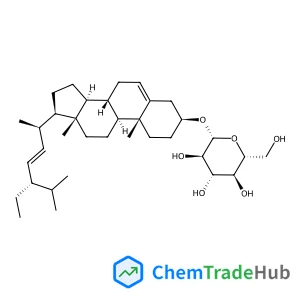
(3beta,22E)-Stigmasta-5,22-dien-3-yl beta-D-glucopyranoside
CAS Number:
19716-26-8
Molecular Formula:
C35H58O6
Zhongxue Fang, Chenlong Wei, Jing Lin, Zhenhua Liu, Wei Wang, Chenshu Xu, Xuemin Wang, Yu Wang
A silver catalyzed decarboxylative C(sp2)–C(sp3) coupling of vinylic carboxylic acids with alcohols, alkylbenzenes, cycloalkanes and cyclic ethers was developed by using DTBP as an oxidant. This reaction tolerates a wide range of substrates, and products are obtained in good to excellent yields. The reaction also shows good stereoselectivity, and only trans-isomers are obtained. In addition, a radical pathway would be involved to facilitate this decarboxylative C(sp2)–C(sp3) coupling reaction.
Marcin Drąg, Adam Jezierski, Pawel Kafarski
DOI: 10.1039/B401633E
Min Wu, Yoshiaki Yuguchi, Takako Kumagai, Takashi Endo, Takahiro Hirotsu
DOI: 10.1039/B400289J
Narcis Avarvari, Marc Fourmigué
DOI: 10.1039/B403168G
Myroslav O. Vysotsky, Anca Bogdan, Leyong Wang, Volker Böhmer
DOI: 10.1039/B402719A
Anne Petitjean, Nathalie Kyritsakas, Jean-Marie Lehn
DOI: 10.1039/B402854F
Thi X. T. Sayle, Stephen C. Parker, Dean C. Sayle
DOI: 10.1039/B408752F
Julie Grumelard, Andreas Taubert, Wolfgang Meier
DOI: 10.1039/B405671J
Martina H. Stenzel, Thomas P. Davis, Christopher Barner-Kowollik
DOI: 10.1039/B404763J
Nan Ding, Duck-Young Chung, Mercouri G. Kanatzidis
DOI: 10.1039/B402686A
Nakcheol Jeong, Dong Hoon Kim, Jun Hun Choi
DOI: 10.1039/B401288G
When handling 2-Chloro-1,2-bis(4-methylphenyl)ethanone (CAS: 71193-32-3), it is ...
4-Ethoxy-3-(5-methyl-4-oxo-7-propyl-1,4-dihydroimidazo[5,1-f][1,2,4]triazin-2-yl...
Methyl 3-Oxo-4-Androsten-17-Carboxylate (CAS: 2681-55-2) should be stored in a c...
(R)-3-Amino-4-(3-hexylphenylamino)-4-oxobutylphosphonic acid is primarily used i...
2-Methyl-2-propanyl 3-amino-3-carbamoyl-1-azetidinecarboxylate (CAS: 1254120-14-...
There are alternative reagents that can be used in synthesis instead of (E)-4-(t...
[2-(3-Chlorophenyl)-1,3-thiazol-4-yl]methanol (CAS: 121202-20-8) is a crystallin...
The market and research trends for Methyl (2S)-[(4S)-2,2-dimethyl-1,3-dioxolan-4...
The market for 1-Bromo-2-isocyanatoethane (CAS: 42865-19-0) is driven by its use...
4-Nitro-D-phenylalanine hydrochloride (CAS: 147065-06-3) is primarily used in re...

Organic & Biomolecular Chemistry (OBC) publishes original and high impact research and reviews in organic chemistry. We welcome research that shows new or significantly improved protocols or methodologies in total synthesis, synthetic methodology or physical and theoretical organic chemistry as well as research that shows a significant advance in the organic chemistry or molecular design aspects of chemical biology, catalysis, supramolecular and macromolecular chemistry, theoretical chemistry, mechanism-oriented physical organic chemistry, medicinal chemistry or natural products. Articles published in the journal should report new work which makes a highly-significant impact in the field. Routine and incremental work is generally not suitable for publication in the journal. More details about key areas of our scope are below. In all cases authors should include in their article clear rationale for why their research has been carried out.