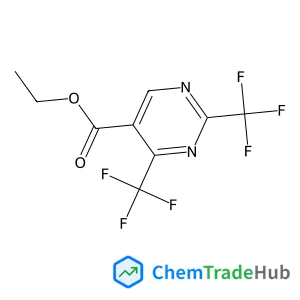
Ethyl 2,4-bis(trifluoromethyl)-5-pyrimidinecarboxylate
CAS Number:
188781-15-9
Molecular Formula:
C9H6F6N2O2
Nakcheol Jeong, Dong Hoon Kim, Jun Hun Choi
Desymmetrization of the meso dienynes, such as propargyl 1-vinylallyl N-tosylamides (1a–c) and propargyl 1-vinylallyl ethers (1d–e), by asymmetric Pauson–Khand type reaction catalysts was studied. The corresponding vinyl substituted bicyclic pentenones (2 and 3) were obtained with high diastereoselectivity and enantioselectivity.
Kaisheng Song, Hongwei Song, Jun Li
DOI: 10.1039/D2CP00870J
Jonathan Utterson, Radek Erban
DOI: 10.1039/D1CP04056A
Mihai Asandulesa, Sergei Kostromin, Alexey Aleksandrov, Alexey Tameev, Sergei Bronnikov
DOI: 10.1039/D2CP00770C
Jiajia Zhang, Chenggen Xie, Lijuan Chen
DOI: 10.1039/D1CP05552F
DOI: 10.1039/D2CP01763F
Yogesh Kumar, M. Gupta
DOI: 10.1039/D1CP05711A
Yuanyuan Sun, Ying Li, Xiaoyan Li, Yanli Zeng
DOI: 10.1039/D2CP00075J
Bruno Ipaves, João F. Justo, Lucy V. C. Assali
DOI: 10.1039/D1CP05867C
Tao Gao, Shiyin Ma, Xiaoqiu Ye
DOI: 10.1039/D2CP00059H
When handling lithium chloride hydrate (1:1:1) (CAS: 16712-20-2), it is importan...
4-(4H-1,2,4-Triazol-4-yl)piperidine is generally considered safe for use in phar...
Waste containing 1,3-Thiazole-2-carboxamide (CAS: 16733-85-0) should be collecte...
5-(Difluoromethyl)-2-fluorobenzonitrile (CAS: 934175-58-3) is subject to regulat...
Methyl 3-acetamido-2-thiophenecarboxylate can be synthesized by the reaction of ...
4-Isoquinolinecarbonitrile is a chemical compound with the CAS number 34846-65-6...
Store Methyl 1H-1,2,3-triazole-4-carboxylate (CAS: 877309-59-6) in a cool, dry p...
6-Bromo[1,3]thiazolo[5,4-b]pyridin-2-amine (CAS: 1160791-13-8) is subject to the...
(2S,3S)-2-Ammonio-3-(3,4-dihydroxyphenyl)-3-hydroxypropanoate (CAS: 23651-95-8) ...
7-Bromo-3-methyl-3,4-dihydroquinazolin-4-one is a solid with a crystalline form....

ChemComm publishes urgent research which is of outstanding significance and interest to experts in the field, while also appealing to the journal’s broad chemistry readership. Our communication format is ideally suited to short, urgent studies that are of such importance that they require accelerated publication. Our scope covers all topics in chemistry, and research at the interface of chemistry and other disciplines (such as materials science, nanoscience, physics, engineering and biology) where there is a significant novelty in the chemistry aspects. Major topic areas covered include: Analytical Chemistry Catalysis Chemical Biology and medicinal chemistry Computational Chemistry and Machine Learning Energy and sustainable chemistry Environmental Chemistry Green Chemistry Inorganic Chemistry Materials Chemistry Nanoscience Organic Chemistry Physical Chemistry Polymer Chemistry Supramolecular Chemistry