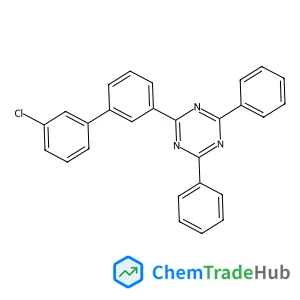
2-(3'-Chlorobiphenyl-3-yl)-4,6-diphenyl-1,3,5-triazine
CAS Number:
1443049-83-9
Molecular Formula:
C27H18ClN3
Artur Przydacz, Rafał Kowalczyk, Łukasz Albrecht
This study demonstrates that the remote cascade functionalization of 2,4-dienones can be realized by employing Brønsted base catalysis. The developed cascade involving 1,6-addition followed by the intramolecular aldol reaction provides a straightforward access to polysubstituted tetrahydrothiophene derivatives of biological and synthetic importance. Target products, bearing three contiguous stereocenters including one quaternary, have been obtained with excellent yields (up to 98%) and with good to high stereocontrol (>20 : 1 dr, up to 97 : 3 er) with the reaction cascade being promoted by a simple and readily available cinchona alkaloid cinchonine.
Taramatee Ramnial, Iain McKenzie, Brian Gorodetsky, Emily M. W. Tsang, Jason A. C. Clyburne
DOI: 10.1039/B314110A
Steven M. Miles, Stephen P. Marsden, Robin J. Leatherbarrow, William J. Coates
DOI: 10.1039/B409528F
Myroslav O. Vysotsky, Anca Bogdan, Leyong Wang, Volker Böhmer
DOI: 10.1039/B402719A
Xiaoxing Wang, Qinghong Zhang, Qian Guo, Yinchuan Lou, Lüjuan Yang, Ye Wang
DOI: 10.1039/B402839B
Nakcheol Jeong, Dong Hoon Kim, Jun Hun Choi
DOI: 10.1039/B401288G
Paul A. Midgley
DOI: 10.1039/B315513G
Gema Blanco-Brieva, Encarnación Cano-Serrano, Jose M. Campos-Martin, Jose L. G. Fierro
DOI: 10.1039/B402530J
Tomoko Matsuda, Kazunori Watanabe, Tadao Harada, Kaoru Nakamura, Yoshitaka Arita, Yukihiro Misumi, Shinichiro Ichikawa, Takao Ikariya
DOI: 10.1039/B406882C
Nikolaï G. Naumov, Stéphane Cordier, Christiane Perrin
DOI: 10.1039/B400668B
Yasuo Iida, Kyuichi Yasui, Toru Tuziuti, Manickam Sivakumar, Yoshishige Endo
DOI: 10.1039/B410015H
When handling 2-Chloro-1,2-bis(4-methylphenyl)ethanone (CAS: 71193-32-3), it is ...
4-Ethoxy-3-(5-methyl-4-oxo-7-propyl-1,4-dihydroimidazo[5,1-f][1,2,4]triazin-2-yl...
Methyl 3-Oxo-4-Androsten-17-Carboxylate (CAS: 2681-55-2) should be stored in a c...
(R)-3-Amino-4-(3-hexylphenylamino)-4-oxobutylphosphonic acid is primarily used i...
2-Methyl-2-propanyl 3-amino-3-carbamoyl-1-azetidinecarboxylate (CAS: 1254120-14-...
There are alternative reagents that can be used in synthesis instead of (E)-4-(t...
[2-(3-Chlorophenyl)-1,3-thiazol-4-yl]methanol (CAS: 121202-20-8) is a crystallin...
The market and research trends for Methyl (2S)-[(4S)-2,2-dimethyl-1,3-dioxolan-4...
The market for 1-Bromo-2-isocyanatoethane (CAS: 42865-19-0) is driven by its use...
4-Nitro-D-phenylalanine hydrochloride (CAS: 147065-06-3) is primarily used in re...

Organic & Biomolecular Chemistry (OBC) publishes original and high impact research and reviews in organic chemistry. We welcome research that shows new or significantly improved protocols or methodologies in total synthesis, synthetic methodology or physical and theoretical organic chemistry as well as research that shows a significant advance in the organic chemistry or molecular design aspects of chemical biology, catalysis, supramolecular and macromolecular chemistry, theoretical chemistry, mechanism-oriented physical organic chemistry, medicinal chemistry or natural products. Articles published in the journal should report new work which makes a highly-significant impact in the field. Routine and incremental work is generally not suitable for publication in the journal. More details about key areas of our scope are below. In all cases authors should include in their article clear rationale for why their research has been carried out.