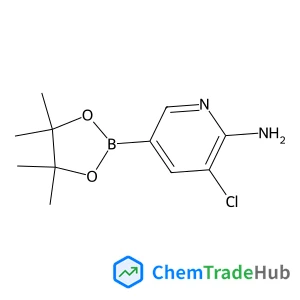
3-Chloro-5-(4,4,5,5-tetramethyl-1,3,2-dioxaborolan-2-yl)-2-pyridinamine
CAS Number:
1032758-99-8
Molecular Formula:
C11H16BClN2O2
Xiaolu Xiong, Guangshi Li, Hongwei Cheng, Qian Xu
Experimental and computational studies were carried out to investigate the oxidation of pentlandite (Fe4.5Ni4.5S8). The oxidation product was first analyzed by energy dispersive spectrometry to reveal the elemental distribution at the cross section. Our experimental study shows that the Fe atoms in pentlandite migrated to the surface and were preferentially oxidized to form a thin layer of Fe2O3, whereas the Ni atoms remained at the center of the grain. Furthermore, density functional theory calculations were performed to investigate the adsorption and diffusion of atomic oxygen as well as the adsorption and dissociation of molecular oxygen on the (001) and (010) surfaces of pentlandite. From the calculated adsorption energies of atomic oxygen at the different sites of the (001) and (010) surfaces, we found that oxidation of the Fe sites was preferable to that of the Ni sites when exposed to an oxidizing atmosphere. For molecular oxygen adsorption on the surfaces of pentlandite, the bridge sites (Fe–Ni and Fe–Fe) were found to be the most favorable adsorption sites. The dissociative adsorption of O2 is thermodynamically more favorable than the molecular adsorption. Calculated dissociation barriers show that the oxidation is feasible during high temperature roasting.
Jun Ueda, Shingo Harada, Hiroki Nakayama
DOI: 10.1039/C8OB00894A
Ali Hachem, Ali Alaaeddine, Estelle Métay, Marc Lemaire
DOI: 10.1039/C8OB01751D
You Zi, Fritz Schömberg, Fabian Seifert, Helmar Görls, Ivan Vilotijevic
DOI: 10.1039/C8OB01343H
Jie Wang, Xing-Yu Zhang, Guo-Kai Jia, Zhong Cao, Zilong Tang, Xianyong Yu, Xinhua Xu
DOI: 10.1039/C8OB01005F
Luca Massaro, Antonio Puglisi, Lucrezia Angelini, Achille Antenucci, Simone Placidi, Fabio Sciubba, Luciano Galantini, Marco Bella
DOI: 10.1039/C8OB01772G
Seong Nam, David C. Ware
DOI: 10.1039/C8OB00957K
Yuki Mimura, Sayaka Kitamura, Motohiro Shizuma, Mizuki Kitamatsu, Yoshitane Imai
DOI: 10.1039/C8OB01869C
Yi Man, Shaomin Fu, Juan Chen, Bo Liu
DOI: 10.1039/C8OB01168K
This compound is mainly used as an intermediate in the synthesis of antipsychoti...
Waste containing 1-(D-Ribofuranosyl)-1,4-dihydro-3-pyridinecarboxamide (CAS: 191...
2-Methyl-2-propanyl 3-bromo-3-(hydroxymethyl)-1-azetidinecarboxylate (CAS: 20079...
N-(4-Chloro-2-pyridinyl)acetamide (CAS: 245056-66-0) is a chemical compound with...
5-Chloro-2-hydroxybenzoic acid, also known as 5-chlorosalicylic acid, is an arom...
When handling 1,1-Dichloro-1-fluoroethane (CAS: 1717-00-6), it is important to u...
Fmoc-(2S,3R)-3-phenylpyrrolidine-2-carboxylic acid is a white crystalline solid ...
4-Amino-5-bromo-2-pyridinecarboxylic acid is primarily used as a precursor in th...
Handling this compound should be done with personal protective equipment (PPE) i...
When handling 8-bromo-2,2-dimethyl-3,4-dihydro-2H-1,4-benzoxazin-3-one, use prop...

Physical Chemistry Chemical Physics (PCCP) is an international journal co-owned by 19 physical chemistry and physics societies from around the world. This journal publishes original, cutting-edge research in physical chemistry, chemical physics and biophysical chemistry. To be suitable for publication in PCCP, articles must include significant innovation and/or insight into physical chemistry; this is the most important criterion that reviewers and Editors will judge against when evaluating submissions. The journal has a broad scope and welcomes contributions spanning experiment, theory, computation and data science. Topical coverage includes spectroscopy, dynamics, kinetics, statistical mechanics, thermodynamics, electrochemistry, catalysis, surface science, quantum mechanics, quantum computing and machine learning. Interdisciplinary research areas such as polymers and soft matter, materials, nanoscience, energy, surfaces/interfaces, and biophysical chemistry are welcomed if they demonstrate significant innovation and/or insight into physical chemistry. Joined experimental/theoretical studies are particularly appreciated when complementary and based on up-to-date approaches.
![1-[3-(4-Morpholinylsulfonyl)phenyl]methanamine structure](https://static.chemtradehub.com/structs/933/933989-32-3-51af.webp "1-[3-(4-Morpholinylsulfonyl)phenyl]methanamine structure")
![4-Chloro-3-(trifluoromethyl)-1H-pyrrolo[2,3-b]pyridine structure](https://static.chemtradehub.com/structs/869/869335-75-1-a9d0.webp "4-Chloro-3-(trifluoromethyl)-1H-pyrrolo[2,3-b]pyridine structure")
![tert-Butyl N-[(2-chloropyridin-4-yl)methyl]carbamate structure](https://static.chemtradehub.com/structs/916/916210-27-0-9f95.webp "tert-Butyl N-[(2-chloropyridin-4-yl)methyl]carbamate structure")