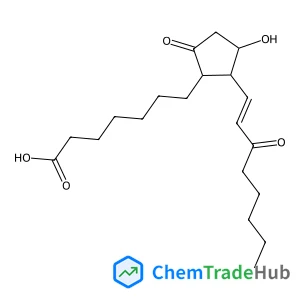
(11alpha,13E)-11-Hydroxy-9,15-dioxoprost-13-en-1-oic acid
CAS Number:
22973-19-9
Molecular Formula:
C20H32O5
Liwei Wang, Xingyi Huang, Yingke Zhu, Pingkai Jiang
Introducing a high dielectric constant (high-k) nanofiller into a dielectric polymer is the most common way to achieve flexible nanocomposites for electrostatic energy storage devices. However, the significant decrease of breakdown strength and large increase of dielectric loss has long been known as the bottleneck restricting the enhancement of practical energy storage capability of the nanocomposites. In this study, by introducing ultra-small platinum (<2 nm) nanoparticles, high-k polymer nanocomposites with high breakdown strength and low dielectric loss were prepared successfully. Core–shell structured polydopamine@BaTiO3 (PDA@BT) and core–satellite ultra-small platinum decorated PDA@BT (Pt@PDA@BT) were used as nanofillers. Compared with PDA@BT nanocomposites, the maximum discharged energy density of the Pt@PDA@BT nanocomposites is increased by nearly 70% because of the improved energy storage efficiency. This research provides a simple, promising and unique way to enhance energy storage capability of high-k polymer nanocomposites.
Mohammad Aarabi, Satchin Soorkia, Gilles Grégoire, Aurélien de la Lande, Benoît Soep, Reza Omidyan, Niloufar Shafizadeh
DOI: 10.1039/C9CP03608C
Mohsen Yarmohammadi, Kavoos Mirabbaszadeh
DOI: 10.1039/C9CP03655E
Guoxun Zheng, Tingting Fu, Jiajun Hong, Fengcheng Li, Xiaojun Yao, Weiwei Xue
DOI: 10.1039/C9CP05764A
Manas Ghara, Sudip Pan
DOI: 10.1039/C9CP03756J
Guangchao Han, Qian Peng
DOI: 10.1039/C9CP06987A
Hong Zhong, Liwen Li, Rui Ma, Jie Zhong, Youguo Yan, Shuguang Li, Jun Zhang, Jinxiang Liu
DOI: 10.1039/C9CP06296C
Anthony M. S. Pembere, Chaonan Cui, Rajini Anumula, Haiming Wu, Pan An, Tongling Liang, Zhixun Luo
DOI: 10.1039/D0CP90052D
Giuseppe Cassone, Jiri Sponer, Sebastiano Trusso, Franz Saija
DOI: 10.1039/C9CP03101D
6-(3-Fluorophenyl)picolinic acid is generally considered safe for laboratory use...
(3R)-3-Pyrrolidinol is used in the pharmaceutical industry as a precursor for dr...
When handling (4R,5R)-4,5-Diethoxycarbonyl-2,2-dimethyldioxolane (CAS: 59779-75-...
1-(6-Chloroimidazo[1,2-b]pyridazin-3-yl)ethanone is often synthesized via a mult...
The market for N-Ethyl-3,4-dimethylbenzylamine (CAS: 39180-83-1) remains steady,...
Tert-butyl 3-(pyrrolidin-1-yl)azetidine-1-carboxylate is a chemical compound wit...
1-Bromo-3-chloro-2,4-dimethoxybenzene (CAS: 1228956-93-1) falls under the classi...
The safety of 8-Bromo-2-methyl-3,4-dihydroisoquinolin-1(2H)-one (CAS: 1368622-07...
Benzyl [(3S)-2,6-dioxo-3-piperidinyl]carbamate is generally safe when handled wi...
1-{[4-(4,4,5,5-Tetramethyl-1,3,2-dioxaborolan-2-yl)phenyl]sulfonyl}pyrrolidine s...

Physical Chemistry Chemical Physics (PCCP) is an international journal co-owned by 19 physical chemistry and physics societies from around the world. This journal publishes original, cutting-edge research in physical chemistry, chemical physics and biophysical chemistry. To be suitable for publication in PCCP, articles must include significant innovation and/or insight into physical chemistry; this is the most important criterion that reviewers and Editors will judge against when evaluating submissions. The journal has a broad scope and welcomes contributions spanning experiment, theory, computation and data science. Topical coverage includes spectroscopy, dynamics, kinetics, statistical mechanics, thermodynamics, electrochemistry, catalysis, surface science, quantum mechanics, quantum computing and machine learning. Interdisciplinary research areas such as polymers and soft matter, materials, nanoscience, energy, surfaces/interfaces, and biophysical chemistry are welcomed if they demonstrate significant innovation and/or insight into physical chemistry. Joined experimental/theoretical studies are particularly appreciated when complementary and based on up-to-date approaches.