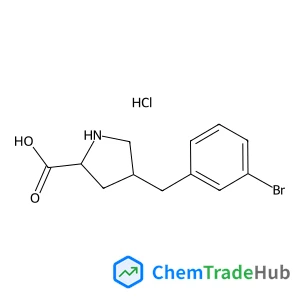
(2S,4R)-4-(3-Bromobenzyl)pyrrolidine-2-carboxylic acid hydrochloride
CAS Number:
1049734-10-2
Molecular Formula:
C12H15BrClNO2
Stephan Friedrich, Lei Li, Ziliang Mao, Pinghua Ge, Mahalingam Balasubramanian, Daulat S. Patil
According to L-edge sum rules, the number of 3d vacancies at a transition metal site is directly proportional to the integrated intensity of the L-edge X-ray absorption spectrum (XAS) for the corresponding metal complex. In this study, the numbers of 3d holes are characterized quantitatively or semi-quantitatively for a series of manganese (Mn) and nickel (Ni) complexes, including the electron configurations 3d10 → 3d0. In addition, extremely dilute (<0.1% wt/wt) Ni enzymes were examined by two different approaches: (1) by using a high resolution superconducting tunnel junction X-ray detector to obtain XAS spectra with a very high signal-to-noise ratio, especially in the non-variant edge jump region; and (2) by adding an inert tracer to the sample that provides a prominent spectral feature to replace the weak edge jump for intensity normalization. In this publication, we present for the first time: (1) L-edge sum rule analysis for a series of Mn and Ni complexes that include electron configurations from an open shell 3d0 to a closed shell 3d10; (2) a systematic analysis on the uncertainties, especially on that from the edge jump, which was missing in all previous reports; (3) a clearly-resolved edge jump between pre-L3 and post-L2 regions from an extremely dilute sample; (4) an evaluation of an alternative normalization standard for L-edge sum rule analysis. XAS from two copper (Cu) proteins measured using a conventional semiconductor X-ray detector are also repeated as bridges between Ni complexes and dilute Ni enzymes. The differences between measuring 1% Cu enzymes and measuring <0.1% Ni enzymes are compared and discussed. This study extends L-edge sum rule analysis to virtually any 3d metal complex and any dilute biological samples that contain 3d metals.
Lin Wang, Chuan Wang
DOI: 10.1039/C8QO01044G
Yu Du, Qiang Kang
DOI: 10.1039/C8QO00809D
Bharatkumar Chaudhary, Monika Diwaker, Satyasheel Sharma
DOI: 10.1039/C8QO00932E
Xincheng Li, Boshun Wan
DOI: 10.1039/C8QO00984H
Rong-Ran Liang, Xin Zhao
DOI: 10.1039/C8QO00830B
Somasundaram Muthuramalingam, Jai Anand Garg, R. Karthick, Thomas Fox, Olivier Blacque, Saiganesh Ramanathan, Senthamaraikannan Kabilan, K. K. Balasubramanian
DOI: 10.1039/C8QO00820E
Chunsheng Li, Jianxiao Li, Chaowei Tan, Wanqing Wu, Huanfeng Jiang
DOI: 10.1039/C8QO00799C
Xin-Ming Xu, Chuan-Hu Lei, Shuo Tong, Jieping Zhu, Mei-Xiang Wang
DOI: 10.1039/C8QO00839F
2-(2-Chloroacetamido)-3-phenylpropanoic acid (CAS: 7765-11-9) is generally consi...
2-(Benzyloxy)-5-bromobenzoic acid can be handled safely if appropriate precautio...
(4-Methyl-1,2,5-oxadiazol-3-yl)methanamine hydrochloride is a chemical compound ...
2-(5-Hexylthiophen-2-yl)-4,4,5,5-tetramethyl-1,3,2-dioxaborolane (CAS: 917985-54...
While 4-(8-Methyl-9H-1,3-dioxolo[4,5-h][2,3]benzodiazepin-5-yl)benzenamine (CAS:...
The market for tert-butyl 3-hydroxy-4,5,7,8-tetrahydro-2H-pyrazolo[3,4-d]azepine...
Waste containing 3,5-Diamino-1H-pyrazole-4-carbonitrile (CAS: 6844-58-2) should ...
(6-Fluoro-3-pyridinyl)boronic acid can be synthesized through the reaction of 6-...
Dibenzyl carbonimidoylbiscarbamate (CAS: 10065-79-9) finds applications in vario...
The market for (beta,beta,2,3,4,5,6-~2~H_7_)Phenylalanine (CAS: 74228-83-4) is g...

Physical Chemistry Chemical Physics (PCCP) is an international journal co-owned by 19 physical chemistry and physics societies from around the world. This journal publishes original, cutting-edge research in physical chemistry, chemical physics and biophysical chemistry. To be suitable for publication in PCCP, articles must include significant innovation and/or insight into physical chemistry; this is the most important criterion that reviewers and Editors will judge against when evaluating submissions. The journal has a broad scope and welcomes contributions spanning experiment, theory, computation and data science. Topical coverage includes spectroscopy, dynamics, kinetics, statistical mechanics, thermodynamics, electrochemistry, catalysis, surface science, quantum mechanics, quantum computing and machine learning. Interdisciplinary research areas such as polymers and soft matter, materials, nanoscience, energy, surfaces/interfaces, and biophysical chemistry are welcomed if they demonstrate significant innovation and/or insight into physical chemistry. Joined experimental/theoretical studies are particularly appreciated when complementary and based on up-to-date approaches.
![{3-[Bis(4-hydroxyphenyl)methyl]-1-[2-(dimethylamino)ethyl]-1H-indol-2-yl}[4-(2-chlorophenyl)-1-piperazinyl]methanone structure](https://static.chemtradehub.com/structs/170/170365-25-0-e4d7.webp "{3-[Bis(4-hydroxyphenyl)methyl]-1-[2-(dimethylamino)ethyl]-1H-indol-2-yl}[4-(2-chlorophenyl)-1-piperazinyl]methanone structure")