













The effects of glycine, TMAO and osmolyte mixtures on the pressure dependent enzymatic activity of α-chymotrypsin
Literature Information
Publication Date
2017-11-23
DOI
10.1039/C7CP06042D
Impact Factor
3.676
Authors
Michel W. Jaworek, Vitor Schuabb, Roland Winter
View Original
Abstract
High pressure is an important feature of certain natural environments, such as the deep sea where pressures up to about 1000 bar are encountered. Further, pressure effects on biosystems are of increasing interest for biotechnological applications, such as baroenzymology. We studied the effect of two different natural osmolyte mixtures, with major components being glycine and trimethylamine-N-oxide (TMAO), on the activity of α-chymotrypsin, using high-pressure stopped-flow methodology in combination with fast UV/Vis detection. We show that pressure is not only able to drastically enhance the catalytic activity and efficiency of the enzyme, but also that glycine has a significant and diverse effect on the enzymatic activity and volumetric properties of the reaction compared to TMAO. The results might not only help to understand the modulation of enzymatic reactions by natural osmolytes, but also elucidate ways to optimize enzymatic processes in biotechnological applications.
Related Literature
One-step synthesized silver micro-dendrites used as novel separation mediums and their applications in multi-DNA analysis
Dan Li, Zhaozi Lv, Erkang Wang
2011-04-21
Communication
DOI: 10.1039/C1CC11374G
Sequential chemical deposition of metal alloy jellyfish using polyaniline: redox chemistry at the metal–polymer interface
Elshan Akhadov, Leeyih Wang, Hsing-Lin Wang
2011-08-30
Communication
DOI: 10.1039/C1CC13025K
β-Cyclodextrin for design of alumina supported cobalt catalysts efficient in Fischer–Tropsch synthesis
Anne Griboval-Constant, Andrei Y. Khodakov, Fabrice Diehl
2011-08-26
Communication
DOI: 10.1039/C1CC13800F
Remarkable Lewis acid catalytic performance of the scandium trimesate metal organic framework MIL-100(Sc) for C–C and CN bond-forming reactions
Laura Mitchell, Berenice Gonzalez-Santiago, John P. S. Mowat, Mary E. Gunn, Patrick Williamson, Nadia Acerbi, Matthew L. Clarke, Paul A. Wright
2012-10-11
Paper
DOI: 10.1039/C2CY20577G
Titanium nitride catalyst cathode in a Li–air fuel cell with an acidic aqueous solution
Ping He, Yonggang Wang, Haoshen Zhou
2011-09-05
Communication
DOI: 10.1039/C1CC14144A
A gram scale synthesis of a multi-13C-labelled anthocyanin, [6,8,10,3′,5′-13C5]cyanidin-3-glucoside, for use in oral tracer studies in humans
Qingzhi Zhang, Nigel P. Botting, Colin Kay
2011-09-05
Communication
DOI: 10.1039/C1CC14323A
Direct C–H bond arylations and alkenylations with phenol-derived fluorine-free electrophiles
Sergei I. Kozhushkov, Harish Kumar Potukuchi, Lutz Ackermann
2012-10-24
Minireview
DOI: 10.1039/C2CY20505J
Recent advances in hierarchically structured zeolites: synthesis and material performances
Zi Le Hua, Jian Zhou, Jian Lin Shi
2011-07-01
Feature Article
DOI: 10.1039/C1CC10261C
Secondary phosphineoxides as pre-ligands for nanoparticle stabilization
Eoin Rafter, Florian Löw, Gerd Buntkowsky, Bruno Chaudret, Piet W. N. M. van Leeuwen
2012-12-12
Paper
DOI: 10.1039/C2CY20683H
You might also like
Compound Q&A
What industries use (1R,3S)-1,3-Cyclopentanediol (CAS: 16326-97-9)?
(1R,3S)-1,3-Cyclopentanediol finds applications in various industries. In the ph...
16326-97-9(1R,3S)-1,3-Cyclopen...
Compound Q&A
What precautions should be taken when handling N'-[4-(Dimethylamino)phenyl]-N,N-dimethyl-1,4-benzenediamine (CAS: 637-31-0)?
When handling N'-[4-(Dimethylamino)phenyl]-N,N-dimethyl-1,4-benzenediamine, it i...
637-31-0N'-[4-(Dimethylamino...
Compound Q&A
Are there alternatives to 5-(2,4-Difluorophenyl)-2-methoxypyrimidine (CAS: 1352318-16-1) in synthesis?
There are several alternatives to 5-(2,4-Difluorophenyl)-2-methoxypyrimidine in ...
1352318-16-15-(2,4-Difluoropheny...
Compound Q&A
What regulatory guidelines apply to 1-(3-Methoxyphenoxy)propan-2-ol (CAS: 382141-68-6)?
1-(3-Methoxyphenoxy)propan-2-ol (CAS: 382141-68-6) must comply with the Globally...
382141-68-61-(3-Methoxyphenoxy)...
Compound Q&A
Is Tetrodotoxin Citrate (CAS: 18660-81-6) safe?
Tetrodotoxin Citrate is extremely dangerous and should be handled with extreme c...
18660-81-6Tetrodotoxin Citrate
Compound Q&A
What are the main uses of 2-Methyl-2-propanyl [(1R,3S)-3-hydroxycyclopentyl]carbamate (CAS: 225641-84-9)?
2-Methyl-2-propanyl [(1R,3S)-3-hydroxycyclopentyl]carbamate (CAS: 225641-84-9) i...
225641-84-92-Methyl-2-propanyl ...
Compound Q&A
How should waste containing 4-(2-Hydroxyhexafluoroisopropyl)Benzoic Acid (CAS: 16261-80-6) be handled?
Waste containing 4-(2-Hydroxyhexafluoroisopropyl)Benzoic Acid (CAS: 16261-80-6) ...
16261-80-64-(2-Hydroxyhexafluo...
Compound Q&A
How is 2-Methyl-2-proanyl {(2S)-1-[(benzyloxy)amino]-3-hydroxy-3-methyl-1-oxo-2-butanyl}carbamate (CAS: 102507-19-7) typically synthesized?
2-Methyl-2-proanyl {(2S)-1-[(benzyloxy)amino]-3-hydroxy-3-methyl-1-oxo-2-butanyl...
102507-19-72-Methyl-2-propanyl ...
Compound Q&A
What is Benzeneethanamine, α-ethyl-, hydrochloride (1:1) (CAS: 20735-15-3)?
Benzeneethanamine, α-ethyl-, hydrochloride (1:1) is an organic compound with the...
20735-15-3Benzeneethanamine, α...
Compound Q&A
Are there alternatives to 3-{(E)-[4-(Dimethylamino)phenyl]diazenyl}benzoic acid (CAS: 20691-84-3) in synthesis?
In the synthesis of compounds similar to 3-{(E)-[4-(Dimethylamino)phenyl]diazeny...
20691-84-33-{(E)-[4-(Dimethyla...
Source Journal
Physical Chemistry Chemical Physics

CiteScore:
5.5
Self-citation Rate:
10.3%
Articles per Year:
3036
Physical Chemistry Chemical Physics (PCCP) is an international journal co-owned by 19 physical chemistry and physics societies from around the world. This journal publishes original, cutting-edge research in physical chemistry, chemical physics and biophysical chemistry. To be suitable for publication in PCCP, articles must include significant innovation and/or insight into physical chemistry; this is the most important criterion that reviewers and Editors will judge against when evaluating submissions. The journal has a broad scope and welcomes contributions spanning experiment, theory, computation and data science. Topical coverage includes spectroscopy, dynamics, kinetics, statistical mechanics, thermodynamics, electrochemistry, catalysis, surface science, quantum mechanics, quantum computing and machine learning. Interdisciplinary research areas such as polymers and soft matter, materials, nanoscience, energy, surfaces/interfaces, and biophysical chemistry are welcomed if they demonstrate significant innovation and/or insight into physical chemistry. Joined experimental/theoretical studies are particularly appreciated when complementary and based on up-to-date approaches.
Recommended Compounds

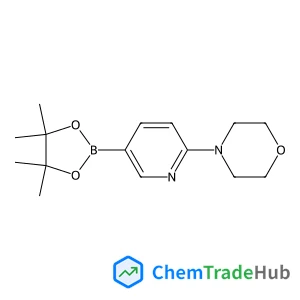
4-(5-(4,4,5,5-tetramethyl-1,3,2-dioxaborolan-2-yl)pyridin-2-yl)morpholine
CAS Number:
485799-04-0
Molecular Formula:
C15H23BN2O3
Recommended Suppliers





Disclaimer
This page provides academic journal information for reference and research purposes only. We are not affiliated with any journal publishers and do not handle publication submissions. For publication-related inquiries, please contact the respective journal publishers directly.
If you notice any inaccuracies in the information displayed, please contact us at support@chemtradehub.com. We will promptly review and address your concerns.