












Untangling the methane chemistry in interstellar and solar system ices toward ionizing radiation: a combined infrared and reflectron time-of-flight analysis
Literature Information
Publication Date
2017-09-26
DOI
10.1039/C7CP05882A
Impact Factor
3.676
Authors
View Original
Abstract
Pure methane (CH4/CD4) ices were exposed to three ionizing radiation sources at 5.5 K under ultrahigh vacuum conditions to compare the complex hydrocarbon spectrum produced across several interstellar environments. These irradiation sources consisted of energetic electrons to simulate secondary electrons formed in the track of galactic cosmic rays (GCRs), Lyman α (10.2 eV; 121.6 nm) photons simulated the internal VUV field in a dense cloud, and broadband (112.7–169.8 nm; 11.0–7.3 eV) photons which mimic the interstellar ultra-violet field. The in situ chemical evolution of the ices was monitored via Fourier transform infrared spectroscopy (FTIR) and during heating via mass spectrometry utilizing a quadrupole mass spectrometer with an electron impact ionization source (EI-QMS) and a reflectron time-of-flight mass spectrometer with a photoionization source (PI-ReTOF-MS). The FTIR analysis detected six small hydrocarbon products from the three different irradiation sources: propane [C3H8(C3D8)], ethane [C2H6(C2D6)], the ethyl radical [C2H5(C2D5)], ethylene [C2H4(C2D4)], acetylene [C2H2(C2D2)], and the methyl radical [CH3(CD3)]. The sensitive PI-ReTOF-MS analysis identified a complex array of products with different products being detected between experiments with general formulae: CnH2n+2 (n = 4–8), CnH2n (n = 3–9), CnH2n−2 (n = 3–9), CnH2n−4 (n = 4–9), and CnH2n−6 (n = 6–7) from electron irradiation and CnH2n+2 (n = 4–8), CnH2n (n = 3–10), CnH2n−2 (n = 3–11), CnH2n−4 (n = 4–11), CnH2n−6 (n = 5–11), and CnH2n−8 (n = 6–11) from broadband photolysis and Lyman α photolysis. These experiments show that even the simplest hydrocarbon can produce important complex hydrocarbons such as C3H4 and C4H6 isomers. Distinct isomers from these groups have been shown to be important reactants in the synthesis of polycyclic aromatic hydrocarbons like indene (C9H8) and naphthalene (C10H8) under interstellar conditions.
Related Literature
Asymmetric 1,3-dipolar cycloaddition with a P-stereogenic dipolarophile: An efficient approach to novel P-stereogenic 1,2-diphosphine systems
Nikolai Vinokurov, K. Michał Pietrusiewicz, Sławomir Frynas, Michael Wiebcke, Holger Butenschön
2008-09-12
Communication
DOI: 10.1039/B810573A
Direct growth of novel alloyed PtAu nanodendrites
Dan F. Thomas, Aicheng Chen
2008-09-01
Communication
DOI: 10.1039/B807660J
A novel type of N-formylation and related reactions of aminesviacyanides and esters as formylating agents
Kai Bao, Weige Zhang, Xiujuan Bu, Zhichun Song, Liang Zhang, Maosheng Cheng
2008-09-16
Communication
DOI: 10.1039/B810086A
Copper-catalyzed asymmetric allylic substitution with aryl and ethylGrignard reagents
Khalid B. Selim, Ken-ichi Yamada, Kiyoshi Tomioka
2008-09-09
Communication
DOI: 10.1039/B809140D
Defect chemistry of polyfluorenes: identification of the origin of “interface defects” in polyfluorene based light-emitting devices
Stefan Kappaun, Egbert Zojer, Christian Slugovc
2008-09-12
Communication
DOI: 10.1039/B808407F
Room temperature benzene C–H activation by a new [PSiP]Ir pincer complex
Darren F. MacLean, Robert McDonald, Michael J. Ferguson, Andrew J. Caddell, Laura Turculet
2008-09-23
Communication
DOI: 10.1039/B811811F
Facile synthesis and high d33 of single-crystalline KNbO3 nanocubes
Haiyan Ge, Yudong Hou, Mankang Zhu, Hao Wang, Hui Yan
2008-09-08
Communication
DOI: 10.1039/B810342A
Quantitative formation of a tetraporphyrin [2]catenaneviacopper and zinc coordination
Maryline Beyler, Valérie Heitz, Jean-Pierre Sauvage
2008-09-17
Communication
DOI: 10.1039/B811013A
Photopolymerization of metal nanoparticles on multiwall carbon nanotubes
Xichen Cai, Kelechi C. Anyaogu, Douglas C. Neckers
2008-09-01
Communication
DOI: 10.1039/B807407K
Self-organization of a new fluorous porphyrin and C60 films on indium-tin-oxide electrode
Alessandro Varotto, Louis Todaro, Mikki Vinodu, Gang-yu Liu
2008-09-19
Communication
DOI: 10.1039/B806795C
You might also like
Compound Q&A
What are the main uses of 1-(3-Aminophenyl)-3-[(3R)-1-(3,3-dimethyl-2-oxobutyl)-2-oxo-5-(2-pyridinyl)-2,3-dihydro-1H-1,4-benzodiazepin-3-yl]urea (CAS: 155412-88-7)?
This compound is mainly used as an intermediate in the synthesis of antipsychoti...
155412-88-71-(3-Aminophenyl)-3-...
Compound Q&A
How should waste containing 1-(D-Ribofuranosyl)-1,4-dihydro-3-pyridinecarboxamide (CAS: 19132-12-8) be handled?
Waste containing 1-(D-Ribofuranosyl)-1,4-dihydro-3-pyridinecarboxamide (CAS: 191...
19132-12-81-(D-Ribofuranosyl)-...
Compound Q&A
What regulatory guidelines apply to 2-Methyl-2-propanyl 3-bromo-3-(hydroxymethyl)-1-azetidinecarboxylate (CAS: 2007919-81-3)?
2-Methyl-2-propanyl 3-bromo-3-(hydroxymethyl)-1-azetidinecarboxylate (CAS: 20079...
2007919-81-32-Methyl-2-propanyl ...
Compound Q&A
What is N-(4-Chloro-2-pyridinyl)acetamide (CAS: 245056-66-0)?
N-(4-Chloro-2-pyridinyl)acetamide (CAS: 245056-66-0) is a chemical compound with...
245056-66-0N-(4-Chloro-2-pyridi...
Compound Q&A
What is 5-Chloro-2-hydroxybenzoic acid (CAS: 321-14-2)?
5-Chloro-2-hydroxybenzoic acid, also known as 5-chlorosalicylic acid, is an arom...
321-14-25-Chloro-2-hydroxybe...
Compound Q&A
What precautions should be taken when handling 1,1-Dichloro-1-fluoroethane (CAS: 1717-00-6)?
When handling 1,1-Dichloro-1-fluoroethane (CAS: 1717-00-6), it is important to u...
1717-00-61,1-Dichloro-1-fluor...
Compound Q&A
What are the physical and chemical properties of Fmoc-(2S,3R)-3-phenylpyrrolidine-2-carboxylic acid (CAS: 281655-32-1)?
Fmoc-(2S,3R)-3-phenylpyrrolidine-2-carboxylic acid is a white crystalline solid ...
281655-32-1Fmoc-(2S,3R)-3-pheny...
Compound Q&A
What are the main uses of 4-Amino-5-bromo-2-pyridinecarboxylic acid (CAS: 1363381-01-4)?
4-Amino-5-bromo-2-pyridinecarboxylic acid is primarily used as a precursor in th...
1363381-01-44-Amino-5-bromo-2-py...
Compound Q&A
What precautions should be taken when handling (S)-tert-butyl 2-((2-(4-bromophenyl)-2-oxoethyl)carbamoyl)pyrrolidine-1-carboxylate (CAS: 1007881-98-2)?
Handling this compound should be done with personal protective equipment (PPE) i...
1007881-98-2(S)-tert-butyl 2-((2...
Compound Q&A
What precautions should be taken when handling 8-bromo-2,2-dimethyl-3,4-dihydro-2H-1,4-benzoxazin-3-one (CAS: 688363-73-7)?
When handling 8-bromo-2,2-dimethyl-3,4-dihydro-2H-1,4-benzoxazin-3-one, use prop...
688363-73-78-bromo-2,2-dimethyl...
Source Journal
Physical Chemistry Chemical Physics

CiteScore:
5.5
Self-citation Rate:
10.3%
Articles per Year:
3036
Physical Chemistry Chemical Physics (PCCP) is an international journal co-owned by 19 physical chemistry and physics societies from around the world. This journal publishes original, cutting-edge research in physical chemistry, chemical physics and biophysical chemistry. To be suitable for publication in PCCP, articles must include significant innovation and/or insight into physical chemistry; this is the most important criterion that reviewers and Editors will judge against when evaluating submissions. The journal has a broad scope and welcomes contributions spanning experiment, theory, computation and data science. Topical coverage includes spectroscopy, dynamics, kinetics, statistical mechanics, thermodynamics, electrochemistry, catalysis, surface science, quantum mechanics, quantum computing and machine learning. Interdisciplinary research areas such as polymers and soft matter, materials, nanoscience, energy, surfaces/interfaces, and biophysical chemistry are welcomed if they demonstrate significant innovation and/or insight into physical chemistry. Joined experimental/theoretical studies are particularly appreciated when complementary and based on up-to-date approaches.
Recommended Compounds
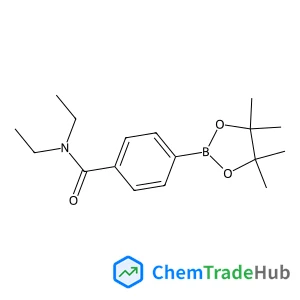
N,N-Diethyl-4-(4,4,5,5-tetramethyl-1,3,2-dioxaborolan-2-yl)benzamide
CAS Number:
325142-99-2
Molecular Formula:
C17H26BNO3
Recommended Suppliers






Disclaimer
This page provides academic journal information for reference and research purposes only. We are not affiliated with any journal publishers and do not handle publication submissions. For publication-related inquiries, please contact the respective journal publishers directly.
If you notice any inaccuracies in the information displayed, please contact us at support@chemtradehub.com. We will promptly review and address your concerns.