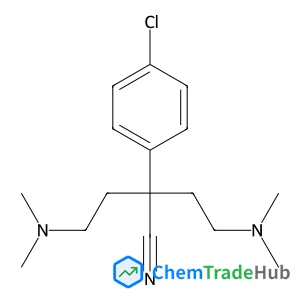
2-(4-Chlorophenyl)-4-(dimethylamino)-2-(2-(dimethylamino)ethyl)butanenitrile
CAS Number:
1246816-57-8
Molecular Formula:
C16H24ClN3
Kai Bao, Weige Zhang, Xiujuan Bu, Zhichun Song, Liang Zhang, Maosheng Cheng
A novel N-formylation and related reactions proceed from cyanides promoted by esters.
Jie Yang, Yifei Zhang, Ting-Fang He, Yangyi Lu, Lijuan Wang, Bei Ding
DOI: 10.1039/D1CP04445A
Gurudutt Dubey, Nutan Mahawar, Tejender Singh, Nirjhar Saha, Subash C. Sahoo, Prasad V. Bharatam
DOI: 10.1039/D1CP04732A
Jesús Jara-Cortés, Edith Leal-Sánchez, Evelio Francisco, José A. Pérez-Pimienta, Ángel Martín Pendás, Jesús Hernández-Trujillo
DOI: 10.1039/D1CP02837E
Giuseppe Mattioli, Paola Alippi, Lorenzo Avaldi, Paola Bolognesi, Laura Carlini, Rocio Borrego Varillas, Manjot Singh, Robert Richter
DOI: 10.1039/D1CP04050B
Alexander Guda, Johannes Windisch, Benjamin Probst, Roger Alberto, Maarten Nachtegaal, Grigory Smolentsev
DOI: 10.1039/D1CP02823E
Mohammad Mahdi Kalantarian, Amir Haghipour
DOI: 10.1039/D1CP04800G
Václav Pokorný, Vojtěch Štejfa, Květoslav Růžička, Ctirad Červinka
DOI: 10.1039/D1CP03717J
Alexander Zech
DOI: 10.1039/D1CP04587C
Yi Lu, Lei Yang, Yangmin Kuang, Yongchen Song, Jiafei Zhao, Amadeu K. Sum
DOI: 10.1039/D1CP03325E
Yueh-Chun Wu, Takashi Taniguchi, Kenji Watanabe, Jun Yan
DOI: 10.1039/D1CP03490A
This compound is mainly used as an intermediate in the synthesis of antipsychoti...
Waste containing 1-(D-Ribofuranosyl)-1,4-dihydro-3-pyridinecarboxamide (CAS: 191...
2-Methyl-2-propanyl 3-bromo-3-(hydroxymethyl)-1-azetidinecarboxylate (CAS: 20079...
N-(4-Chloro-2-pyridinyl)acetamide (CAS: 245056-66-0) is a chemical compound with...
5-Chloro-2-hydroxybenzoic acid, also known as 5-chlorosalicylic acid, is an arom...
When handling 1,1-Dichloro-1-fluoroethane (CAS: 1717-00-6), it is important to u...
Fmoc-(2S,3R)-3-phenylpyrrolidine-2-carboxylic acid is a white crystalline solid ...
4-Amino-5-bromo-2-pyridinecarboxylic acid is primarily used as a precursor in th...
Handling this compound should be done with personal protective equipment (PPE) i...
When handling 8-bromo-2,2-dimethyl-3,4-dihydro-2H-1,4-benzoxazin-3-one, use prop...

ChemComm publishes urgent research which is of outstanding significance and interest to experts in the field, while also appealing to the journal’s broad chemistry readership. Our communication format is ideally suited to short, urgent studies that are of such importance that they require accelerated publication. Our scope covers all topics in chemistry, and research at the interface of chemistry and other disciplines (such as materials science, nanoscience, physics, engineering and biology) where there is a significant novelty in the chemistry aspects. Major topic areas covered include: Analytical Chemistry Catalysis Chemical Biology and medicinal chemistry Computational Chemistry and Machine Learning Energy and sustainable chemistry Environmental Chemistry Green Chemistry Inorganic Chemistry Materials Chemistry Nanoscience Organic Chemistry Physical Chemistry Polymer Chemistry Supramolecular Chemistry
![6-Benzyl-4,5,6,7-tetrahydro-1H-pyrazolo[3,4-c]pyridin-3(2H)-one structure](https://static.chemtradehub.com/structs/909/909187-64-0-f54f.webp "6-Benzyl-4,5,6,7-tetrahydro-1H-pyrazolo[3,4-c]pyridin-3(2H)-one structure")