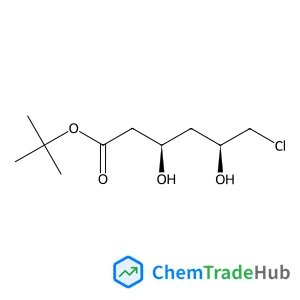
2-Methyl-2-propanyl (3R,5S)-6-chloro-3,5-dihydroxyhexanoate
CAS Number:
154026-93-4
Molecular Formula:
C10H19ClO4
Jianzhong Chen, Jinan Wang, Weiliang Zhu
Anaplastic lymphoma kinase (ALK) has been regarded as a promising drug target in the treatment of tumors and the mutation L1196M induces different levels of drug resistance toward the existing inhibitors. Free energy perturbation (FEP) coupled with umbrella sampling simulation is used to investigate the conformational change of ALK induced by L1196M and drug-resistant mechanisms of L1196M on four inhibitors VGH, 3U9, 5P8 and IV7. Dynamics analysis shows that L119M produces significant influences on the flexibility of the loops L1 and L2 in ALK. FEP calculations suggest that the drug-resistant intensity of L1196M toward inhibitors decreases in the order 3U9 > VGH > 5P8 > IV7, in accordance with the experimentally determined results. Moreover, statistical analysis of hydrophobic contacts of inhibitors with separate residues in ALK further demonstrates that the decrease in the hydrophobic interactions of inhibitors with L1256 mostly drives drug resistance of L1196M toward inhibitors. The calculations of potential of mean force (PMF) based on umbrella sampling simulations indicate that the free energies of inhibitor-L1196M ALKs are lower than those of inhibitor-wild ALKs. This study is expected to provide significant theoretical support which would help in the design of potent inhibitors alleviating the drug resistance of L1196M in ALK.
M. Briant, M.-A. Gaveau, B. Soep, J.-M. Mestdagh, L. Poisson
DOI: 10.1039/C7CP07741F
Xiya Wang, Hao Su, Rutao Liu, Yongjun Liu
DOI: 10.1039/C8CP02362J
Miroslav Menšík, Petr Toman, Urszula Bielecka, Wojciech Bartkowiak, Jiří Pfleger, Bartosz Paruzel
DOI: 10.1039/C7CP06423C
Sanae Benabou, Cyril Ruckebusch, Michel Sliwa, Anna Aviñó, Ramon Eritja, Raimundo Gargallo, Anna de Juan
DOI: 10.1039/C8CP00850G
Takeyuki Sekimoto, Michio Suzuka, Tomoyasu Yokoyama, Ryusuke Uchida, Shin’ichi Machida, Takashi Sekiguchi, Kenji Kawano
DOI: 10.1039/C7CP07477H
Ivan Ljubić, Antti Kivimäki, Marcello Coreno, Saša Kazazić, Igor Novak
DOI: 10.1039/C7CP07266J
Götz Bucher, Mukul Lal, Anup Rana, Michael Schmittel
DOI: 10.1039/C8CP03311K
Hongwei Song, Minghui Yang
DOI: 10.1039/C8CP03240H
Ashley E. Shields, Mark T. Storr, Andrew S. Wills
DOI: 10.1039/C8CP03583K
(1R,3S)-1,3-Cyclopentanediol finds applications in various industries. In the ph...
When handling N'-[4-(Dimethylamino)phenyl]-N,N-dimethyl-1,4-benzenediamine, it i...
There are several alternatives to 5-(2,4-Difluorophenyl)-2-methoxypyrimidine in ...
1-(3-Methoxyphenoxy)propan-2-ol (CAS: 382141-68-6) must comply with the Globally...
Tetrodotoxin Citrate is extremely dangerous and should be handled with extreme c...
2-Methyl-2-propanyl [(1R,3S)-3-hydroxycyclopentyl]carbamate (CAS: 225641-84-9) i...
Waste containing 4-(2-Hydroxyhexafluoroisopropyl)Benzoic Acid (CAS: 16261-80-6) ...
2-Methyl-2-proanyl {(2S)-1-[(benzyloxy)amino]-3-hydroxy-3-methyl-1-oxo-2-butanyl...
Benzeneethanamine, α-ethyl-, hydrochloride (1:1) is an organic compound with the...
In the synthesis of compounds similar to 3-{(E)-[4-(Dimethylamino)phenyl]diazeny...

Physical Chemistry Chemical Physics (PCCP) is an international journal co-owned by 19 physical chemistry and physics societies from around the world. This journal publishes original, cutting-edge research in physical chemistry, chemical physics and biophysical chemistry. To be suitable for publication in PCCP, articles must include significant innovation and/or insight into physical chemistry; this is the most important criterion that reviewers and Editors will judge against when evaluating submissions. The journal has a broad scope and welcomes contributions spanning experiment, theory, computation and data science. Topical coverage includes spectroscopy, dynamics, kinetics, statistical mechanics, thermodynamics, electrochemistry, catalysis, surface science, quantum mechanics, quantum computing and machine learning. Interdisciplinary research areas such as polymers and soft matter, materials, nanoscience, energy, surfaces/interfaces, and biophysical chemistry are welcomed if they demonstrate significant innovation and/or insight into physical chemistry. Joined experimental/theoretical studies are particularly appreciated when complementary and based on up-to-date approaches.