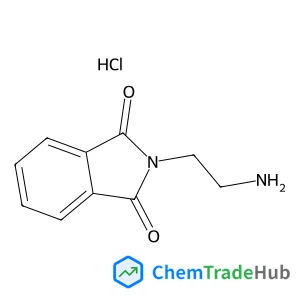
2-(2-Aminoethyl)-1H-isoindole-1,3(2H)-dione hydrochloride (1:1)
CAS Number:
30250-67-0
Molecular Formula:
C10H11ClN2O2
J. Huang, N. Mizushima, S. Ko, T. Tatsuma
Graphene edge sites not only facilitate heterogeneous electron transfer reactions of redox species because of localization of electrons, but also allow sensitivities and selectivities to be tuned by controlling the atomic oxygen/carbon (O/C) ratio. Here, we immobilized fructose dehydrogenase (FDH) onto the surface of cup-stacked carbon nanofibers (CSCNFs), which provide highly ordered graphene edges with a controlled O/C ratio, and investigated the direct electron communication with FDH. As the O/C ratio decreased at the CSCNF surface, the negative zeta potential was mitigated and the electrochemical communication with FDH was facilitated. This is likely due to improved orientation of FDH molecules on the CSCNF surface. CSCNFs with a controlled O/C ratio could be applied to FDH-based D-fructose biosensors with tunable dynamic range and fructose biofuel cells with a controlled maximum current.
Steven A. Raw, Richard J. K. Taylor
DOI: 10.1039/B316107B
Barbara Binotti, Carla Carfagna, Cristiano Zuccaccia, Alceo Macchioni
DOI: 10.1039/B411214H
Richard T. Baker, Leila Naji, Karen Lochhead, John A. Chudek
DOI: 10.1039/B301039B
Yuyang Liu, Jing Tang, J. H. Xin
DOI: 10.1039/B412282H
Yahong Zhang, Xijuan Yu, Xiaoyan Wang, Wei Shan, Pengyuan Yang, Yi Tang
DOI: 10.1039/B411336E
Olaf Köhler, Dilip Venkatrao Jarikote, Oliver Seitz
DOI: 10.1039/B411877D
Elizabeth A. Whitsitt, Andrew R. Barron
DOI: 10.1039/B212808J
DOI: 10.1039/B300963G
Toshiaki Mori, Yoshimi Sekine, Kenji Yamamoto, Yoshio Okahata
DOI: 10.1039/B411082J
Narcis Avarvari, Marc Fourmigué
DOI: 10.1039/B412193G
(1R,3S)-1,3-Cyclopentanediol finds applications in various industries. In the ph...
When handling N'-[4-(Dimethylamino)phenyl]-N,N-dimethyl-1,4-benzenediamine, it i...
There are several alternatives to 5-(2,4-Difluorophenyl)-2-methoxypyrimidine in ...
1-(3-Methoxyphenoxy)propan-2-ol (CAS: 382141-68-6) must comply with the Globally...
Tetrodotoxin Citrate is extremely dangerous and should be handled with extreme c...
2-Methyl-2-propanyl [(1R,3S)-3-hydroxycyclopentyl]carbamate (CAS: 225641-84-9) i...
Waste containing 4-(2-Hydroxyhexafluoroisopropyl)Benzoic Acid (CAS: 16261-80-6) ...
2-Methyl-2-proanyl {(2S)-1-[(benzyloxy)amino]-3-hydroxy-3-methyl-1-oxo-2-butanyl...
Benzeneethanamine, α-ethyl-, hydrochloride (1:1) is an organic compound with the...
In the synthesis of compounds similar to 3-{(E)-[4-(Dimethylamino)phenyl]diazeny...

Physical Chemistry Chemical Physics (PCCP) is an international journal co-owned by 19 physical chemistry and physics societies from around the world. This journal publishes original, cutting-edge research in physical chemistry, chemical physics and biophysical chemistry. To be suitable for publication in PCCP, articles must include significant innovation and/or insight into physical chemistry; this is the most important criterion that reviewers and Editors will judge against when evaluating submissions. The journal has a broad scope and welcomes contributions spanning experiment, theory, computation and data science. Topical coverage includes spectroscopy, dynamics, kinetics, statistical mechanics, thermodynamics, electrochemistry, catalysis, surface science, quantum mechanics, quantum computing and machine learning. Interdisciplinary research areas such as polymers and soft matter, materials, nanoscience, energy, surfaces/interfaces, and biophysical chemistry are welcomed if they demonstrate significant innovation and/or insight into physical chemistry. Joined experimental/theoretical studies are particularly appreciated when complementary and based on up-to-date approaches.