


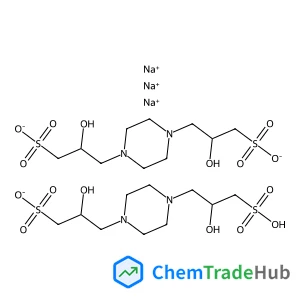
3,3'-(Piperazine-1,4-diyl)bis(2-hydroxypropane-1-sulfonic acid) Sodium Salt
CAS Number:
108321-08-0
Molecular Formula:
C20H41N4Na3O16S4
Jiao Shi, Ling-Nan Liu, Qing-Hua Qin
A string of fullerenes is used for generating a nanotube by self-assembly of a black phosphorus (BP) nanoribbon at a temperature of 8 K. Among the fullerenes in the string, there are at least two fixed fullerenes placed along the edge of the BP ribbon for keeping its configuration stability during winding. By way of molecular dynamics simulations, it is found that successful generation of a BP nanotube depends on the bending stiffness of the ribbon and the attraction between the fullerenes and the ribbon. When the attraction is strong enough, the two edges (along the zigzag direction) of the BP ribbon will be able to bond covalently to form a nanotube. By the molecular dynamics approach, the maximum width of the BP ribbon capable of forming a nanotube with a perfect length is investigated in three typical models. The maximum width of the BP ribbon becomes larger with the string containing more fullerenes. This finding reveals a way to control the width of the BP ribbon which forms a nanotube. It provides guidance for fabricating a BP nanotube with a specified length, the same as to the width of the ribbon.

New Journal of Chemistry

Chemistry Education Research and Practice

Russian Journal of Coordination Chemistry

Organic Process Research & Development

Current Opinion in Colloid & Interface Science

Russian Journal of General Chemistry

Russian Chemical Bulletin

Russian Journal of Applied Chemistry

Russian Journal of Organic Chemistry

Acta Materialia
Georg Ehlers, Joerg C. Neuefeind, Souleymane O. Diallo, Christopher B. Stanley, Luke Daemen
DOI: 10.1039/C7CP04013J
Mihirsinh Chauhan, Vishal Bharti, Manoj Kumar, Suresh Chand, Brijesh Tripathi, J. P. Tiwari
DOI: 10.1039/C7CP05235A
Helmut Baltruschat
DOI: 10.1039/C7CP03914J
Jonatan Bergek, Björn Elgh, Anders E. C. Palmqvist, Lars Nordstierna
DOI: 10.1039/C7CP02571H
Guofeng Yang, Rui Sun, Pengfei Yan, Yanan Lu, Junjun Xue, Guoqing Chen
DOI: 10.1039/C7CP05386J
Yanan Tang, Huadou Chai, Weiguang Chen, Xiao Cui, Yaqiang Ma, Mingyu Zhao
DOI: 10.1039/C7CP05683D
Miguel de Abreu, Lyndsey J. Ferguson, Derek J. Quinn, Thomas S. Moody, Meilan Huang
DOI: 10.1039/C7CP03640J
Sam Karpiniec, James K. Ferri
DOI: 10.1039/C7CP02599H
Zongyuan Liu, Carl O. Trindle, Quanli Gu, Wei Wu, Peifeng Su
DOI: 10.1039/C7CP03491A
3-Fluoro-2-methylbenzylamine is an organic compound with the CAS number 771573-3...
Tert-butyl 2-(oxetan-3-ylidene)acetate is considered safe for its intended uses ...
Proper personal protective equipment (PPE) such as gloves, goggles, and a lab co...
2-Ethyl-4-methyl-1,3-thiazole is commonly synthesized via the reaction of thiour...
This compound should be stored in a cool, dry place away from direct sunlight an...
L-Lysine Acetate Salt (CAS: 52315-92-1) is subject to various regulatory guideli...
6-Fluoro-3-hydroxy-2-pyrazinecarboxamide (CAS: 259793-96-9) is generally conside...
1,1'-Sulfonylbis(1H-imidazole) is a crystalline solid with a molecular weight of...
4-Methyl-7-nitro-1H-indole-3-carbonitrile (CAS: 289483-82-5) is primarily used i...
Waste containing 5-Bromo-3-indolyl-beta-galactoside (CAS: 97753-82-7) should be ...

Physical Chemistry Chemical Physics (PCCP) is an international journal co-owned by 19 physical chemistry and physics societies from around the world. This journal publishes original, cutting-edge research in physical chemistry, chemical physics and biophysical chemistry. To be suitable for publication in PCCP, articles must include significant innovation and/or insight into physical chemistry; this is the most important criterion that reviewers and Editors will judge against when evaluating submissions. The journal has a broad scope and welcomes contributions spanning experiment, theory, computation and data science. Topical coverage includes spectroscopy, dynamics, kinetics, statistical mechanics, thermodynamics, electrochemistry, catalysis, surface science, quantum mechanics, quantum computing and machine learning. Interdisciplinary research areas such as polymers and soft matter, materials, nanoscience, energy, surfaces/interfaces, and biophysical chemistry are welcomed if they demonstrate significant innovation and/or insight into physical chemistry. Joined experimental/theoretical studies are particularly appreciated when complementary and based on up-to-date approaches.
![trans,trans-4-n-Propyl-4-[4-(trifluoromethoxy)phenyl]bicyclohexyl structure](https://static.chemtradehub.com/structs/133/133937-72-1-25ef.webp "trans,trans-4-n-Propyl-4-[4-(trifluoromethoxy)phenyl]bicyclohexyl structure")

![(3R)-3-(3-Fluorophenyl)-3-({[(2-methyl-2-propanyl)oxy]carbonyl}amino)propanoic acid structure](https://static.chemtradehub.com/structs/500/500789-04-8-20dd.webp "(3R)-3-(3-Fluorophenyl)-3-({[(2-methyl-2-propanyl)oxy]carbonyl}amino)propanoic acid structure")


