












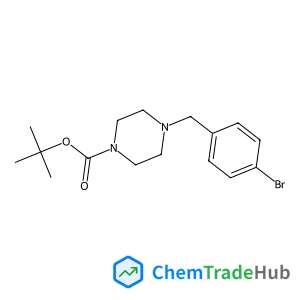
2-Methyl-2-propanyl 4-(4-bromobenzyl)-1-piperazinecarboxylate
CAS Number:
844891-10-7
Molecular Formula:
C16H23BrN2O2
Lisa Peterhans, Elisa Alloa, Yauhen Sheima, Laurent Vannay, Mario Leclerc, Clémence Corminboeuf, Sophia C. Hayes
We report here the photophysical properties of a water-soluble conjugated polythiophene with cationic side-chains. When dissolved in aqueous buffer solution (PBS, phosphate buffered saline), there is ordering of the polymer chains due to the presence of the salts, in contrast to pure water, where a random-coil conformation is adopted at room temperature. The ordering leads to a pronounced colour change of the solution (the absorption maximum shifts from 400 nm to 525 nm). Combining resonance Raman spectroscopy with density functional theory computations, we show a significant backbone planarization in the ordered phase. Moreover, the ratio of ordered phase to random-coil phase in PBS solution, as well as the extent of intermolecular interactions in the ordered phase, can be tuned by varying the temperature. Femtosecond transient absorption spectroscopy reveals that the excited-state behaviour of the polyelectrolyte is strongly affected by the degree of ordering. While triplet state formation is favoured in the random-coil chains, the ordered chains show a weak yield of polarons, related to interchain interactions. The investigated polyelectrolyte has been previously used as a biological DNA sensor, based on optical transduction when the conformation of the polyelectrolyte changes during assembly with the biomolecule. Therefore, our results, by correlating the photophysical properties of the polyelectrolyte to backbone and intermolecular conformation in a biologically relevant buffer, provide a significant step forward in understanding the mechanism of the biological sensing.
Xiaomin Li, Jinwei Miao, Fulong Hu, Kang Yan, Lin Song, Huiqing Fan, Longtao Ma, Weijia Wang
DOI: 10.1039/D3TA05814J
Guowei Gao, Xiaochen Yang, Jingxuan Bi, Wanqing Guan, Zhuzhu Du
DOI: 10.1039/D3TA06057H
Gabriele Centi, Siglinda Perathoner
DOI: 10.1039/D3GC02135A
Irina Delidovich, Valérie Toussaint
DOI: 10.1039/D3GC04049F
Ho Ngoc Nam, Katsuhiro Suzuki
DOI: 10.1039/D3TA06259G
Luis E. Botello, José Solla-Gullón, Víctor Climent, Juan M. Feliu, Rolf Schuster
DOI: 10.1039/D3TA04937J
Boli Nie, Xiangyu Dou, Yanming Meng, Xi Zhao, Yan-Chao Wu, Hui-Jing Li
DOI: 10.1039/D3TA06114K
Bommaramoni Yadagiri, Sanjay Sandhu, Ashok Kumar Kaliamurthy, Francis Kwaku Asiam, Jongdeok Park, Appiagyei Ewusi Mensah, Jae-Joon Lee
DOI: 10.1039/D3TA05915D
Taegon Jeon, Gyeong Ho Cha, Sung Chul Jung
DOI: 10.1039/D3TA06069A
Tongxiang Ma, Yuzheng Pan, Junyu Chen, Zhiming Yan, Buxin Chen, Lang Zhao, Liwen Hu, Liangying Wen, Meilong Hu
DOI: 10.1039/D3TA90269B
Waste containing 2-Ethyl-4-Methyl-1H-Imidazole-5-Carbaldehyde (CAS: 88634-80-4) ...
Triethoxy(octyl)silane (CAS: 1385031-14-0) is widely used in the pharmaceuticals...
Several alternatives to 3-iodo-7-nitro-1H-indazole (CAS: 864724-64-1) exist in t...
Yes, there are alternatives to Benzene, bis[(trimethoxysilyl)ethyl] (CAS: 266317...
Isothiazole-3-carbonitrile (CAS: 1452-17-1) is generally considered safe when us...
(3-Chlorophenyl)methanol (CAS: 873-63-2) is considered low to moderately toxic. ...
(2S,3S)-2-Hydroxy-3-({[(2-methyl-2-propanyl)oxy]carbonyl}amino)-3-(2-naphthyl)pr...
Proper handling of methyl 2-(bromomethyl)-5-methoxybenzoate requires the use of ...
6,8-Dibromoimidazo[1,2-a]pyridine-2-carboxylic acid (CAS: 904805-36-3) is an aro...
3-Amino-5-bromo-2-pyridinecarbonitrile is considered safe when handled under pro...

Physical Chemistry Chemical Physics (PCCP) is an international journal co-owned by 19 physical chemistry and physics societies from around the world. This journal publishes original, cutting-edge research in physical chemistry, chemical physics and biophysical chemistry. To be suitable for publication in PCCP, articles must include significant innovation and/or insight into physical chemistry; this is the most important criterion that reviewers and Editors will judge against when evaluating submissions. The journal has a broad scope and welcomes contributions spanning experiment, theory, computation and data science. Topical coverage includes spectroscopy, dynamics, kinetics, statistical mechanics, thermodynamics, electrochemistry, catalysis, surface science, quantum mechanics, quantum computing and machine learning. Interdisciplinary research areas such as polymers and soft matter, materials, nanoscience, energy, surfaces/interfaces, and biophysical chemistry are welcomed if they demonstrate significant innovation and/or insight into physical chemistry. Joined experimental/theoretical studies are particularly appreciated when complementary and based on up-to-date approaches.
![4-chloro-N-[5-methyl-2-(7H-pyrrolo[2,3-d]pyrimidine-4-carbonyl)-3-pyridyl]-3-(trifluoromethyl)benzenesulfonamide structure](https://static.chemtradehub.com/structs/110/1100318-47-5-127d.webp "4-chloro-N-[5-methyl-2-(7H-pyrrolo[2,3-d]pyrimidine-4-carbonyl)-3-pyridyl]-3-(trifluoromethyl)benzenesulfonamide structure")




