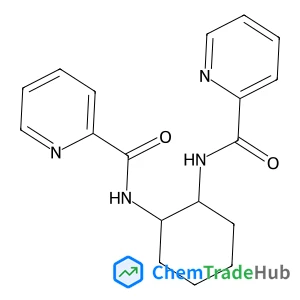
N,N'-(1R,2R)-1,2-Cyclohexanediyldi(2-pyridinecarboxamide)
CAS Number:
218290-24-5
Molecular Formula:
C18H20N4O2
Ryan E. Holcomb, James R. Kraly, Charles S. Henry
Selectivity and resolution for analyses conducted using microfluidic devices can be improved by increasing the total number of individual detection elements in the device. Here, a poly(dimethylsiloxane) capillary electrophoresis microchip was fabricated with an integrated electrode array for selective detection of small molecules. Eight individually addressable gold electrodes were incorporated in series after a palladium current decoupler in the separation channel of an electrophoresis microchip. The electrode array device was characterized using a mixture of biologically relevant analytes and xenobiotics: norepinephrine, 4-aminophenol, acetaminophen, uric acid, and 3,4-dihydroxyphenylacetic acid. Separation efficiencies as high as 9000 ± 1000 plates (n = 3) for 3,4-dihydroxyphenylacetic acid and limits of detection as low as 2.6 ± 1.2 µM (n = 3) for norepinephrine were obtained using this device. After characterizing the performance of the device, potential step detection was conducted at the array electrodes and selective detection achieved based upon differences in redox potentials for individual analytes. Utilization of potential step detection was particularly advantageous for resolving co-migrating species; resolution of 3,4-dihydroxy-L-phenylalanine from acetaminophen using potential control was demonstrated. Finally, a human urine sample was analyzed using potential step detection to demonstrate the applicability of this device for complex sample analysis.

Nature Reviews Drug Discovery

Environmental Toxicology and Pharmacology

Mini-Reviews in Medicinal Chemistry

European Journal of Organic Chemistry

Coloration Technology

Current Pharmaceutical Biotechnology

Lab on a Chip

Photochemical & Photobiological Sciences

Physical Chemistry Chemical Physics

Contact Lens & Anterior Eye
María T. Baumgartner, Raúl A. Taccone, Mariano A. Teruel, Silvia I. Lane
DOI: 10.1039/B108856B
Osvaldo H. Scalise, Moises Silbert
DOI: 10.1039/B107990P
Yoshio Nosaka, Masatsugu Nakamura, Tsutomu Hirakawa
DOI: 10.1039/B108441K
Apichart Linhananta, Kieran F. Lim
DOI: 10.1039/B109074G
Anan Tongraar, Kritsana Sagarik, Bernd Michael Rode
DOI: 10.1039/B107786D
P. Valentin
DOI: 10.1039/B109105K
Michael J. Blandamer, Paul M. Cullis, Peter T. Gleeson
DOI: 10.1039/B107646A
DOI: 10.1039/B108775D
DOI: 10.1039/B111564M
6-Bromo-2-methylimidazo[1,2-a]pyrimidine (CAS: 1111638-05-1) falls under various...
While there are no direct alternatives, similar compounds like 1-Pyrrolidineetha...
4-Methyl-2,6-bis(2-methyl-2-propanyl)phenyl methylcarbamate (CAS: 1918-11-2) is ...
2-(3-Bromo-4-fluorophenyl)-1,3-dioxolane (CAS: 77771-04-1) should be stored in a...
4,5,6,7-Tetrahydro-1H-indazole hydrochloride is a white crystalline solid with a...
(2R)-1-Methoxy-3-phenyl-2-propanamine is a chiral organic compound with the CAS ...
Ethyl 1-(1-phenylethyl)-1H-imidazole-5-carboxylate is used in various industries...
4-[(1E,3S)-1-(4-Hydroxyphenyl)-1,4-pentadien-3-yl]phenol (CAS: 17676-24-3) falls...
(S)-3-Amino-5-phenylpentanoic acid hydrochloride is primarily used in the pharma...
7-Methoxy-1-benzothiophene-2-carboxylic acid is typically synthesized by reactin...

Analyst publishes analytical and bioanalytical research that reports premier fundamental discoveries and inventions, and the applications of those discoveries, unconfined by traditional discipline barriers.
![9H-Fluoren-9-ylmethyl {15-[(2,5-dioxo-1-pyrrolidinyl)oxy]-15-oxo-3,6,9,12-tetraoxapentadec-1-yl}carbamate structure](https://static.chemtradehub.com/structs/131/1314378-14-7-4316.webp "9H-Fluoren-9-ylmethyl {15-[(2,5-dioxo-1-pyrrolidinyl)oxy]-15-oxo-3,6,9,12-tetraoxapentadec-1-yl}carbamate structure")