












A novel approach to correct variations in Raman spectra due to photo-bleachable cellular components
Literature Information
Publication Date
2008-11-14
DOI
10.1039/B811596F
Impact Factor
4.616
Authors
Maarten Scholtes-Timmerman, Alex van Belkum
View Original
Abstract
Bacterial typing by Raman spectroscopy is based on small spectral differences that exist between strains, due to differences in their overall molecular composition. These strain-specific spectral differences can be obscured by sources of non-specific signal variance. One such source is the signal contribution of microbial pigments that can vary strongly in intensity. Examples of such pigments are carotenoids in Staphylococcus aureus, and other pigments in Pseudomonas aeruginosa and Mycobacterium lentiflavum. The variance in the intensity of these pigments greatly overshadows strain-specific differences, and therefore lowers spectral reproducibility and causes misclassification of microbial strains. Here a method is presented to determine the spectral signature of pigments of which the relative signal contribution decreases under laser irradiation; so-called photo-bleachable pigments. These signatures are used to eliminate signal variance caused by these pigments by means of the extended multiplicative scatter correction algorithm and spectral interferent subtraction. Application of this method increases the reproducibility of the spectra of microorganisms that contain such pigments to the extent that reproducible identification of samples at strain level is achieved.
Related Literature
Photo- and radiation-chemical production of radical cations of methylbenzenes and benzyl alcohols and their reactivity in aqueous solution
2002-03-14
Paper
DOI: 10.1039/B109974D
Thermodynamic properties and dielectric constants in water/methanol mixtures by integral equation theory and molecular dynamics simulations
2002-02-06
Paper
DOI: 10.1039/B108724J
Pairing of the nucleobase guanine studied by IR–UV double-resonance spectroscopy and ab initio calculations
Christoph Janzen, Petra Imhof, Karl Kleinermanns, Mattanjah S. de Vries
2002-01-29
Paper
DOI: 10.1039/B110360C
Unimolecular decomposition of antimony and bismuth cluster ions studied by surface collision induced dissociation mass spectrometry
Thorsten M. Bernhardt, Bernhard Kaiser, Klaus Rademann
2002-02-26
Paper
DOI: 10.1039/B110194C
The influence of concentration-dependent diffusivities on wave stability
Marc R. Roussel, Jichang Wang
2002-03-14
Paper
DOI: 10.1039/B109310J
Gibbs solution of the van der Waals–Maxwell problem and universality of the liquid–gas coexistence curve
Vitaly B. Rogankov, Leonid Z. Boshkov
2002-02-18
Paper
DOI: 10.1039/B107989C
Thermodynamics of thermal methods for rapid screening of combinatorial libraries
Michael J. Blandamer, Paul M. Cullis, Peter T. Gleeson
2002-02-01
Paper
DOI: 10.1039/B107646A
A molecular level study of complex formation between putidaredoxin and cytochrome P450 by scanning tunnelling microscopy
R. Mukhopadhyay, L. L. Wong, K. K. Lo, T. Pochapsky, H. A. O. Hill
2002-01-17
Paper
DOI: 10.1039/B108107A
Density function studies of peptides Part I. Vibrational frequencies including isotopic effects and NMR chemical shifts of N-methylacetamide, a peptide model, from density function and MP2 calculations
G. Cuevas, G. Madrid, A. T. Hagler
2002-03-15
Paper
DOI: 10.1039/B110777C
Dipole strength effects on the polymorphism in smectic A mesophases
2002-01-23
Paper
DOI: 10.1039/B106788E
You might also like
Compound Q&A
What regulatory guidelines apply to 6-Bromo-2-methylimidazo[1,2-a]pyrimidine (CAS: 1111638-05-1)?
6-Bromo-2-methylimidazo[1,2-a]pyrimidine (CAS: 1111638-05-1) falls under various...
1111638-05-16-Bromo-2-methylimid...
Compound Q&A
Are there alternatives to 1-Pyrrolidineethanol, β-methyl-α-phenyl-, (αS,βR) (CAS: 123620-80-4) in synthesis?
While there are no direct alternatives, similar compounds like 1-Pyrrolidineetha...
123620-80-41-Pyrrolidineethanol...
Compound Q&A
Is 4-Methyl-2,6-bis(2-methyl-2-propanyl)phenyl methylcarbamate (CAS: 1918-11-2) safe?
4-Methyl-2,6-bis(2-methyl-2-propanyl)phenyl methylcarbamate (CAS: 1918-11-2) is ...
1918-11-24-Methyl-2,6-bis(2-m...
Compound Q&A
How should 2-(3-Bromo-4-fluorophenyl)-1,3-dioxolane (CAS: 77771-04-1) be stored?
2-(3-Bromo-4-fluorophenyl)-1,3-dioxolane (CAS: 77771-04-1) should be stored in a...
77771-04-12-(3-Bromo-4-fluorop...
Compound Q&A
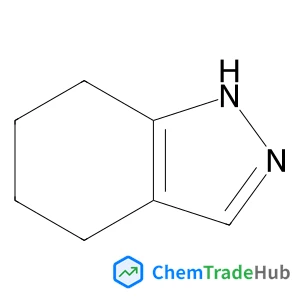
What are the physical and chemical properties of 4,5,6,7-Tetrahydro-1H-indazole hydrochloride (CAS: 18161-11-0)?
4,5,6,7-Tetrahydro-1H-indazole hydrochloride is a white crystalline solid with a...
18161-11-04,5,6,7-Tetrahydro-1...
Compound Q&A
What is (2R)-1-Methoxy-3-phenyl-2-propanamine (CAS: 59919-07-2)?
(2R)-1-Methoxy-3-phenyl-2-propanamine is a chiral organic compound with the CAS ...
59919-07-2(2R)-1-Methoxy-3-phe...
Compound Q&A
What industries use Ethyl 1-(1-phenylethyl)-1H-imidazole-5-carboxylate (CAS: 56649-47-9)?
Ethyl 1-(1-phenylethyl)-1H-imidazole-5-carboxylate is used in various industries...
56649-47-9Ethyl 1-(1-phenyleth...
Compound Q&A
What regulatory guidelines apply to 4-[(1E,3S)-1-(4-Hydroxyphenyl)-1,4-pentadien-3-yl]phenol (CAS: 17676-24-3)?
4-[(1E,3S)-1-(4-Hydroxyphenyl)-1,4-pentadien-3-yl]phenol (CAS: 17676-24-3) falls...
17676-24-34-[(1E,3S)-1-(4-Hydr...
Compound Q&A
What industries use (S)-3-Amino-5-phenylpentanoic acid hydrochloride (CAS: 331846-97-0)?
(S)-3-Amino-5-phenylpentanoic acid hydrochloride is primarily used in the pharma...
331846-97-0(S)-3-Amino-5-phenyl...
Compound Q&A
How is 7-methoxy-1-benzothiophene-2-carboxylic acid (CAS: 88791-07-5) typically synthesized?
7-Methoxy-1-benzothiophene-2-carboxylic acid is typically synthesized by reactin...
88791-07-57-methoxy-1-benzothi...
Source Journal
Analyst

CiteScore:
7.8
Self-citation Rate:
5.6%
Articles per Year:
653
Analyst publishes analytical and bioanalytical research that reports premier fundamental discoveries and inventions, and the applications of those discoveries, unconfined by traditional discipline barriers.
Recommended Compounds
Recommended Suppliers






Disclaimer
This page provides academic journal information for reference and research purposes only. We are not affiliated with any journal publishers and do not handle publication submissions. For publication-related inquiries, please contact the respective journal publishers directly.
If you notice any inaccuracies in the information displayed, please contact us at support@chemtradehub.com. We will promptly review and address your concerns.