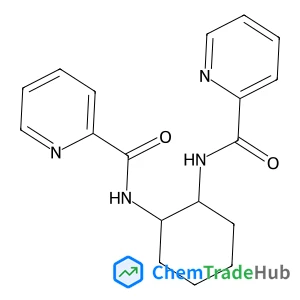
N,N'-(1R,2R)-1,2-Cyclohexanediyldi(2-pyridinecarboxamide)
CAS Number:
218290-24-5
Molecular Formula:
C18H20N4O2
Guixin Li, Hongyan Nan, Xingwang Zheng
A novel space- and time-resolved photo-induced chemiluminescence (PICL) analytical method was developed based on the photocatalysis of the Co2+-doped TiO2 nanoparticles. The PICL reaction procedure under the photocatalysis of Co2+-doped TiO2 nanoparticles was investigated using cyclic voltammetry and potentiometry. Meanwhile, the effect of the electrical double layer outside the Co2+-doped TiO2 nanoparticles on the PICL was investigated by contrasting with the Co2+-doped TiO2–SiO2 core–shell nanoparticles. Significantly, the CL intensity increased apparently and the time of the CL was prolonged in the presence of procaterol hydrochloride because the mechanism of the enhanced PICL reaction may be modified. The route of the PICL was changed due to the participation of the procaterol hydrochloride enriched at the surface of the Co2+-doped TiO2–SiO2 in the PICL reaction, which prolonged the time of the CL reaction and resulted in the long-term PICL. The analytical characteristics of the proposed in-situ PICL method were investigated using the procaterol hydrochloride as the model analyte. The investigation results showed that this new PICL analytical method offered higher sensitivity to the analysis of the procaterol hydrochloride and the PICL intensity was linear with the concentration of the procaterol hydrochloride in the range from ca. 2.0 × 10⁻¹⁰ to 1.0 × 10⁻⁸ g mL−1.

Environmental Toxicology and Pharmacology

Journal of Medical Biochemistry

Journal of Enzyme inhibition and Medicinal Chemistry

Nature Reviews Drug Discovery

Current Pharmaceutical Biotechnology

Foundations of Chemistry

Lab on a Chip

Faraday Discussions

Photochemical & Photobiological Sciences

Physical Chemistry Chemical Physics
DOI: 10.1039/B109522F
R. Tóth, V. Gáspár
DOI: 10.1039/B107627B
Christoffer Johans, Peter Liljeroth, Kyösti Kontturi
DOI: 10.1039/B110182J
T. Griese, S. Kakorin, E. Neumann
DOI: 10.1039/B108193B
Wim G. Roeterdink, Maurice H. M. Janssen
DOI: 10.1039/B107897F
P. Valentin
DOI: 10.1039/B109105K
Thorsten M. Bernhardt, Bernhard Kaiser, Klaus Rademann
DOI: 10.1039/B110194C
G. Billon, B. Ouddane, L. Gengembre, A. Boughriet
DOI: 10.1039/B108638N
6-Bromo-2-methylimidazo[1,2-a]pyrimidine (CAS: 1111638-05-1) falls under various...
While there are no direct alternatives, similar compounds like 1-Pyrrolidineetha...
4-Methyl-2,6-bis(2-methyl-2-propanyl)phenyl methylcarbamate (CAS: 1918-11-2) is ...
2-(3-Bromo-4-fluorophenyl)-1,3-dioxolane (CAS: 77771-04-1) should be stored in a...
4,5,6,7-Tetrahydro-1H-indazole hydrochloride is a white crystalline solid with a...
(2R)-1-Methoxy-3-phenyl-2-propanamine is a chiral organic compound with the CAS ...
Ethyl 1-(1-phenylethyl)-1H-imidazole-5-carboxylate is used in various industries...
4-[(1E,3S)-1-(4-Hydroxyphenyl)-1,4-pentadien-3-yl]phenol (CAS: 17676-24-3) falls...
(S)-3-Amino-5-phenylpentanoic acid hydrochloride is primarily used in the pharma...
7-Methoxy-1-benzothiophene-2-carboxylic acid is typically synthesized by reactin...

Analyst publishes analytical and bioanalytical research that reports premier fundamental discoveries and inventions, and the applications of those discoveries, unconfined by traditional discipline barriers.
![9H-Fluoren-9-ylmethyl {15-[(2,5-dioxo-1-pyrrolidinyl)oxy]-15-oxo-3,6,9,12-tetraoxapentadec-1-yl}carbamate structure](https://static.chemtradehub.com/structs/131/1314378-14-7-4316.webp "9H-Fluoren-9-ylmethyl {15-[(2,5-dioxo-1-pyrrolidinyl)oxy]-15-oxo-3,6,9,12-tetraoxapentadec-1-yl}carbamate structure")