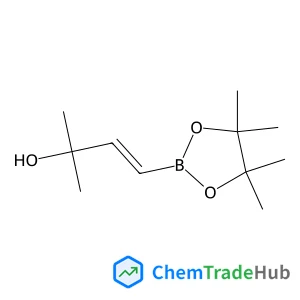
(E)-2-methyl-4-(4,4,5,5-tetramethyl-1,3,2-dioxaborolan-2-yl)but-3-en-2-ol
CAS Number:
581802-26-8
Molecular Formula:
C11H21BO3
Zhaojun Ding, Bin Yao, Jinkui Feng, Jianxin Zhang
A CoCO3–polypyrrole composite (CC–PPy) for lithium ion battery anodes was prepared by first synthesizing urchin-like CoCO3 microspheres (CC) via a hydrothermal route and further modifying them with a PPy coating. The resulting CC–PPy exhibits excellent cycling stability, outstanding rate performance and a great recovery capability compared to CC, delivering a reversible capacity of 1070.7, 811.2, 737.6, 518.7, 504.5 and 559 mA h g−1 after 100 cycles at 0.1, 1, 2, 3, 4 and 5 C, respectively, and a recovery capacity of up to 1787 mA h g−1 after 500 cycles from 1 to 5 C. A more comprehensive lithium storage mechanism of CoCO3 has been proposed to support the experimental data, which includes two-step conversion reactions with a total theoretical value of 7 Li per CoCO3. The ‘first-order’ reaction involves reduction of CoCO3 to metallic Co and the formation of Li2CO3, and the second reaction involves the further reduction of Li2CO3 to LixC2 (x = 0, 1, 2), along with the formation of Li2O. The lithiation and delithiation processes of CC and CC–PPy have been compared based on their potential profiles and CV curves, which show clear two-order character. The kinetic factors for the superior performance of CC–PPy are analyzed based on the Nyquist plots. Furthermore, the transition from CoCO3 to Li2CO3 to Li2O and its reversibility is confirmed by ex situ IR spectra recorded at the different discharge–charge states of CC–PPy.
Anand Babu Velappan, Subhashini Kogatam, Dhrubajyoti Datta, Rakshantha Srithar, Gunasekaran Nanjappan, Joy Debnath
DOI: 10.1039/C9QO00293F
Penglin Wu, Minqiang Jia
DOI: 10.1039/C9QO00192A
Fu-Sheng He, Youqian Wu, Xiaofang Li, Hongguang Xia
DOI: 10.1039/C9QO00300B
Xiaofei Zhang
DOI: 10.1039/C9QO00324J
Daniel Bauer, Beatrice Andrae, Patrick Gaß, Danjano Trenz, Sabine Becker, Stefan Kubik
DOI: 10.1039/C9QO00156E
Bo Wang, Yuankai Wang, Zixuan Wang
DOI: 10.1039/C9QO00403C
Yong You, Jian-Qiang Zhao
DOI: 10.1039/C9QO00347A
Etienne Levernier, Vincent Corcé, Louise-Marie Rakotoarison, Adrien Smith, Mengxue Zhang, Stephanie Ognier, Michael Tatoulian, Cyril Ollivier, Louis Fensterbank
DOI: 10.1039/C9QO00092E
When considering alternatives to 1-(4-Chlorophenyl)-N-hydroxymethanimine (CAS: 3...
This compound should be stored in a cool, dry place away from direct sunlight. I...
3-(4-Bromophenyl)-5-(2-fluorophenyl)-1,2,4-oxadiazole is synthesized through a m...
5-Chloro-2-(4-chlorophenyl)-4-methyl-6-[3-(1-piperidinyl)propoxy]pyrimidine (CAS...
2-Chloro-4-(difluoromethoxy)pyridine is used in the pharmaceutical industry for ...
3-Chloro-6-methylpyridazine (CAS: 1121-79-5) is classified under the Globally Ha...
Several alternatives can be used in the synthesis of Methyl 4,5-dimethyl-2-nitro...
Alternatives to (2E,2'E)-3,3'-(1,4-Phenylene)bisacrylaldehyde include other acry...
3-Amino-5-chloropyridin-2-ol hydrochloride is an organic compound with the CAS n...
When handling 6,7-Difluoro-2,3-dihydro-4H-chromen-4-one, it is essential to wear...

Journal of Materials Chemistry A, B & C cover high quality studies across all fields of materials chemistry. The journals focus on those theoretical or experimental studies that report new understanding, applications, properties and synthesis of materials. The journals have a strong history of publishing quality reports of interest to interdisciplinary communities and providing an efficient and rigorous service through peer review and publication. The journals are led by an international team of Editors-in-Chief and Associate Editors who are all active researchers in their fields. Journal of Materials Chemistry A, B & C are separated by the intended application of the material studied. Broadly, applications in energy and sustainability are of interest to Journal of Materials Chemistry A, applications in biology and medicine are of interest to Journal of Materials Chemistry B, and applications in optical, magnetic and electronic devices are of interest to Journal of Materials Chemistry C. More than one Journal of Materials Chemistry journal may be suitable for certain fields and researchers are encouraged to submit their paper to the journal that they feel best fits for their particular article. Example topic areas within the scope of Journal of Materials Chemistry A are listed below. This list is neither exhaustive nor exclusive. Artificial photosynthesis Batteries Carbon dioxide conversion Catalysis Fuel cells Gas capture/separation/storage Green/sustainable materials Hydrogen generation Hydrogen storage Photocatalysis Photovoltaics Self-cleaning materials Self-healing materials Sensors Supercapacitors Thermoelectrics Water splitting Water treatment