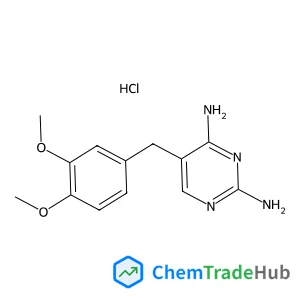
5-(3,4-Dimethoxybenzyl)-2,4-pyrimidinediamine hydrochloride (1:1)
CAS Number:
2507-23-5
Molecular Formula:
C13H17ClN4O2
Rachael E. H. Miles, Jim S. Walker, Daniel R. Burnham, Jonathan P. Reid
The cavity enhanced Raman scattering spectrum recorded from an aerosol droplet provides a unique fingerprint of droplet radius and refractive index, assuming that the droplet is homogeneous in composition. Aerosol optical tweezers are used in this study to capture a single droplet and a Raman fingerprint is recorded using the trapping laser as the source for the Raman excitation. We report here the retrieval of the real part of the refractive index with an uncertainty of ± 0.0012 (better than ± 0.11%), simultaneously measuring the size of the micrometre sized liquid droplet with a precision of better than 1 nm (< ± 0.05% error). In addition, the equilibrium size of the droplet is shown to depend on the laser irradiance due to optical absorption, which elevates the droplet temperature above that of the ambient gas phase. Modulation of the illuminating laser power leads to a modulation in droplet size as the temperature elevation is altered. By measuring induced size changes of <1 nm, we show that the imaginary part of the refractive index can be retrieved even when less than 10 × 10−9 with an accuracy of better than ± 0.5 × 10⁻⁹. The combination of these measurements allows the complex refractive index of a droplet to be retrieved with high accuracy, with the possibility of making extremely sensitive optical absorption measurements on aerosol samples and the testing of frequently used mixing rules for treating aerosol optical properties. More generally, this method provides an extremely sensitive approach for measuring refractive indices, particularly under solute supersaturation conditions that cannot be accessed by simple bulk-phase measurements.
Xiu-ling He, Swarup Majumder, Jiang Wu, Chen-di Jin, Sheng-rong Guo, Zhi-ping Guo, Minghua Yang
DOI: 10.1039/C9QO00350A
Kouya Uchiyama, Hiroshi Ueno, Hiroshi Okada, Hiroshi Moriyama
DOI: 10.1039/C9QO00056A
Huiru Zhang, Nan Sun, Baoxiang Hu, Zhenlu Shen, Xinquan Hu
DOI: 10.1039/C9QO00335E
Wei Shi, Yunfan Yang, Yu Zhao, Yongqing Li
DOI: 10.1039/C9QO00230H
Iryna Vashchenko, Andrii Gerasov, Mykhaylo Vovk, Eduard Rusanov, Volodymyr Fetyukhin, Oleg Lukin
DOI: 10.1039/C9QO00377K
Daniel Bauer, Beatrice Andrae, Patrick Gaß, Danjano Trenz, Sabine Becker, Stefan Kubik
DOI: 10.1039/C9QO90027F
Kuntal Pal, Chandra M. R. Volla
DOI: 10.1039/C7QO00101K
Tianjiao Hou, Jian Zhang, Chenjiao Wang, Jun Luo
DOI: 10.1039/C7QO00357A
Jinzhong Yao, Linlin Chen, Linfeng Hu, Xiaofang Li, Hongwei Zhou
DOI: 10.1039/C9QO00028C
When considering alternatives to 1-(4-Chlorophenyl)-N-hydroxymethanimine (CAS: 3...
This compound should be stored in a cool, dry place away from direct sunlight. I...
3-(4-Bromophenyl)-5-(2-fluorophenyl)-1,2,4-oxadiazole is synthesized through a m...
5-Chloro-2-(4-chlorophenyl)-4-methyl-6-[3-(1-piperidinyl)propoxy]pyrimidine (CAS...
2-Chloro-4-(difluoromethoxy)pyridine is used in the pharmaceutical industry for ...
3-Chloro-6-methylpyridazine (CAS: 1121-79-5) is classified under the Globally Ha...
Several alternatives can be used in the synthesis of Methyl 4,5-dimethyl-2-nitro...
Alternatives to (2E,2'E)-3,3'-(1,4-Phenylene)bisacrylaldehyde include other acry...
3-Amino-5-chloropyridin-2-ol hydrochloride is an organic compound with the CAS n...
When handling 6,7-Difluoro-2,3-dihydro-4H-chromen-4-one, it is essential to wear...

Physical Chemistry Chemical Physics (PCCP) is an international journal co-owned by 19 physical chemistry and physics societies from around the world. This journal publishes original, cutting-edge research in physical chemistry, chemical physics and biophysical chemistry. To be suitable for publication in PCCP, articles must include significant innovation and/or insight into physical chemistry; this is the most important criterion that reviewers and Editors will judge against when evaluating submissions. The journal has a broad scope and welcomes contributions spanning experiment, theory, computation and data science. Topical coverage includes spectroscopy, dynamics, kinetics, statistical mechanics, thermodynamics, electrochemistry, catalysis, surface science, quantum mechanics, quantum computing and machine learning. Interdisciplinary research areas such as polymers and soft matter, materials, nanoscience, energy, surfaces/interfaces, and biophysical chemistry are welcomed if they demonstrate significant innovation and/or insight into physical chemistry. Joined experimental/theoretical studies are particularly appreciated when complementary and based on up-to-date approaches.
![4-[(3-Chloro-2-fluorophenyl)amino]-7-methoxy-6-quinazolinyl acetate structure](https://static.chemtradehub.com/structs/740/740081-22-5-f58f.webp "4-[(3-Chloro-2-fluorophenyl)amino]-7-methoxy-6-quinazolinyl acetate structure")