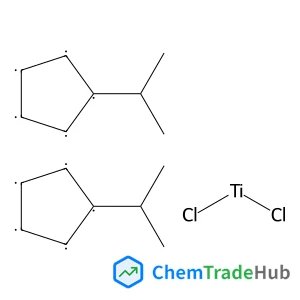
BIS(I-PROPYLCYCLOPENTADIENYL)TITANIUM DICHLORIDE
CAS Number:
12130-65-3
Molecular Formula:
C16H22Cl2Ti
Marat A. Ziganshin, Aisylu S. Safiullina, Sufia A. Ziganshina, Alexander V. Gerasimov, Valery V. Gorbatchuk
The non-zeolitic behavior of L-leucyl–L-leucine and its self-organization in solid state and from solutions with the formation of different nanostructures are reported. This dipeptide forms porous crystals, but does not exhibit molecular sieve effects typical of classical zeolites and biozeolites. The specific sorption properties of L-leucyl–L-leucine result from a change in its crystal packing from channel-type to layered-type, when binding strong proton acceptors or proton donors of molecular size greater than 18–20 cm3 mol−1. The high sorption capacity of L-leucyl–L-leucine toward dichloromethane results from the self-organization of the dipeptide, by forming nanofibers or web-like structures. The low thermal stability of clathrates of the dipeptide containing large guest molecules and the selectivity of L-leucyl–L-leucine toward alcohols over nitriles can be used to separate organic mixtures such as methanol/n-butanol and methanol/acetonitrile.
Karan Bobuatong, Sangita Karanjit, Hidehiro Sakurai
DOI: 10.1039/C2CP23446G
Sachin Chavan, Jenny G. Vitillo, Diego Gianolio, Olena Zavorotynska, Bartolomeo Civalleri, Søren Jakobsen, Merete H. Nilsen, Loredana Valenzano, Carlo Lamberti, Karl Petter Lillerud, Silvia Bordiga
DOI: 10.1039/C1CP23434J
DOI: 10.1039/C2CP23499H
Yuqing Xu, Bin Cui, Guomin Ji, Dongmei Li
DOI: 10.1039/C2CP41480E
Christopher E. Hamilton, Dennis J. Flood
DOI: 10.1039/C3CP50435B
Jinsoo Kim, Hee-Dae Lim, Hyeokjo Gwon, Kisuk Kang
DOI: 10.1039/C3CP43225D
Benjamin N. Moore, Ryan R. Julian
DOI: 10.1039/C2CP23443B
Shashi Kant Shukla, Nageshwar D. Khupse, Anil Kumar
DOI: 10.1039/C2CP23256A
Fan Jiang, Wei Han
DOI: 10.1039/C2CP43633G
Xiaoming Wen, Amit Sitt, Pyng Yu, Yon-Rui Toh, Jau Tang
DOI: 10.1039/C2CP23844F
2-Methylbenzene-1,4-diamine dihydrochloride (CAS: 615-45-2) should be stored in ...
(1S,4S)-2,5-Diazabicyclo[2.2.1]heptane dihydrobromide is generally considered sa...
(6-Chloropyridazin-3-YL)methanamine finds applications in the pharmaceutical ind...
2-Fluoro-3-methylphenol is primarily used in the synthesis of pharmaceuticals, p...
When handling 3-Methoxy-4-nitrobenzonitrile, it is important to wear appropriate...
When handling 1,3-Oxazolo[4,5-b]pyridine-2(3H)-thione (CAS: 211949-57-4), it is ...
4-Ethynylbenzamide (CAS: 90347-86-7) falls under various regulatory guidelines i...
3-(2-Ethylphenyl)-2-thioxo-4-imidazolidinone is primarily used as an intermediat...
(2-Fluoro-6-methoxyphenyl)acetic acid, also known as 4-fluoro-3-methoxybenzoic a...
Market trends for 2-[4-(Hydroxymethyl)phenoxy]ethanol (CAS: 102196-18-9) indicat...

Physical Chemistry Chemical Physics (PCCP) is an international journal co-owned by 19 physical chemistry and physics societies from around the world. This journal publishes original, cutting-edge research in physical chemistry, chemical physics and biophysical chemistry. To be suitable for publication in PCCP, articles must include significant innovation and/or insight into physical chemistry; this is the most important criterion that reviewers and Editors will judge against when evaluating submissions. The journal has a broad scope and welcomes contributions spanning experiment, theory, computation and data science. Topical coverage includes spectroscopy, dynamics, kinetics, statistical mechanics, thermodynamics, electrochemistry, catalysis, surface science, quantum mechanics, quantum computing and machine learning. Interdisciplinary research areas such as polymers and soft matter, materials, nanoscience, energy, surfaces/interfaces, and biophysical chemistry are welcomed if they demonstrate significant innovation and/or insight into physical chemistry. Joined experimental/theoretical studies are particularly appreciated when complementary and based on up-to-date approaches.
![(1R,6R)-6-({[(2-Methyl-2-propanyl)oxy]carbonyl}amino)-3-cyclohexene-1-carboxylic acid structure](https://static.chemtradehub.com/structs/865/865689-24-3-5fef.webp "(1R,6R)-6-({[(2-Methyl-2-propanyl)oxy]carbonyl}amino)-3-cyclohexene-1-carboxylic acid structure")