












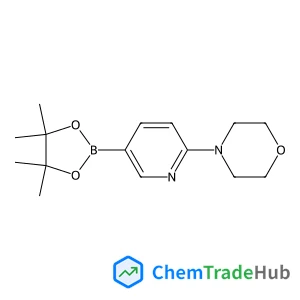
4-(5-(4,4,5,5-tetramethyl-1,3,2-dioxaborolan-2-yl)pyridin-2-yl)morpholine
CAS Number:
485799-04-0
Molecular Formula:
C15H23BN2O3
Ewelina Krzyszkowska, Justyna Walkowiak-Kulikowska, Sven Stienen, Aleksandra Wojcik
Graphene oxide sheets (GO) were covalently functionalized with thionine molecules. The obtained hybrid material, Th–GO, was characterized by means of scanning electron microscopy (SEM), Auger electron spectroscopy (AES), Fourier transform infrared spectroscopy (FTIR) and Raman spectroscopy. Subsequently, the interaction of light with the free dye molecules and with dye molecules bound to the graphene oxide sheets was probed via UV-Vis spectroscopy, fluorescence spectroscopy and femtosecond pump–probe spectroscopy. The experimental results proved that thionine was successfully grafted onto the GO sheets, however, only one of the two amino groups of thionine was always involved in the amide bond formation. The Th–GO hybrid suspended in N,N-dimethylformamide (DMF) exhibited suppressed fluorescence as compared to the free dye in the same solvent, pointing to an efficient interaction between the photoexcited dye and the graphene sheets. Yet, no electron transfer products were detected by transient absorption measurements, even though there was a shortening of the singlet excited state lifetime of thionine (from the 567 ps for the free dye to the 313 ps for the dye in Th–GO). These results can be rationalized in terms of a fast back electron transfer process or possibly an energy transfer process.
David A. Russell, Julien J. Freudenreich, Hannah L. Stewart, Andrew D. Bond, Hannah F. Sore, David R. Spring
DOI: 10.1039/C8OB01919C
DOI: 10.1039/C8OB00504D
Stéphane Sengmany, Anthony Ollivier, Erwan Le Gall, Eric Léonel
DOI: 10.1039/C8OB00500A
Zhen-Yuan Liao, Wen-Hsiung Yeh, Pen-Yuan Liao, Yu-Ting Liu, Ying-Cheng Chen, Yi-Hung Chen, Tsung-Han Hsieh, Chia-Chi Lin, Ming-Hsuan Lu, Yi-Song Chen, Ming-Chih Hsu, Tsai-Kun Li, Tun-Cheng Chien
DOI: 10.1039/C8OB00624E
Xie-Huang Sheng, Cheng-Cheng Cui, Chao Shan, Yu-Zhen Li, Duo-Hong Sheng, Bin Sun, De-Zhan Chen
DOI: 10.1039/C8OB00546J
Xiao-Lan Liu, Luo-Bin Jiang, Mu-Peng Luo, Zhi Ren, Shou-Guo Wang
DOI: 10.1039/D1QO01223A
Jingyang Zhang, Yumiao Ma, Ke Qiu, Bo Li, Zhengwen Xue, Boxue Tian, Yefeng Tang
DOI: 10.1039/D1QO01591E
Viktoria Kahlert, Oliver Ohlenschläger, Jelena Melesina, Christian Lücke
DOI: 10.1039/C8OB00980E
Na Luo, Zhen-Wei Sun, Xing-Xin Xu, Xiao-Qiang Hu, Feng-Cheng Jia
DOI: 10.1039/D1QO01280K
(1R,3S)-1,3-Cyclopentanediol finds applications in various industries. In the ph...
When handling N'-[4-(Dimethylamino)phenyl]-N,N-dimethyl-1,4-benzenediamine, it i...
There are several alternatives to 5-(2,4-Difluorophenyl)-2-methoxypyrimidine in ...
1-(3-Methoxyphenoxy)propan-2-ol (CAS: 382141-68-6) must comply with the Globally...
Tetrodotoxin Citrate is extremely dangerous and should be handled with extreme c...
2-Methyl-2-propanyl [(1R,3S)-3-hydroxycyclopentyl]carbamate (CAS: 225641-84-9) i...
Waste containing 4-(2-Hydroxyhexafluoroisopropyl)Benzoic Acid (CAS: 16261-80-6) ...
2-Methyl-2-proanyl {(2S)-1-[(benzyloxy)amino]-3-hydroxy-3-methyl-1-oxo-2-butanyl...
Benzeneethanamine, α-ethyl-, hydrochloride (1:1) is an organic compound with the...
In the synthesis of compounds similar to 3-{(E)-[4-(Dimethylamino)phenyl]diazeny...

Physical Chemistry Chemical Physics (PCCP) is an international journal co-owned by 19 physical chemistry and physics societies from around the world. This journal publishes original, cutting-edge research in physical chemistry, chemical physics and biophysical chemistry. To be suitable for publication in PCCP, articles must include significant innovation and/or insight into physical chemistry; this is the most important criterion that reviewers and Editors will judge against when evaluating submissions. The journal has a broad scope and welcomes contributions spanning experiment, theory, computation and data science. Topical coverage includes spectroscopy, dynamics, kinetics, statistical mechanics, thermodynamics, electrochemistry, catalysis, surface science, quantum mechanics, quantum computing and machine learning. Interdisciplinary research areas such as polymers and soft matter, materials, nanoscience, energy, surfaces/interfaces, and biophysical chemistry are welcomed if they demonstrate significant innovation and/or insight into physical chemistry. Joined experimental/theoretical studies are particularly appreciated when complementary and based on up-to-date approaches.
![N-[(1S,2R,4S)-2-Amino-4-(dimethylcarbamoyl)cyclohexyl]-N'-(5-chloro-2-pyridinyl)ethanediamide structure](https://static.chemtradehub.com/structs/480/480452-37-7-0898.webp "N-[(1S,2R,4S)-2-Amino-4-(dimethylcarbamoyl)cyclohexyl]-N'-(5-chloro-2-pyridinyl)ethanediamide structure")


