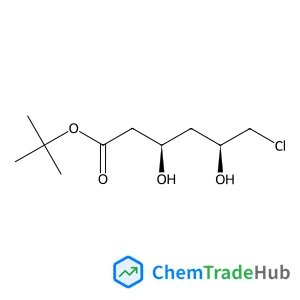
2-Methyl-2-propanyl (3R,5S)-6-chloro-3,5-dihydroxyhexanoate
CAS Number:
154026-93-4
Molecular Formula:
C10H19ClO4
Zhen-Yuan Liao, Wen-Hsiung Yeh, Pen-Yuan Liao, Yu-Ting Liu, Ying-Cheng Chen, Yi-Hung Chen, Tsung-Han Hsieh, Chia-Chi Lin, Ming-Hsuan Lu, Yi-Song Chen, Ming-Chih Hsu, Tsai-Kun Li, Tun-Cheng Chien
The reaction of methyl anthranilates with N-arylcyanamides in the presence of p-TsOH in t-BuOH under reflux afforded predominantly 3-arylquinazolin-4-ones. In contrast, the reaction of the same reactants with TMSCl in t-BuOH at 60 °C followed by the Dimroth rearrangement in aqueous ethanolic sodium hydroxide gave exclusively the regioisomers, 2-(N-arylamino)quinazolin-4-ones. The regioselective synthesis of N-aryl-substituted 2-aminoquinazolin-4-ones can be further applied to the synthesis of benzimidazo[2,1-b]quinazolin-12-ones.
Yi Han, Guobao Li, Lingling Liu, Chenyang Dai, Da-Qing Shi, Yingsheng Zhao
DOI: 10.1039/D0QO00402B
Zhili Chen, Hui Mao, Fangli Hu, Dongmei Li, Yu Tan, Fengqing Yang, Wenling Qin
DOI: 10.1039/C8OB02967A
Bang Li, Qi Mao, Jia Zhou, Feng Liu, Na Ye
DOI: 10.1039/C8OB03073A
Xuelan Wen, Chang-Qiang Ke, Tian Zhang, Ligen Lin, Sheng Yao, Jason D. Goodpaster, Chunping Tang
DOI: 10.1039/D0QO00093K
Fei Meng, Qin Fang, Weidong Yuan, Ning Xu, Shujun Cao, Jianlin Chun, Jie Li, Honglin Zhang, Yingguang Zhu
DOI: 10.1039/D0QO00282H
Elena Lenci, Fernanda I. Saldívar-Gonzalez, José L. Medina-Franco
DOI: 10.1039/C8OB02808G
Huiqing Chen, Jia Xie, Dong Xing, Jinping Wang, Jie Tang, Zhengfang Yi, Fei Xia, Wen-Wei Qiu, Fan Yang
DOI: 10.1039/C8OB02761G
Alejandra Chávez-Riveros, Eduardo Hernández-Vázquez, Antonio Nieto-Camacho, Teresa Ramírez-Apan, Luis D. Miranda
DOI: 10.1039/C8OB03121E
Luyao Li, Bo Zhu, Huihui Fan, Zhiyong Jiang, Junbiao Chang
DOI: 10.1039/D0QO00348D
Karen de la Vega-Hernández, Raffaele Senatore, Margherita Miele, Ernst Urban, Wolfgang Holzer, Vittorio Pace
DOI: 10.1039/C8OB02312C
(1R,3S)-1,3-Cyclopentanediol finds applications in various industries. In the ph...
When handling N'-[4-(Dimethylamino)phenyl]-N,N-dimethyl-1,4-benzenediamine, it i...
There are several alternatives to 5-(2,4-Difluorophenyl)-2-methoxypyrimidine in ...
1-(3-Methoxyphenoxy)propan-2-ol (CAS: 382141-68-6) must comply with the Globally...
Tetrodotoxin Citrate is extremely dangerous and should be handled with extreme c...
2-Methyl-2-propanyl [(1R,3S)-3-hydroxycyclopentyl]carbamate (CAS: 225641-84-9) i...
Waste containing 4-(2-Hydroxyhexafluoroisopropyl)Benzoic Acid (CAS: 16261-80-6) ...
2-Methyl-2-proanyl {(2S)-1-[(benzyloxy)amino]-3-hydroxy-3-methyl-1-oxo-2-butanyl...
Benzeneethanamine, α-ethyl-, hydrochloride (1:1) is an organic compound with the...
In the synthesis of compounds similar to 3-{(E)-[4-(Dimethylamino)phenyl]diazeny...

Organic & Biomolecular Chemistry (OBC) publishes original and high impact research and reviews in organic chemistry. We welcome research that shows new or significantly improved protocols or methodologies in total synthesis, synthetic methodology or physical and theoretical organic chemistry as well as research that shows a significant advance in the organic chemistry or molecular design aspects of chemical biology, catalysis, supramolecular and macromolecular chemistry, theoretical chemistry, mechanism-oriented physical organic chemistry, medicinal chemistry or natural products. Articles published in the journal should report new work which makes a highly-significant impact in the field. Routine and incremental work is generally not suitable for publication in the journal. More details about key areas of our scope are below. In all cases authors should include in their article clear rationale for why their research has been carried out.
![N,N'-1,2-Ethanediylbis[2-(vinylsulfonyl)acetamide] structure](https://static.chemtradehub.com/structs/667/66710-66-5-b556.webp "N,N'-1,2-Ethanediylbis[2-(vinylsulfonyl)acetamide] structure")