












Binary twinned-icosahedral [B21H18]− interacts with cyclodextrins as a precedent for its complexation with other organic motifs
Literature Information
Publication Date
2017-04-19
DOI
10.1039/C7CP01074E
Impact Factor
3.676
Authors
Eduard Bernhardt, Juan Z. Dávalos, Martin Lepšík, Khaleel I. Assaf, Werner M. Nau, Josef Holub, Josep M. Oliva-Enrich, Jindřich Fanfrlík, Drahomír Hnyk
View Original
Abstract
The weakly coordinating binary macropolyhedral anion closo,closo-[B21H18]− (B21; D3h symmetry) has been synthesized using a simplified strategy compared to that in the literature. While gas-phase complexes of B21 with β- and γ-cyclodextrin (CD) were detected using ESI FT-ICR spectrometric measurements, α-CD did not bind to the B21 guest. This spectroscopic evidence has been interpreted using quantum-chemical computations, showing that β- and γ-CD are able to interact with B21 due to their larger cavities, in contrast to the smaller α-CD. The hydridic B–H vectors of the B21 anion interact with K+ counterions and, via dihydrogen bonding, also with the partially positively charged hydrogens of the CD sugar units in the modeled β- and γ-CD complexes. In summary, it has been shown by combined spectrometric/computational analysis that macropolyhedral boron hydride anions with two counterions can form stable complexes with β- and γ-CD in the gas phase, offering a new perspective for the future investigation of this remarkable anion in the areas of supramolecular and medicinal chemistries.
Recommended Journals
Related Literature
Computational and experimental studies on Cu/Au-catalyzed stereoselective synthesis of 1,3-disubstituted allenes
María Magdalena Cid, María Lago-Silva, Marta González Comesaña, Olalla Nieto Faza, Carlos Silva López
2019-04-16
Research Article
DOI: 10.1039/C9QO00364A
I2-Catalyzed sulfenylation of indoles and pyrroles using triethylammonium thiolates as sulfenylating agents
Wei Fan, Zhen Yang
2017-02-20
Research Article
DOI: 10.1039/C6QO00851H
Oxidative dual C–H selenation of imidazoheterocycles with ethers or alkanes using selenium powder via a radical pathway
Tao Guo, Xu-Ning Wei, Yu Liu, Pan-Ke Zhang, Yun-Hui Zhao
2019-03-12
Research Article
DOI: 10.1039/C9QO00198K
A biomimetic strategy for the selective recognition of organophosphates in 100% water: synergies of electrostatic interactions, cavity embedment and metal coordination
Solène Collin, Nicolas Giraud, Elise Dumont, Olivia Reinaud
2019-04-01
Research Article
DOI: 10.1039/C9QO00263D
Highly soluble C2v-symmetrical fullerene derivatives: efficient synthesis, characterization, and electrochemical study
Kouya Uchiyama, Hiroshi Ueno, Hiroshi Okada, Hiroshi Moriyama
2019-02-05
Research Article
DOI: 10.1039/C9QO00056A
A hexameric resorcinarene capsule as a hydrogen bonding catalyst in the conjugate addition of pyrroles and indoles to nitroalkenes
Stefania Gambaro, Margherita De Rosa, Annunziata Soriente, Carmen Talotta, Giuseppe Floresta, Antonio Rescifina, Carmine Gaeta, Placido Neri
2019-05-01
Research Article
DOI: 10.1039/C9QO00224C
Visible-light-mediated hydrodehalogenation and Br/D exchange of inactivated aryl and alkyl halides with a palladium complex
Jia-Hui Zhao, Xue-Ya Gou, Xi-Meng Chen, Yong-Min Liang
2019-03-28
Research Article
DOI: 10.1039/C9QO00240E
Correction: The absolute configurations of hyperilongenols A–C: rare 12,13-seco-spirocyclic polycyclic polyprenylated acylphloroglucinols with enolizable β,β′-tricarbonyl systems from Hypericum longistylum Oliv.
Na Zhang, Zhengyi Shi, Yi Guo, Shuangshuang Xie, Yuben Qiao, Xiao-Nian Li, Yongbo Xue, Zengwei Luo, Hucheng Zhu, Chunmei Chen, Yonghui Zhang
2019-04-30
Correction
DOI: 10.1039/C9QO90045D
Palladium-catalyzed diastereo- and enantioselective formal [3 + 2] cycloaddition of vinyl cyclopropanes with cyclic 1-azadienes
Qing Zhou, Bo Chen, Xiao-Bing Huang, Ya-Li Zeng, Wen-Dao Chu, Quan-Zhong Liu
2019-04-15
Research Article
DOI: 10.1039/C9QO00325H
Facile synthesis of 2-(2-aminobenzoyl)benzoic acids via a base-promoted aerobic cascade reaction
Yangxin Chen, Ting Chen, Zhongai Zou, Yadong Feng, Qihua You
2019-03-05
Research Article
DOI: 10.1039/C9QO00101H
You might also like
Compound Q&A
Are there alternatives to 1-(4-Chlorophenyl)-N-hydroxymethanimine (CAS: 3848-36-0) in synthesis?
When considering alternatives to 1-(4-Chlorophenyl)-N-hydroxymethanimine (CAS: 3...
3848-36-01-(4-Chlorophenyl)-N...
Compound Q&A
How should (1R,9S,10S,12S,14E,16S,19R,20R,21S,22R)-3,9,21-Trihydroxy-5,10,12,14,16,20,22-heptamethyl-23,24-dioxatetracyclo[17.3.1.1~6,9~.0~2,7~]tetracosa-2,5,7,14-tetraen-4-one (CAS: 183202-73-5) be stored?
This compound should be stored in a cool, dry place away from direct sunlight. I...
183202-73-5(1R,9S,10S,12S,14E,1...
Compound Q&A
How is 3-(4-Bromophenyl)-5-(2-fluorophenyl)-1,2,4-oxadiazole (CAS: 419553-16-5) typically synthesized?
3-(4-Bromophenyl)-5-(2-fluorophenyl)-1,2,4-oxadiazole is synthesized through a m...
419553-16-53-(4-Bromophenyl)-5-...
Compound Q&A
How is 5-Chloro-2-(4-chlorophenyl)-4-methyl-6-[3-(1-piperidinyl)propoxy]pyrimidine (CAS: 1639220-19-1) typically synthesized?
5-Chloro-2-(4-chlorophenyl)-4-methyl-6-[3-(1-piperidinyl)propoxy]pyrimidine (CAS...
1639220-19-15-Chloro-2-(4-chloro...
Compound Q&A
What industries use 2-Chloro-4-(difluoromethoxy)pyridine (CAS: 1206978-15-5)?
2-Chloro-4-(difluoromethoxy)pyridine is used in the pharmaceutical industry for ...
1206978-15-52-Chloro-4-(difluoro...
Compound Q&A
What regulatory guidelines apply to 3-Chloro-6-methylpyridazine (CAS: 1121-79-5)?
3-Chloro-6-methylpyridazine (CAS: 1121-79-5) is classified under the Globally Ha...
1121-79-53-Chloro-6-methylpyr...
Compound Q&A
Are there alternatives to Methyl 4,5-dimethyl-2-nitrobenzoate in synthesis?
Several alternatives can be used in the synthesis of Methyl 4,5-dimethyl-2-nitro...
90922-74-0Methyl 4,5-dimethyl-...
Compound Q&A
Are there alternatives to (2E,2'E)-3,3'-(1,4-Phenylene)bisacrylaldehyde in synthesis?
Alternatives to (2E,2'E)-3,3'-(1,4-Phenylene)bisacrylaldehyde include other acry...
63405-68-5(2E,2'E)-3,3'-(1,4-P...
Compound Q&A
What is 3-Amino-5-chloropyridin-2-ol hydrochloride (CAS: 1261906-29-9)?
3-Amino-5-chloropyridin-2-ol hydrochloride is an organic compound with the CAS n...
1261906-29-93-Amino-5-chloropyri...
Compound Q&A
What precautions should be taken when handling 6,7-Difluoro-2,3-dihydro-4H-chromen-4-one (CAS: 1092349-93-3)?
When handling 6,7-Difluoro-2,3-dihydro-4H-chromen-4-one, it is essential to wear...
1092349-93-36,7-Difluoro-2,3-dih...
Source Journal
Physical Chemistry Chemical Physics

CiteScore:
5.5
Self-citation Rate:
10.3%
Articles per Year:
3036
Physical Chemistry Chemical Physics (PCCP) is an international journal co-owned by 19 physical chemistry and physics societies from around the world. This journal publishes original, cutting-edge research in physical chemistry, chemical physics and biophysical chemistry. To be suitable for publication in PCCP, articles must include significant innovation and/or insight into physical chemistry; this is the most important criterion that reviewers and Editors will judge against when evaluating submissions. The journal has a broad scope and welcomes contributions spanning experiment, theory, computation and data science. Topical coverage includes spectroscopy, dynamics, kinetics, statistical mechanics, thermodynamics, electrochemistry, catalysis, surface science, quantum mechanics, quantum computing and machine learning. Interdisciplinary research areas such as polymers and soft matter, materials, nanoscience, energy, surfaces/interfaces, and biophysical chemistry are welcomed if they demonstrate significant innovation and/or insight into physical chemistry. Joined experimental/theoretical studies are particularly appreciated when complementary and based on up-to-date approaches.
Recommended Compounds
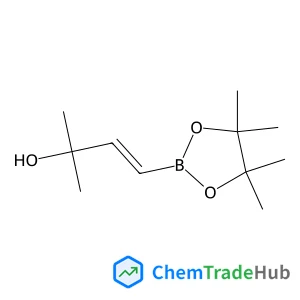
(E)-2-methyl-4-(4,4,5,5-tetramethyl-1,3,2-dioxaborolan-2-yl)but-3-en-2-ol
CAS Number:
581802-26-8
Molecular Formula:
C11H21BO3
Recommended Suppliers





Disclaimer
This page provides academic journal information for reference and research purposes only. We are not affiliated with any journal publishers and do not handle publication submissions. For publication-related inquiries, please contact the respective journal publishers directly.
If you notice any inaccuracies in the information displayed, please contact us at support@chemtradehub.com. We will promptly review and address your concerns.