












Computational and experimental studies on Cu/Au-catalyzed stereoselective synthesis of 1,3-disubstituted allenes
Literature Information
Publication Date
2019-04-16
DOI
10.1039/C9QO00364A
Impact Factor
5.281
Authors
María Magdalena Cid, María Lago-Silva, Marta González Comesaña, Olalla Nieto Faza, Carlos Silva López
View Original
Abstract
Cu- and Au-mediated formation of allenes from terminal alkynes and aldehydes via propargylamine intermediates is hampered by reversibility in the propargylamine formation. The use of a stable Au(I) catalyst in the reaction using a chiral propargylamine provided clues to disentangle the mechanism of the whole process that would have been otherwise hidden. Additionally, the process was observed to be stereoselective when an enantiomerically pure chiral propargylamine was used as starting substrate providing the corresponding 1,3-disubstituted allenes with high enantiomeric ratio.
Recommended Journals
Related Literature
The unexpected behaviour of epoxidised macromonomers derived from catalytic chain transfer during ring opening copolymerisation
Bas G. P. van Ravensteijn, Robbert Duchateau, Johan P. A. Heuts
2012-05-25
Paper
DOI: 10.1039/C2PY20195J
Poly(ethylene) brushes grafted to silicon substrates
Denis Damiron, Jérôme Mazzolini, Fabrice Cousin, Christophe Boisson, Franck D'Agosto, Eric Drockenmuller
2011-11-24
Paper
DOI: 10.1039/C1PY00459J
Functional galactomannan platform from convenient esterification in imidazolium-based ionic liquids
2011-12-23
Paper
DOI: 10.1039/C2PY00512C
Functional conjugated microporous polymers: from 1,3,5-benzene to 1,3,5-triazine
Shijie Ren, Robert Dawson, Andrea Laybourn, Jia-xing Jiang, Yaroslav Khimyak, Dave J. Adams, Andrew I. Cooper
2012-01-30
Paper
DOI: 10.1039/C2PY00585A
Synthesis of cyclic amphiphilic homopolymers and their potential application as polymeric micelles
Boyd A. Laurent, Scott M. Grayson
2011-10-19
Paper
DOI: 10.1039/C1PY00378J
Synthesis and post-polymerization modification of poly(pentafluorophenyl methacrylate) brushes
Kemal Arda Günay, Nicolas Schüwer, Harm-Anton Klok
2012-05-02
Paper
DOI: 10.1039/C2PY20162C
Benzoxazine-based phosphinated bisphenols and their application in preparing flame-retardant, low dielectric cyanate ester thermosets
Hou Chien Chang, Hung Tse Lin, Ching Hsuan Lin
2012-02-01
Paper
DOI: 10.1039/C2PY00528J
Emulsifier-free, organotellurium-mediated living radical emulsion polymerization (emulsion TERP) of methyl methacrylate with dimethyl ditelluride as the catalyst
Yukiya Kitayama, Hirotaka Moribe, Kazuya Kishida
2012-03-30
Paper
DOI: 10.1039/C2PY20105D
You might also like
Compound Q&A
Are there alternatives to 1-(4-Chlorophenyl)-N-hydroxymethanimine (CAS: 3848-36-0) in synthesis?
When considering alternatives to 1-(4-Chlorophenyl)-N-hydroxymethanimine (CAS: 3...
3848-36-01-(4-Chlorophenyl)-N...
Compound Q&A
How should (1R,9S,10S,12S,14E,16S,19R,20R,21S,22R)-3,9,21-Trihydroxy-5,10,12,14,16,20,22-heptamethyl-23,24-dioxatetracyclo[17.3.1.1~6,9~.0~2,7~]tetracosa-2,5,7,14-tetraen-4-one (CAS: 183202-73-5) be stored?
This compound should be stored in a cool, dry place away from direct sunlight. I...
183202-73-5(1R,9S,10S,12S,14E,1...
Compound Q&A
How is 3-(4-Bromophenyl)-5-(2-fluorophenyl)-1,2,4-oxadiazole (CAS: 419553-16-5) typically synthesized?
3-(4-Bromophenyl)-5-(2-fluorophenyl)-1,2,4-oxadiazole is synthesized through a m...
419553-16-53-(4-Bromophenyl)-5-...
Compound Q&A
How is 5-Chloro-2-(4-chlorophenyl)-4-methyl-6-[3-(1-piperidinyl)propoxy]pyrimidine (CAS: 1639220-19-1) typically synthesized?
5-Chloro-2-(4-chlorophenyl)-4-methyl-6-[3-(1-piperidinyl)propoxy]pyrimidine (CAS...
1639220-19-15-Chloro-2-(4-chloro...
Compound Q&A
What industries use 2-Chloro-4-(difluoromethoxy)pyridine (CAS: 1206978-15-5)?
2-Chloro-4-(difluoromethoxy)pyridine is used in the pharmaceutical industry for ...
1206978-15-52-Chloro-4-(difluoro...
Compound Q&A
What regulatory guidelines apply to 3-Chloro-6-methylpyridazine (CAS: 1121-79-5)?
3-Chloro-6-methylpyridazine (CAS: 1121-79-5) is classified under the Globally Ha...
1121-79-53-Chloro-6-methylpyr...
Compound Q&A
Are there alternatives to Methyl 4,5-dimethyl-2-nitrobenzoate in synthesis?
Several alternatives can be used in the synthesis of Methyl 4,5-dimethyl-2-nitro...
90922-74-0Methyl 4,5-dimethyl-...
Compound Q&A
Are there alternatives to (2E,2'E)-3,3'-(1,4-Phenylene)bisacrylaldehyde in synthesis?
Alternatives to (2E,2'E)-3,3'-(1,4-Phenylene)bisacrylaldehyde include other acry...
63405-68-5(2E,2'E)-3,3'-(1,4-P...
Compound Q&A
What is 3-Amino-5-chloropyridin-2-ol hydrochloride (CAS: 1261906-29-9)?
3-Amino-5-chloropyridin-2-ol hydrochloride is an organic compound with the CAS n...
1261906-29-93-Amino-5-chloropyri...
Compound Q&A
What precautions should be taken when handling 6,7-Difluoro-2,3-dihydro-4H-chromen-4-one (CAS: 1092349-93-3)?
When handling 6,7-Difluoro-2,3-dihydro-4H-chromen-4-one, it is essential to wear...
1092349-93-36,7-Difluoro-2,3-dih...
Source Journal
Organic Chemistry Frontiers

CiteScore:
7.8
Self-citation Rate:
8.7%
Articles per Year:
724
Organic Chemistry Frontiers publishes high-quality research from across organic chemistry. Emphases are placed on studies that make significant contributions to the field of organic chemistry by reporting either new or significantly improved protocols or methodologies. Topics include, but are not limited to the following: Organic synthesis Development of synthetic methodologies Catalysis Natural products Functional organic materials Supramolecular and macromolecular chemistry Physical and computational organic chemistry
Recommended Compounds
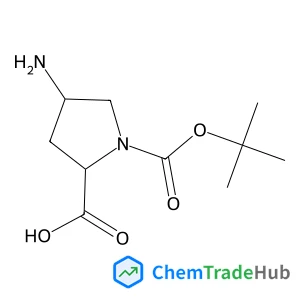
(2R,4R)-1-Boc-4-Aminopyrrolidine-2-carboxylic acid
CAS Number:
132622-98-1
Molecular Formula:
C10H18N2O4
![[4-(Isobutyrylamino)phenyl]boronic acid structure](https://static.chemtradehub.com/structs/874/874219-50-8-6ab5.webp "[4-(Isobutyrylamino)phenyl]boronic acid structure")
Recommended Suppliers






Disclaimer
This page provides academic journal information for reference and research purposes only. We are not affiliated with any journal publishers and do not handle publication submissions. For publication-related inquiries, please contact the respective journal publishers directly.
If you notice any inaccuracies in the information displayed, please contact us at support@chemtradehub.com. We will promptly review and address your concerns.