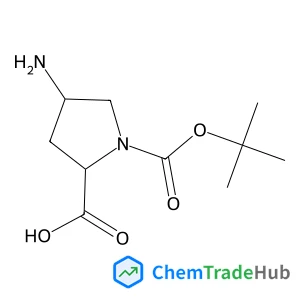
(2R,4R)-1-Boc-4-Aminopyrrolidine-2-carboxylic acid
CAS Number:
132622-98-1
Molecular Formula:
C10H18N2O4
Solène Collin, Nicolas Giraud, Elise Dumont, Olivia Reinaud
Phosphate recognition in water is a hot topic due to their importance in biology and environment. The design and conception of water-soluble receptors that are efficient and selective is a difficult task because of the water medium, which provides highly competitive electrostatic interactions. A possible strategy relies on multipoint recognition with a polycationic site for electrostatic interaction with the phosphate moiety and a hydrophobic cavity for the organic one. Following this strategy, a detailed study of the hosting properties of a water-soluble resorcinarene-based metallo-cavitand, WRim4Zn, with various organophosphates is presented. The ZnII receptor showed good affinity and selectivity for n-alkyl phosphates (CnP) having from 2 to 6 carbons, in 100% water at physiological pH. The strongest association was obtained with C6P [K′pD7.4 = 3.6 × 10⁴ M−1] whereas C7P binds 100 times less strongly. This very sharp selectivity pattern stands in strong contrast with carboxylate guests for which the optimum size corresponds to acetate. The different selectivity pattern stems from a switch in the coordination mode of ZnII upon phosphate binding, inducing the decoordination of two out of the four imidazole arms grafted on the resorcinarene macrocycle. Hence, the efficiency of WRim4Zn for alkyl phosphate recognition and unusual selectivity relative to the organic moiety of the phosphate analytes is ascribed to the synergistic action of a metal binding site for the phosphate head (the ZnII receptor is 100 times more efficient than the cavity ligand WRim4 itself), a hydrophobic cavity for alkyl embedment, protonated arms leading to further electrostatic stabilization, spacers between the recognition points (ZnII, imidazoliums, resorcinarene bowl cavity) allowing directional and spatial control of guest binding. Another key point is the water-solubility of the hydrophobic core insured by the pyridinium feet positioned away from the receptacle, which avoids the destructuring of the receptor metallo-site. Phosphodiesters, which are singly charged and congested, are not recognized. Hence, the good affinity displayed for C6P makes WRim4Zn one of the best cavity-based receptor for organophosphates described to date. These results open new routes for sensing biologically and environmentally important organic anions, considering the tunability of the functionalization pattern of the resorcinarene core.
Wei-Hsun Hu, Kai-Wei Huang, Shiao-Wei Kuo
DOI: 10.1039/C2PY20090B
Shogo Takamuku, Patric Jannasch
DOI: 10.1039/C2PY00611A
Shadi Houshyar, Daniel J. Keddie, Graeme Moad, Roger J. Mulder, Simon Saubern, John Tsanaktsidis
DOI: 10.1039/C2PY00529H
Lie Chen, Fan Li, Xingye Ren, Hongming Wang, Yongfang Li
DOI: 10.1039/C2PY00523A
Tomohito Ogura, Yuta Saito, Tomoya Higashihara, Mitsuru Ueda
DOI: 10.1039/C2PY20093G
Christoph Herfurth, Paula Malo de Molina, Christoph Wieland, Sarah Rogers, Michael Gradzielski
DOI: 10.1039/C2PY20126G
When considering alternatives to 1-(4-Chlorophenyl)-N-hydroxymethanimine (CAS: 3...
This compound should be stored in a cool, dry place away from direct sunlight. I...
3-(4-Bromophenyl)-5-(2-fluorophenyl)-1,2,4-oxadiazole is synthesized through a m...
5-Chloro-2-(4-chlorophenyl)-4-methyl-6-[3-(1-piperidinyl)propoxy]pyrimidine (CAS...
2-Chloro-4-(difluoromethoxy)pyridine is used in the pharmaceutical industry for ...
3-Chloro-6-methylpyridazine (CAS: 1121-79-5) is classified under the Globally Ha...
Several alternatives can be used in the synthesis of Methyl 4,5-dimethyl-2-nitro...
Alternatives to (2E,2'E)-3,3'-(1,4-Phenylene)bisacrylaldehyde include other acry...
3-Amino-5-chloropyridin-2-ol hydrochloride is an organic compound with the CAS n...
When handling 6,7-Difluoro-2,3-dihydro-4H-chromen-4-one, it is essential to wear...

Organic Chemistry Frontiers publishes high-quality research from across organic chemistry. Emphases are placed on studies that make significant contributions to the field of organic chemistry by reporting either new or significantly improved protocols or methodologies. Topics include, but are not limited to the following: Organic synthesis Development of synthetic methodologies Catalysis Natural products Functional organic materials Supramolecular and macromolecular chemistry Physical and computational organic chemistry
![6-Bromo-2,3-dihydro-1H-pyrido[2,3-b][1,4]oxazine structure](https://static.chemtradehub.com/structs/120/1203499-17-5-b4d1.webp "6-Bromo-2,3-dihydro-1H-pyrido[2,3-b][1,4]oxazine structure")