












Photoinduced charge transport over branched conjugation pathways: donor–acceptor substituted 1,1-diphenylethene and 2,3-diphenylbutadiene
Literature Information
Publication Date
2013-08-09
DOI
10.1039/C3CP52148F
Impact Factor
3.676
Authors
Bas C. van der Wiel, René M. Williams
View Original
Abstract
Photoinduced charge transport in 1,1-diphenylethene and 2,3-diphenylbutadiene functionalized with an electron donating dimethylamino group and an electron accepting cyano group is reported. UV-spectroscopy reveals that in these compounds, which incorporate a cross-conjugated spacer, a direct charge transfer transition is possible. It is shown by application of the generalized Mulliken–Hush approach that introduction of an additional branching point in the π-electron spacer (i.e., when going from the 1,1-diphenylethene to the 2,3-diphenylbutadiene) leads to only a moderate reduction (68–92%) of the electronic coupling between the ground and the charge separated state. The σ-electron system is however likely to be dominant in the photoinduced charge separation process.
Related Literature
Reactions of Cl atoms with CH3I, C2H5I, 1-C3H7I, 2-C3H7I and CF3I: kinetics and atmospheric relevance
E. S. N. Cotter, N. J. Booth, C. E. Canosa-Mas, D. J. Gray, D. E. Shallcross, R. P. Wayne
2001-01-09
Paper
DOI: 10.1039/B007608M
Distribution thermodynamics of 1,10-phenanthroline in non-ionic surfactant Triton X-100 micelles
Ryo Kanzaki, Yasuhiro Umebayashi, Kenshi Uemura, Shin-ichi Ishiguro
2001-02-06
Paper
DOI: 10.1039/B009132O
Structure–cytotoxicity relationship of drug-initiated polymer prodrug nanoparticles
Yinyin Bao, Julien Nicolas
2017-04-19
Paper
DOI: 10.1039/C7PY00536A
Supramolecular polymersomes constructed from water-soluble pillar[5]arene and cationic poly(glutamamide)s and their applications in targeted anticancer drug delivery
Shuwen Guo, Tingxizi Liang, Yongshang Song, Ming Cheng, Xiao-Yu Hu, Jun-Jie Zhu
2017-08-16
Paper
DOI: 10.1039/C7PY01259D
Toward alternating copolymerization of maleimide and vinyl acetate driven by hydrogen bonding
Yanyan Zhou, Qingqing Liu, Zhengbiao Zhang, Jian Zhu, Xiulin Zhu
2017-10-23
Paper
DOI: 10.1039/C7PY01399J
Photophysics and photochemistry of the EE and ZE isomers of 1-(n-pyridyl)-4-phenyl-1,3-butadiene (n = 2, 3 and 4)
G. Bartocci, G. Galiazzo, U. Mazzucato, A. Spalletti
2001-01-05
Paper
DOI: 10.1039/B009107N
A study of the OH-initiated oxidation of chlorinated ethenes in the gas phase
Carlos E. Canosa-Mas, Terry J. Dillon, Howard Sidebottom, Katherine C. Thompson, Richard P. Wayne
2001-01-26
Paper
DOI: 10.1039/B005392I
The reactions of IO with HO2, NO and CH3SCH3: Flow tube studies of kinetics and product formation
Gary P. Knight, John N. Crowley
2001-01-08
Paper
DOI: 10.1039/B008447F
Astaxanthin-based polymers as new antimicrobial compounds
S. Weintraub, T. Shpigel, L. G. Harris, R. Schuster, E. C. Lewis, D. Y. Lewitus
2017-06-27
Paper
DOI: 10.1039/C7PY00663B
You might also like
Compound Q&A
Are there alternatives to 1-(4-Chlorophenyl)-N-hydroxymethanimine (CAS: 3848-36-0) in synthesis?
When considering alternatives to 1-(4-Chlorophenyl)-N-hydroxymethanimine (CAS: 3...
3848-36-01-(4-Chlorophenyl)-N...
Compound Q&A
How should (1R,9S,10S,12S,14E,16S,19R,20R,21S,22R)-3,9,21-Trihydroxy-5,10,12,14,16,20,22-heptamethyl-23,24-dioxatetracyclo[17.3.1.1~6,9~.0~2,7~]tetracosa-2,5,7,14-tetraen-4-one (CAS: 183202-73-5) be stored?
This compound should be stored in a cool, dry place away from direct sunlight. I...
183202-73-5(1R,9S,10S,12S,14E,1...
Compound Q&A
How is 3-(4-Bromophenyl)-5-(2-fluorophenyl)-1,2,4-oxadiazole (CAS: 419553-16-5) typically synthesized?
3-(4-Bromophenyl)-5-(2-fluorophenyl)-1,2,4-oxadiazole is synthesized through a m...
419553-16-53-(4-Bromophenyl)-5-...
Compound Q&A
How is 5-Chloro-2-(4-chlorophenyl)-4-methyl-6-[3-(1-piperidinyl)propoxy]pyrimidine (CAS: 1639220-19-1) typically synthesized?
5-Chloro-2-(4-chlorophenyl)-4-methyl-6-[3-(1-piperidinyl)propoxy]pyrimidine (CAS...
1639220-19-15-Chloro-2-(4-chloro...
Compound Q&A
What industries use 2-Chloro-4-(difluoromethoxy)pyridine (CAS: 1206978-15-5)?
2-Chloro-4-(difluoromethoxy)pyridine is used in the pharmaceutical industry for ...
1206978-15-52-Chloro-4-(difluoro...
Compound Q&A
What regulatory guidelines apply to 3-Chloro-6-methylpyridazine (CAS: 1121-79-5)?
3-Chloro-6-methylpyridazine (CAS: 1121-79-5) is classified under the Globally Ha...
1121-79-53-Chloro-6-methylpyr...
Compound Q&A
Are there alternatives to Methyl 4,5-dimethyl-2-nitrobenzoate in synthesis?
Several alternatives can be used in the synthesis of Methyl 4,5-dimethyl-2-nitro...
90922-74-0Methyl 4,5-dimethyl-...
Compound Q&A
Are there alternatives to (2E,2'E)-3,3'-(1,4-Phenylene)bisacrylaldehyde in synthesis?
Alternatives to (2E,2'E)-3,3'-(1,4-Phenylene)bisacrylaldehyde include other acry...
63405-68-5(2E,2'E)-3,3'-(1,4-P...
Compound Q&A
What is 3-Amino-5-chloropyridin-2-ol hydrochloride (CAS: 1261906-29-9)?
3-Amino-5-chloropyridin-2-ol hydrochloride is an organic compound with the CAS n...
1261906-29-93-Amino-5-chloropyri...
Compound Q&A
What precautions should be taken when handling 6,7-Difluoro-2,3-dihydro-4H-chromen-4-one (CAS: 1092349-93-3)?
When handling 6,7-Difluoro-2,3-dihydro-4H-chromen-4-one, it is essential to wear...
1092349-93-36,7-Difluoro-2,3-dih...
Source Journal
Physical Chemistry Chemical Physics

CiteScore:
5.5
Self-citation Rate:
10.3%
Articles per Year:
3036
Physical Chemistry Chemical Physics (PCCP) is an international journal co-owned by 19 physical chemistry and physics societies from around the world. This journal publishes original, cutting-edge research in physical chemistry, chemical physics and biophysical chemistry. To be suitable for publication in PCCP, articles must include significant innovation and/or insight into physical chemistry; this is the most important criterion that reviewers and Editors will judge against when evaluating submissions. The journal has a broad scope and welcomes contributions spanning experiment, theory, computation and data science. Topical coverage includes spectroscopy, dynamics, kinetics, statistical mechanics, thermodynamics, electrochemistry, catalysis, surface science, quantum mechanics, quantum computing and machine learning. Interdisciplinary research areas such as polymers and soft matter, materials, nanoscience, energy, surfaces/interfaces, and biophysical chemistry are welcomed if they demonstrate significant innovation and/or insight into physical chemistry. Joined experimental/theoretical studies are particularly appreciated when complementary and based on up-to-date approaches.
Recommended Compounds
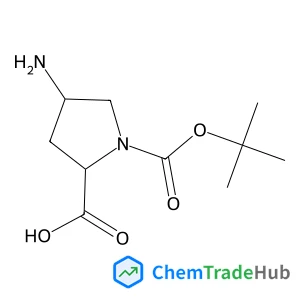
(2R,4R)-1-Boc-4-Aminopyrrolidine-2-carboxylic acid
CAS Number:
132622-98-1
Molecular Formula:
C10H18N2O4
Recommended Suppliers






Disclaimer
This page provides academic journal information for reference and research purposes only. We are not affiliated with any journal publishers and do not handle publication submissions. For publication-related inquiries, please contact the respective journal publishers directly.
If you notice any inaccuracies in the information displayed, please contact us at support@chemtradehub.com. We will promptly review and address your concerns.