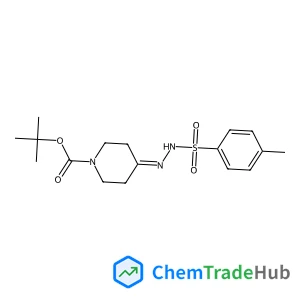
tert-Butyl 4-(2-(p-Tolylsulfonyl)hydrazono)piperidine-1-carboxylate
CAS Number:
1046478-89-0
Molecular Formula:
C17H25N3O4S
Izabela Czekaj, Katarzyna A. Kacprzak, John Mantzaras
This research is focused on the analysis of adsorbed CH4 intermediates at oxidized Pd9 nanoparticles supported on γ-alumina. From first-principle density functional theory calculations, several configurations, charge transfer and electronic density of states have been analyzed in order to determine feasible paths for the oxidation process. Methane oxidation cycles have been considered as a further step at differently oxidized Pd nanoparticles. For low oxidized Pd nanoparticles, activation of methane is observed, whereby hydrogen from methane is adsorbed at one oxygen atom. This reaction is exothermic with adsorption energy equal to −0.38 eV. In a subsequent step, desorption of two water molecules is observed. Additionally, a very interesting structural effect is evident, mainly Pd-carbide formation, which is also an exothermic reaction with an energy of −0.65 eV. Furthermore, oxidation of such carbidized Pd nanoparticles leads to CO2 formation, which is an endothermic reaction. Important result is that the support is involved in CO2 formation. A different mechanism of methane oxidation has been found for highly oxidized Pd nanoparticles. When the Pd nanoparticle is more strongly exposed to oxidative conditions, adsorption of methane is also possible, but it will proceed with carbonic acid production at the interface between Pd nanoparticles and support. However, this step is endothermic.
Sonja Elf, Kevin E. Eboigbodin
DOI: 10.1039/C9AY01350D
Siyu Xu, Quan Yu
DOI: 10.1039/C9AY01669D
Shingo Saito, Mitsuyoshi Kawashima, Hiroki Ohshima, Kazuki Enomoto, Makoto Sato, Hajime Yoshimura, Keitaro Yoshimoto, Mizuo Maeda, Masami Shibukawa
DOI: 10.1039/C3AN01107K
Rui Chen, Sam Williamson, Kelly M. Fulton, Susan M. Twine, Jianjun Li
DOI: 10.1039/C9AY01756A
Raimundo R. Gamela, Marco A. Sperança, Daniel F. Andrade, Edenir R. Pereira-Filho
DOI: 10.1039/C9AY01916B
Weijia Leng, Kimberly Evans, Michael G. Roper
DOI: 10.1039/C9AY01758E
Jichao Zhang, Yi Zhang, Aiguo Li, Xiaohan Yu, Qing Huang, Chunhai Fan, Xiaoqing Cai
DOI: 10.1039/C3AN01267K
When considering alternatives to 1-(4-Chlorophenyl)-N-hydroxymethanimine (CAS: 3...
This compound should be stored in a cool, dry place away from direct sunlight. I...
3-(4-Bromophenyl)-5-(2-fluorophenyl)-1,2,4-oxadiazole is synthesized through a m...
5-Chloro-2-(4-chlorophenyl)-4-methyl-6-[3-(1-piperidinyl)propoxy]pyrimidine (CAS...
2-Chloro-4-(difluoromethoxy)pyridine is used in the pharmaceutical industry for ...
3-Chloro-6-methylpyridazine (CAS: 1121-79-5) is classified under the Globally Ha...
Several alternatives can be used in the synthesis of Methyl 4,5-dimethyl-2-nitro...
Alternatives to (2E,2'E)-3,3'-(1,4-Phenylene)bisacrylaldehyde include other acry...
3-Amino-5-chloropyridin-2-ol hydrochloride is an organic compound with the CAS n...
When handling 6,7-Difluoro-2,3-dihydro-4H-chromen-4-one, it is essential to wear...

Physical Chemistry Chemical Physics (PCCP) is an international journal co-owned by 19 physical chemistry and physics societies from around the world. This journal publishes original, cutting-edge research in physical chemistry, chemical physics and biophysical chemistry. To be suitable for publication in PCCP, articles must include significant innovation and/or insight into physical chemistry; this is the most important criterion that reviewers and Editors will judge against when evaluating submissions. The journal has a broad scope and welcomes contributions spanning experiment, theory, computation and data science. Topical coverage includes spectroscopy, dynamics, kinetics, statistical mechanics, thermodynamics, electrochemistry, catalysis, surface science, quantum mechanics, quantum computing and machine learning. Interdisciplinary research areas such as polymers and soft matter, materials, nanoscience, energy, surfaces/interfaces, and biophysical chemistry are welcomed if they demonstrate significant innovation and/or insight into physical chemistry. Joined experimental/theoretical studies are particularly appreciated when complementary and based on up-to-date approaches.
![(2S)-2-{[(9H-Fluoren-9-ylmethoxy)carbonyl]amino}-4-(methylselanyl)butanoic acid structure](https://static.chemtradehub.com/structs/121/1217852-49-7-f252.webp "(2S)-2-{[(9H-Fluoren-9-ylmethoxy)carbonyl]amino}-4-(methylselanyl)butanoic acid structure")