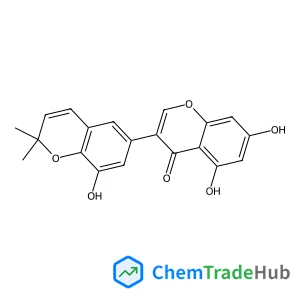
5,7,8'-Trihydroxy-2',2'-dimethyl-2'H,4H-3,6'-bichromen-4-one
CAS Number:
129280-33-7
Molecular Formula:
C20H16O6
Rebecca Sure, Andreas Hansen, Peter Schwerdtfeger, Stefan Grimme
We investigate all 1812 isomers of the fullerene C60 consistently with high-accuracy quantum chemistry methods. The isomers are optimized at the PBE-D3/def2-TZVP level of theory and their relative energies are obtained at the affordable and accurate hybrid-DFT level PW6B95-D3ATM/def2-QZVP. For the first time reliable values for the relative energy distribution among the 1812 isomers (maximum value of 549.1 kcal mol−1, average value of 189.8 ± 46.8 kcal mol−1, 1267 isomers in an energy window of 150–250 kcal mol−1) are given. The quality of the DFT energies is verified by comparison with highly accurate DLPNO-CCSD(T)/CBS* results for ten selected C60 isomers, and the DFT results are further used to benchmark several semiempirical methods. Our findings yield methodological insight into future multi-level modelling of larger carbon nano-structures. We correlate the best relative energies of the isomers to a number of topological indices, electronic properties, and geometrical measures in order to rationalize the isomeric stability aside from the common isolated pentagon rule minimizing the number of pentagon fusions. The information from the best qualitative measures can be condensed to the statement, that a small pentagon signature P1, a large volume, and a more spherical cage lead to a relatively stable isomer. In addition, the best semiempirical method was applied to all 31 924 isomers of C80.

Chinese Journal of Chemistry

Journal of Asian Natural Products Research

NDT & E International

Polycyclic Aromatic Compounds

Biocatalysis and Biotransformation

Bioorganic & Medicinal Chemistry

Journal of Chemical Sciences

Cellulose

Herald of the Russian Academy of Sciences

Journal of the Indian Institute of Science
Duc Duy Vo, Cécile Becquart, Thi Phuong Anh Tran, Audrey Di Giorgio, Fabien Darfeuille, Cathy Staedel, Maria Duca
DOI: 10.1039/C8OB01858H
Xintao Gu, Yin Wei
DOI: 10.1039/D1QO01373D
Yuan Chen, Xiaoyu Ren, Yumeng Guo, Bing Yi, Hongkui Zhang, Guowei Gao, Tianli Wang
DOI: 10.1039/D1QO01501J
Verena Klaus, Stéphane Wittmann, Hans M. Senn, J. Stephen Clark
DOI: 10.1039/C8OB00924D
DOI: 10.1039/C8OB00956B
Lingyun Yao, Jun Ying
DOI: 10.1039/D1QO01284C
Pei Dong, Long Chen, Zhendong Yang, Shunxi Dong, Xiaoming Feng
DOI: 10.1039/D1QO01194D
Jixing Lai, Juan Yang, Chen Yang, René Csuk, Baoan Song, Shengkun Li
DOI: 10.1039/D1QO01510A
Chuan-Ming Hong, Fei-Fei Zou, Xin Zhuang, Zhen Luo, Zheng-Qiang Liu, Li-Qing Ren, Qing-Hua Li, Tang-Lin Liu
DOI: 10.1039/D1QO01446C
David A. Russell, Julien J. Freudenreich, Hannah L. Stewart, Andrew D. Bond, Hannah F. Sore, David R. Spring
DOI: 10.1039/C8OB01919C
(1R,3S)-1,3-Cyclopentanediol finds applications in various industries. In the ph...
When handling N'-[4-(Dimethylamino)phenyl]-N,N-dimethyl-1,4-benzenediamine, it i...
There are several alternatives to 5-(2,4-Difluorophenyl)-2-methoxypyrimidine in ...
1-(3-Methoxyphenoxy)propan-2-ol (CAS: 382141-68-6) must comply with the Globally...
Tetrodotoxin Citrate is extremely dangerous and should be handled with extreme c...
2-Methyl-2-propanyl [(1R,3S)-3-hydroxycyclopentyl]carbamate (CAS: 225641-84-9) i...
Waste containing 4-(2-Hydroxyhexafluoroisopropyl)Benzoic Acid (CAS: 16261-80-6) ...
2-Methyl-2-proanyl {(2S)-1-[(benzyloxy)amino]-3-hydroxy-3-methyl-1-oxo-2-butanyl...
Benzeneethanamine, α-ethyl-, hydrochloride (1:1) is an organic compound with the...
In the synthesis of compounds similar to 3-{(E)-[4-(Dimethylamino)phenyl]diazeny...

Physical Chemistry Chemical Physics (PCCP) is an international journal co-owned by 19 physical chemistry and physics societies from around the world. This journal publishes original, cutting-edge research in physical chemistry, chemical physics and biophysical chemistry. To be suitable for publication in PCCP, articles must include significant innovation and/or insight into physical chemistry; this is the most important criterion that reviewers and Editors will judge against when evaluating submissions. The journal has a broad scope and welcomes contributions spanning experiment, theory, computation and data science. Topical coverage includes spectroscopy, dynamics, kinetics, statistical mechanics, thermodynamics, electrochemistry, catalysis, surface science, quantum mechanics, quantum computing and machine learning. Interdisciplinary research areas such as polymers and soft matter, materials, nanoscience, energy, surfaces/interfaces, and biophysical chemistry are welcomed if they demonstrate significant innovation and/or insight into physical chemistry. Joined experimental/theoretical studies are particularly appreciated when complementary and based on up-to-date approaches.