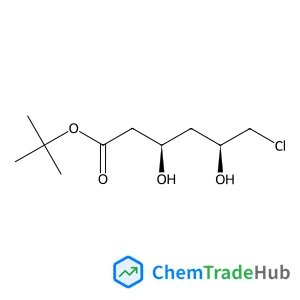
2-Methyl-2-propanyl (3R,5S)-6-chloro-3,5-dihydroxyhexanoate
CAS Number:
154026-93-4
Molecular Formula:
C10H19ClO4
A palladium-catalyzed double isocyanide insertion using 2-iodo-2′-isocyano-1,1′-biphenyls followed by copper-catalyzed intramolecular C–N coupling, delivering a unique heterocyclic structure containing both phenanthridine and carbazole scaffolds, has been developed. In this cascade process, four chemical bonds, including two C–C, one C–O, and one C–N bonds are formed consecutively without isolating an intermediate. The strategy of using a functionalized isocyanide in double insertion provides a quick approach for constructing heterocyclic systems with high bond-forming efficiency.
Foziya Yusuf Vadia, Jinet Susan Johny, Naved I. Malek, Suresh Kumar Kailasa
DOI: 10.1039/D3FB90017G
Anju Srivastava, Sriparna Dutta, Reena Jain
DOI: 10.1039/D3SU00246B
Herlys Viltres, Valeria B. López-Cervantes, Camilo Serrano-Fuentes, Amin Reza Rajabzadeh, Seshasai Srinivasan, Ricardo A. Peralta, Carolina Leyva
DOI: 10.1039/D3LF00061C
Daniele Carullo, Cesare Rovera, Tommaso Bellesia, Nadia Santo, Diego Romano, Stefano Farris
DOI: 10.1039/D3FB00147D
Akiho Horibe, Tomoko Murayama, Tsuyoshi Kawai, Yoshiyuki Nonoguchi
DOI: 10.1039/D3LF00119A
Sumit Kumar Verma, Remya Sasikala, Pankaj Kishore, C. O. Mohan, P. Ganesan, Pandurengan Padmavathy, Nagarajan Muralidharan, Bindu Jaganath, Soottawat Benjakul
DOI: 10.1039/D3FB00144J
(1R,3S)-1,3-Cyclopentanediol finds applications in various industries. In the ph...
When handling N'-[4-(Dimethylamino)phenyl]-N,N-dimethyl-1,4-benzenediamine, it i...
There are several alternatives to 5-(2,4-Difluorophenyl)-2-methoxypyrimidine in ...
1-(3-Methoxyphenoxy)propan-2-ol (CAS: 382141-68-6) must comply with the Globally...
Tetrodotoxin Citrate is extremely dangerous and should be handled with extreme c...
2-Methyl-2-propanyl [(1R,3S)-3-hydroxycyclopentyl]carbamate (CAS: 225641-84-9) i...
Waste containing 4-(2-Hydroxyhexafluoroisopropyl)Benzoic Acid (CAS: 16261-80-6) ...
2-Methyl-2-proanyl {(2S)-1-[(benzyloxy)amino]-3-hydroxy-3-methyl-1-oxo-2-butanyl...
Benzeneethanamine, α-ethyl-, hydrochloride (1:1) is an organic compound with the...
In the synthesis of compounds similar to 3-{(E)-[4-(Dimethylamino)phenyl]diazeny...

Organic & Biomolecular Chemistry (OBC) publishes original and high impact research and reviews in organic chemistry. We welcome research that shows new or significantly improved protocols or methodologies in total synthesis, synthetic methodology or physical and theoretical organic chemistry as well as research that shows a significant advance in the organic chemistry or molecular design aspects of chemical biology, catalysis, supramolecular and macromolecular chemistry, theoretical chemistry, mechanism-oriented physical organic chemistry, medicinal chemistry or natural products. Articles published in the journal should report new work which makes a highly-significant impact in the field. Routine and incremental work is generally not suitable for publication in the journal. More details about key areas of our scope are below. In all cases authors should include in their article clear rationale for why their research has been carried out.
![N,N'-1,2-Ethanediylbis[2-(vinylsulfonyl)acetamide] structure](https://static.chemtradehub.com/structs/667/66710-66-5-b556.webp "N,N'-1,2-Ethanediylbis[2-(vinylsulfonyl)acetamide] structure")