



Binding site opening by loop C shift and chloride ion-pore interaction in the GABAA receptor model
Literature Information
Publication Date
2017-04-10
DOI
10.1039/C7CP00582B
Impact Factor
3.676
Authors
S. Kraszewski, J. W. Mozrzymas
View Original
Abstract
GABAA receptors (GABAARs) are crucial in mediating inhibition in the adult mammalian brain. Although the kinetics of this receptor has been extensively studied, the molecular picture of interactions occurring at various channel conformations remains elusive. While electrophysiology combined with mutagenesis sheds light on the role of specific residues, ultrastructural studies reveal static structures which, in the case of GABAARs, are limited to the β3 homomer. To take advantage of the newest crystal structures of cys-loop receptors, a homology model of α1β2γ2 GABAAR in the unbound closed state was built using a template of the homomeric glycine receptor in the closed state. The template model contained strychnine molecules at the binding sites which were removed and molecular dynamics was used to study the system relaxation. The modeled GABAAR preserved the closed conformation. Two interfaces forming orthosteric binding sites (β2/α1) exhibited opening due to the outward shift of loop C. Similar movement, although less pronounced, was observed at the α1/γ2 (modulatory) interface. In contrast, interfaces α1/β2 and γ2/β2 remained closed. The former one, due to interactions mediated mainly by loops C and F, affected the neighboring β2/α1 interface leading to asymmetry between the orthosteric binding sites. Such interactions were not observed at the β2/α1 interface preceded by a γ2 subunit. As expected, in the channel pore, the conserved leucine gate and selectivity filter were present. However, an additional constriction was found at the top of the pore which differed from a typical hydrophobic channel gate as it consisted of charged residues. Interestingly, this site showed a capacity to trap chloride ions and to undergo conformation transition-like expansion, suggesting an impact on pore properties. In conclusion, our homology model faithfully reproduced major features of heteromeric GABAARs offering insight into the underlying mechanisms of stabilizing the shut conformation and chloride ion interaction with the channel pore.
Recommended Journals

Russian Journal of Applied Chemistry

Russian Journal of Bioorganic Chemistry

Chemistry Education Research and Practice

New Journal of Chemistry

Drug Discovery Today

Nature Medicine

Journal of Saudi Chemical Society

Russian Journal of Coordination Chemistry

Current Opinion in Colloid & Interface Science

Russian Chemical Bulletin
Related Literature
Growth, solvent effects, and thermal desorption behavior of octylthiocyanate self-assembled monolayers on Au(111)
Youngsik Choi, Eisuke Ito
2013-01-16
Paper
DOI: 10.1039/C3CP44425B
Critical roles of key domains in complete adsorption of Aβ peptide on single-walled carbon nanotubes: insights with point mutations and MD simulations
Asis K. Jana, Jaya C. Jose, Neelanjana Sengupta
2012-11-12
Paper
DOI: 10.1039/C2CP42933K
Sodium–oxygen batteries with alkyl-carbonate and ether based electrolytes
Jinsoo Kim, Hee-Dae Lim, Hyeokjo Gwon, Kisuk Kang
2013-01-08
Paper
DOI: 10.1039/C3CP43225D
Operando surface spectroscopy—placing catalytic solids at work under the spotlight
B. M. Weckhuysen, A. Zecchina
2012-01-20
Editorial
DOI: 10.1039/C2CP90005J
Exploring similarities in reactivity of superatom species: a combined theoretical and experimental investigation
Eric C. Tyo, Melanie Nöβler, Sabine Rabe, Christopher L. Harmon, Roland Mitrić, A. W. Castleman, Jr.
2011-12-19
Communication
DOI: 10.1039/C2CP23243J
Higher-order split operator schemes for solving the Schrödinger equation in the time-dependent wave packet method: applications to triatomic reactive scattering calculations
Weitao Yang
2012-01-10
Perspective
DOI: 10.1039/C1CP22790D
A donor–acceptor type organic dye connected with a quinoidal thiophene for dye-sensitized solar cells
Makoto Komatsu, Jotaro Nakazaki, Satoshi Uchida, Takaya Kubo, Hiroshi Segawa
2013-01-03
Paper
DOI: 10.1039/C2CP43598E
Confinement induced conformational changes in n-alkanes sequestered within a narrow carbon nanotube
Piyush P. Wanjari, Ashish V. Sangwai, Henry S. Ashbaugh
2012-01-19
Paper
DOI: 10.1039/C2CP22940D
You might also like
Compound Q&A
How should 2-Methylbenzene-1,4-diamine dihydrochloride (CAS: 615-45-2) be stored?
2-Methylbenzene-1,4-diamine dihydrochloride (CAS: 615-45-2) should be stored in ...
615-45-22-Methylbenzene-1,4-...
Compound Q&A
Is (1S,4S)-2,5-Diazabicyclo[2.2.1]heptane dihydrobromide (CAS: 132747-20-7) safe?
(1S,4S)-2,5-Diazabicyclo[2.2.1]heptane dihydrobromide is generally considered sa...
132747-20-7(1S,4S)-2,5-Diazabic...
Compound Q&A
What industries use (6-Chloropyridazin-3-YL)methanamine (CAS: 871826-15-2)?
(6-Chloropyridazin-3-YL)methanamine finds applications in the pharmaceutical ind...
871826-15-2(6-Chloropyridazin-3...
Compound Q&A
What are the main uses of 2-Fluoro-3-methylphenol (CAS: 77772-72-6)?
2-Fluoro-3-methylphenol is primarily used in the synthesis of pharmaceuticals, p...
77772-72-62-Fluoro-3-methylphe...
Compound Q&A
What precautions should be taken when handling 3-Methoxy-4-nitrobenzonitrile (CAS: 177476-75-4)?
When handling 3-Methoxy-4-nitrobenzonitrile, it is important to wear appropriate...
177476-75-43-Methoxy-4-nitroben...
Compound Q&A
What precautions should be taken when handling 1,3-Oxazolo[4,5-b]pyridine-2(3H)-thione (CAS: 211949-57-4)?
When handling 1,3-Oxazolo[4,5-b]pyridine-2(3H)-thione (CAS: 211949-57-4), it is ...
211949-57-4[1,3]Oxazolo[4,5-b]p...
Compound Q&A
What regulatory guidelines apply to 4-Ethynylbenzamide (CAS: 90347-86-7)?
4-Ethynylbenzamide (CAS: 90347-86-7) falls under various regulatory guidelines i...
90347-86-74-Ethynylbenzamide
Compound Q&A
What are the main uses of 3-(2-Ethylphenyl)-2-thioxo-4-imidazolidinone (CAS: 186822-57-1)?
3-(2-Ethylphenyl)-2-thioxo-4-imidazolidinone is primarily used as an intermediat...
186822-57-13-(2-Ethylphenyl)-2-...
Compound Q&A
What is (2-Fluoro-6-methoxyphenyl)acetic acid (CAS: 500912-19-6)?
(2-Fluoro-6-methoxyphenyl)acetic acid, also known as 4-fluoro-3-methoxybenzoic a...
500912-19-6(2-Fluoro-6-methoxyp...
Compound Q&A
What is the market or research trend for 2-[4-(Hydroxymethyl)phenoxy]ethanol (CAS: 102196-18-9)?
Market trends for 2-[4-(Hydroxymethyl)phenoxy]ethanol (CAS: 102196-18-9) indicat...
102196-18-92-[4-(Hydroxymethyl)...
Source Journal
Physical Chemistry Chemical Physics

CiteScore:
5.5
Self-citation Rate:
10.3%
Articles per Year:
3036
Physical Chemistry Chemical Physics (PCCP) is an international journal co-owned by 19 physical chemistry and physics societies from around the world. This journal publishes original, cutting-edge research in physical chemistry, chemical physics and biophysical chemistry. To be suitable for publication in PCCP, articles must include significant innovation and/or insight into physical chemistry; this is the most important criterion that reviewers and Editors will judge against when evaluating submissions. The journal has a broad scope and welcomes contributions spanning experiment, theory, computation and data science. Topical coverage includes spectroscopy, dynamics, kinetics, statistical mechanics, thermodynamics, electrochemistry, catalysis, surface science, quantum mechanics, quantum computing and machine learning. Interdisciplinary research areas such as polymers and soft matter, materials, nanoscience, energy, surfaces/interfaces, and biophysical chemistry are welcomed if they demonstrate significant innovation and/or insight into physical chemistry. Joined experimental/theoretical studies are particularly appreciated when complementary and based on up-to-date approaches.
Recommended Compounds
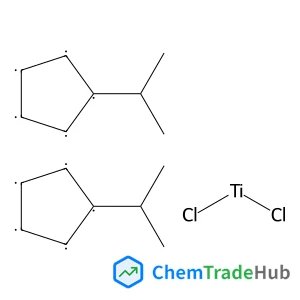
BIS(I-PROPYLCYCLOPENTADIENYL)TITANIUM DICHLORIDE
CAS Number:
12130-65-3
Molecular Formula:
C16H22Cl2Ti


Recommended Suppliers





Disclaimer
This page provides academic journal information for reference and research purposes only. We are not affiliated with any journal publishers and do not handle publication submissions. For publication-related inquiries, please contact the respective journal publishers directly.
If you notice any inaccuracies in the information displayed, please contact us at support@chemtradehub.com. We will promptly review and address your concerns.