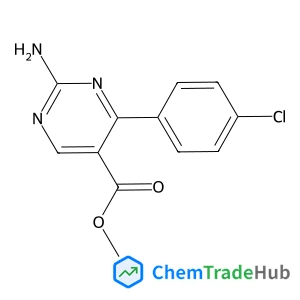
Methyl 2-amino-4-(4-chlorophenyl)-5-pyrimidinecarboxylate
CAS Number:
1133115-56-6
Molecular Formula:
C12H10ClN3O2
The first page of this article is displayed as the abstract.
Yu Gao, Hong-Ning Lv, Sheng-Hua Zha, Xiao-Li Sun
DOI: 10.1039/D3NJ03311B
Jinzhe Li, Jianguo Zhou
DOI: 10.1039/D3NJ02733C
Xuanyu Xiao, Lei Li, Hui Deng, Yuting Zhong, Wei Deng, Yuanyuan Xu, Zhiyu Chen, Jieyu Zhang, Xuefeng Hu, Yunbing Wang
DOI: 10.1039/D3TB01910A
Li Xing, Youshan An, Yishan Qin, Hui Xin, Tianyu Deng, Kaini Meng, Da Liu, Wei Xue
DOI: 10.1039/D3NJ04902G
Md Mohiuddin Soliman, Mohammad Tariqul Islam, Muhammad E. H. Chowdhury, Farayi Musharavati, Touhidul Alam, Norbahiah Misran, Sakib Mahmud, Amith Khandakar
DOI: 10.1039/D3TB01469J
Yihua Fu, Yan Zhang, Changwei Hu, Zhishan Su
DOI: 10.1039/D3NJ04395A
Francisco Gámez, Roberto Gallardo, Manuel Pernia Leal
DOI: 10.1039/D3TB01821K
Shuoyu Chen, Tengfei Bi, Zhenxi Du, Shenghao Luo, Yuechun Fu, Huan He, Xiaoming Shen
DOI: 10.1039/D3NJ04722A
Alexander S. Ovsyannikov, Aida I. Samigullina, Daut R. Islamov, Mikhail A. Cherosov, Ruslan G. Batulin, Airat G. Kiiamov, Aidar T. Gubaidullin, Pavel V. Dorovatovskii, Svetlana E. Solovieva, Igor S. Antipin
DOI: 10.1039/D3NJ04809H
6-(3-Fluorophenyl)picolinic acid is generally considered safe for laboratory use...
(3R)-3-Pyrrolidinol is used in the pharmaceutical industry as a precursor for dr...
When handling (4R,5R)-4,5-Diethoxycarbonyl-2,2-dimethyldioxolane (CAS: 59779-75-...
1-(6-Chloroimidazo[1,2-b]pyridazin-3-yl)ethanone is often synthesized via a mult...
The market for N-Ethyl-3,4-dimethylbenzylamine (CAS: 39180-83-1) remains steady,...
Tert-butyl 3-(pyrrolidin-1-yl)azetidine-1-carboxylate is a chemical compound wit...
1-Bromo-3-chloro-2,4-dimethoxybenzene (CAS: 1228956-93-1) falls under the classi...
The safety of 8-Bromo-2-methyl-3,4-dihydroisoquinolin-1(2H)-one (CAS: 1368622-07...
Benzyl [(3S)-2,6-dioxo-3-piperidinyl]carbamate is generally safe when handled wi...
1-{[4-(4,4,5,5-Tetramethyl-1,3,2-dioxaborolan-2-yl)phenyl]sulfonyl}pyrrolidine s...

Physical Chemistry Chemical Physics (PCCP) is an international journal co-owned by 19 physical chemistry and physics societies from around the world. This journal publishes original, cutting-edge research in physical chemistry, chemical physics and biophysical chemistry. To be suitable for publication in PCCP, articles must include significant innovation and/or insight into physical chemistry; this is the most important criterion that reviewers and Editors will judge against when evaluating submissions. The journal has a broad scope and welcomes contributions spanning experiment, theory, computation and data science. Topical coverage includes spectroscopy, dynamics, kinetics, statistical mechanics, thermodynamics, electrochemistry, catalysis, surface science, quantum mechanics, quantum computing and machine learning. Interdisciplinary research areas such as polymers and soft matter, materials, nanoscience, energy, surfaces/interfaces, and biophysical chemistry are welcomed if they demonstrate significant innovation and/or insight into physical chemistry. Joined experimental/theoretical studies are particularly appreciated when complementary and based on up-to-date approaches.