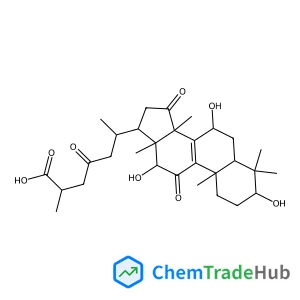
(3beta,7beta,12beta)-3,7,12-Trihydroxy-11,15,23-trioxolanost-8-en-26-oic acid
CAS Number:
98665-22-6
Molecular Formula:
C30H44O8
David Rais, Miroslav Menšík, Bartosz Paruzel, Dharmalingam Kurunthu, Jiří Pfleger
Localized surface plasmon (LSP) photophysical phenomena occurring in metal nanostructures are often presented as a method to effectively couple light into photovoltaic devices of sub-wavelength-scale thickness. However, the excitation of LSP is also associated with rapid energy dissipation leading to local heating, which affects the excitation energy pathway. We studied a system consisting of a planar gold nanoparticle (AuNP) array deposited at the surface of a semiconducting polymer thin film (P3HT). We observed heat transfer from laser pulse excited AuNPs into the P3HT, which was evidenced as a long-living thermochromic effect on transient optical absorption. By modeling of the ultrafast kinetics of exciton population evolution, we determined that their decay was caused by their mutual annihilation. The decay rate was controlled by a phonon-assisted one-dimensional diffusion mechanism with a diffusion constant of 2.2 nm2 ps−1. The transferred heat resulted in an increase of the diffusion constant by a factor of almost 2, compared to the control system of P3HT without AuNPs. These results are of practical use for the design of plasmon-enhanced optoelectronic devices.
André Severo Pereira Gomes, Christoph R. Jacob, Florent Réal, Lucas Visscher, Valérie Vallet
DOI: 10.1039/C3CP52090K
Zhenhuan Lu, Xin Zhang, Chuanlang Zhan, Bo Jiang, Xinliang Zhang, Lili Chen, Jiannian Yao
DOI: 10.1039/C3CP51475G
Harry L. Tuller, Melanie Kuhn, Guido Ciampi, William Higgins, Kanai S. Shah
DOI: 10.1039/C3CP51043C
DOI: 10.1039/C3CP51650D
Dima Vingurt, David Fuks, Miron V. Landau, Roxana Vidruk, Moti Herskowitz
DOI: 10.1039/C3CP51086G
Robert P. Lynch, Nathan Quill, Shohei Nakahara, D. Noel Buckley
DOI: 10.1039/C3CP52253A
Bruce F. Milne, Patrick Norman, Fernando Nogueira, Cláudia Cardoso
DOI: 10.1039/C3CP52528G
Youyi Xia, Tenjiao Li, Jun Chen
DOI: 10.1039/C3CP51080H
Mengjiao Cheng, Chao Jiang, Zhiyi Ding, Yajun Zhang, Yu Fu, Feng Shi
DOI: 10.1039/C3CP52217B
Waste containing N-Methoxy-N-methyl-1,3-thiazole-5-carboxamide (CAS: 898825-89-3...
N-(4-Biphenylyl)dibenzo[b,d]furan-4-amine should be stored in a tightly sealed c...
The market for 3-Acetamido-5-amino-2,4,6-triiodobenzoic acid (CAS: 1713-07-1) is...
Benzyl 2-O-acetyl-3,4,6-tri-O-benzyl-beta-D-galactopyranoside (CAS: 61820-03-9) ...
2-Ethylpiperazine dihydrochloride (CAS: 438050-52-3) is regulated under the Glob...
1,1'-[1,3-Phenylenebis(methylene)]bis(3-methyl-1H-pyrrole-2,5-dione) (CAS: 11946...
Several alternatives can be used in the synthesis of 5-Fluoro-2-(1-pyrrolidinyl)...
Proper personal protective equipment (PPE) must be worn when handling this compo...
When handling 6-Bromoimidazo[1,2-a]pyridin-8-amine, it is important to wear appr...
Alternatives to (2S,4R)-4-(4-Nitrobenzyl)pyrrolidine-2-carboxylic acid hydrochlo...

Physical Chemistry Chemical Physics (PCCP) is an international journal co-owned by 19 physical chemistry and physics societies from around the world. This journal publishes original, cutting-edge research in physical chemistry, chemical physics and biophysical chemistry. To be suitable for publication in PCCP, articles must include significant innovation and/or insight into physical chemistry; this is the most important criterion that reviewers and Editors will judge against when evaluating submissions. The journal has a broad scope and welcomes contributions spanning experiment, theory, computation and data science. Topical coverage includes spectroscopy, dynamics, kinetics, statistical mechanics, thermodynamics, electrochemistry, catalysis, surface science, quantum mechanics, quantum computing and machine learning. Interdisciplinary research areas such as polymers and soft matter, materials, nanoscience, energy, surfaces/interfaces, and biophysical chemistry are welcomed if they demonstrate significant innovation and/or insight into physical chemistry. Joined experimental/theoretical studies are particularly appreciated when complementary and based on up-to-date approaches.