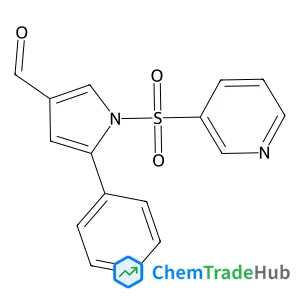
5-Phenyl-1-(pyridin-3-ylsulfonyl)-1H-pyrrole-3-carbaldehyde
CAS Number:
881676-90-0
Molecular Formula:
C16H12N2O3S
André Severo Pereira Gomes, Christoph R. Jacob, Florent Réal, Lucas Visscher, Valérie Vallet
In this work we explore the use of frozen density embedding [Gomes et al., Phys. Chem. Chem. Phys., 2008, 10, 5353] as a way to construct models of increasing sophistication for describing the low-lying electronic absorption spectra of UO22+ in the Cs2UO2Cl4 crystal. We find that a relatively simple embedding model, in which all but the UO22+ unit are represented by an embedding potential, can already describe the main spectral features and the main environment effects can be attributed to the four chloride ions situated at the UO22+ equatorial plane. Contributions from species further away, albeit small, are found to be important for reaching a close agreement with experimentally observed quantities such as the excited states' relative positions. These findings suggest that such an embedding approach is a viable alternative to supermolecular calculations employing larger models of actinyl species in condensed phase. Nevertheless, we observe a slight red shift of the excitation energies calculated with our models compared to experimental results, and attribute this discrepancy to inaccuracies in the underlying structural parameters.
Yanli Zhu, Yiyang Sun, Qingyun Cai
DOI: 10.1039/D0AN00816H
Raimundo R. Gamela, Marco A. Sperança, Daniel F. Andrade, Edenir R. Pereira-Filho
DOI: 10.1039/C9AY01916B
Xiaoqing Zhu, Lianglan Wu, Divyesh C. Mungra, Sijing Xia, Jin Zhu
DOI: 10.1039/C2AN35074B
Iqbal Bin Imran
DOI: 10.1039/C9AY01067J
Rui Chen, Sam Williamson, Kelly M. Fulton, Susan M. Twine, Jianjun Li
DOI: 10.1039/C9AY01756A
Stuart T. Read, Garth Wells, Michael Jacobs, Scott M. Rosendahl, Sven Achenbach, Ian J. Burgess
DOI: 10.1039/C9AY02248A
Jhih-Siang Chen, Pin-Fan Chen, Hana Tzu-Han Lin
DOI: 10.1039/D0AN01201G
When considering alternatives to 1-(4-Chlorophenyl)-N-hydroxymethanimine (CAS: 3...
This compound should be stored in a cool, dry place away from direct sunlight. I...
3-(4-Bromophenyl)-5-(2-fluorophenyl)-1,2,4-oxadiazole is synthesized through a m...
5-Chloro-2-(4-chlorophenyl)-4-methyl-6-[3-(1-piperidinyl)propoxy]pyrimidine (CAS...
2-Chloro-4-(difluoromethoxy)pyridine is used in the pharmaceutical industry for ...
3-Chloro-6-methylpyridazine (CAS: 1121-79-5) is classified under the Globally Ha...
Several alternatives can be used in the synthesis of Methyl 4,5-dimethyl-2-nitro...
Alternatives to (2E,2'E)-3,3'-(1,4-Phenylene)bisacrylaldehyde include other acry...
3-Amino-5-chloropyridin-2-ol hydrochloride is an organic compound with the CAS n...
When handling 6,7-Difluoro-2,3-dihydro-4H-chromen-4-one, it is essential to wear...

Physical Chemistry Chemical Physics (PCCP) is an international journal co-owned by 19 physical chemistry and physics societies from around the world. This journal publishes original, cutting-edge research in physical chemistry, chemical physics and biophysical chemistry. To be suitable for publication in PCCP, articles must include significant innovation and/or insight into physical chemistry; this is the most important criterion that reviewers and Editors will judge against when evaluating submissions. The journal has a broad scope and welcomes contributions spanning experiment, theory, computation and data science. Topical coverage includes spectroscopy, dynamics, kinetics, statistical mechanics, thermodynamics, electrochemistry, catalysis, surface science, quantum mechanics, quantum computing and machine learning. Interdisciplinary research areas such as polymers and soft matter, materials, nanoscience, energy, surfaces/interfaces, and biophysical chemistry are welcomed if they demonstrate significant innovation and/or insight into physical chemistry. Joined experimental/theoretical studies are particularly appreciated when complementary and based on up-to-date approaches.