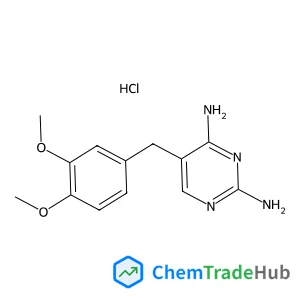
5-(3,4-Dimethoxybenzyl)-2,4-pyrimidinediamine hydrochloride (1:1)
CAS Number:
2507-23-5
Molecular Formula:
C13H17ClN4O2
Sebastian Engmann, Hyun Wook Ro, Andrew Herzing, Chad R. Snyder, Lee J. Richter, Paul B. Geraghty, David J. Jones
Solution-processable small molecule photovoltaics based on the novel molecular donor, benzodithiophene terthiophene rhodanine (BTR), recently have shown maximum power conversion efficiencies above 8% for active layer thicknesses up to 400 nm, using post process solvent vapor annealing (SVA) with tetrahydrofuran (THF). Here we report an in situ study on the morphology evolution during SVA using the moderate solvent THF and the good solvent chloroform (CF). The combination of real-time grazing incidence X-ray diffraction (GIXD) and grazing incidence small angle X-ray scattering (GISAXS) allows us to draw a complete picture of the evolution of crystallinity and phase purity during post process annealing. We find that the relative crystallinity compared to the as-cast films is only modestly affected by SVA and solvent choice. However, both the phase purity and the characteristic domain sizes within the film vary significantly and are controlled by the solvent quality as well as exposure time. Using THF, films with high phase purity and desirable characteristic length scales of about 30 nm can be achieved, while the use of CF rapidly leads to excessive film coarsening and less preferable domain sizes on the order of 60 nm, too large for optimized charge separation.

Polycyclic Aromatic Compounds

Critical Reviews in Solid State and Materials Sciences

Medicinal Chemistry Research

Bioorganic & Medicinal Chemistry

Biocatalysis and Biotransformation

Acta Metallurgica Sinica-English Letters

Journal of Chemical Sciences

Herald of the Russian Academy of Sciences

Atomization and Sprays

Bioorganic & Medicinal Chemistry Letters
Radovan Vukićević, Ivana Vukovic, Hristiyan Stoyanov, Andreas Korwitz, Doris Pospiech, Guggi Kofod, Katja Loos, Gerrit ten Brinke, Sabine Beuermann
DOI: 10.1039/C2PY20166F
Shaojie Chen, Qiuyu Zhang, Hepeng Zhang, Junwei Gu, Mingliang Ma, Tiejun Xin, Yanyang Zhou, Jian Zhou, Qing Liu
DOI: 10.1039/C2PY20122D
Yanzi Gou, Sarah-Jane Richards, David M. Haddleton, Matthew I. Gibson
DOI: 10.1039/C2PY20140B
Stergios Pispas
DOI: 10.1039/C2PY20189E
Xingfen Liu, Lan Ouyang, Yanqin Huang, Xiaomiao Feng, Quli Fan, Wei Huang
DOI: 10.1039/C2PY00499B
Haiting Shi, Li Liu, Xiaobei Wang, Jingyi Li
DOI: 10.1039/C2PY20021J
Wei-Hsun Hu, Kai-Wei Huang, Shiao-Wei Kuo
DOI: 10.1039/C2PY20090B
Yukiya Kitayama, Mika Yorizane, Hideto Minami
DOI: 10.1039/C2PY20120H
Guillaume Delaittre, Maud Save, Marianne Gaborieau, Patrice Castignolles, Jutta Rieger, Bernadette Charleux
DOI: 10.1039/C2PY20084H
When considering alternatives to 1-(4-Chlorophenyl)-N-hydroxymethanimine (CAS: 3...
This compound should be stored in a cool, dry place away from direct sunlight. I...
3-(4-Bromophenyl)-5-(2-fluorophenyl)-1,2,4-oxadiazole is synthesized through a m...
5-Chloro-2-(4-chlorophenyl)-4-methyl-6-[3-(1-piperidinyl)propoxy]pyrimidine (CAS...
2-Chloro-4-(difluoromethoxy)pyridine is used in the pharmaceutical industry for ...
3-Chloro-6-methylpyridazine (CAS: 1121-79-5) is classified under the Globally Ha...
Several alternatives can be used in the synthesis of Methyl 4,5-dimethyl-2-nitro...
Alternatives to (2E,2'E)-3,3'-(1,4-Phenylene)bisacrylaldehyde include other acry...
3-Amino-5-chloropyridin-2-ol hydrochloride is an organic compound with the CAS n...
When handling 6,7-Difluoro-2,3-dihydro-4H-chromen-4-one, it is essential to wear...
Journal of Materials Chemistry A, B & C cover high quality studies across all fields of materials chemistry. The journals focus on those theoretical or experimental studies that report new understanding, applications, properties and synthesis of materials. The journals have a strong history of publishing quality reports of interest to interdisciplinary communities and providing an efficient and rigorous service through peer review and publication. The journals are led by an international team of Editors-in-Chief and Associate Editors who are all active researchers in their fields. Journal of Materials Chemistry A, B & C are separated by the intended application of the material studied. Broadly, applications in energy and sustainability are of interest to Journal of Materials Chemistry A, applications in biology and medicine are of interest to Journal of Materials Chemistry B, and applications in optical, magnetic and electronic devices are of interest to Journal of Materials Chemistry C. More than one Journal of Materials Chemistry journal may be suitable for certain fields and researchers are encouraged to submit their paper to the journal that they feel best fits for their particular article. Example topic areas within the scope of Journal of Materials Chemistry A are listed below. This list is neither exhaustive nor exclusive. Artificial photosynthesis Batteries Carbon dioxide conversion Catalysis Fuel cells Gas capture/separation/storage Green/sustainable materials Hydrogen generation Hydrogen storage Photocatalysis Photovoltaics Self-cleaning materials Self-healing materials Sensors Supercapacitors Thermoelectrics Water splitting Water treatment
![[4-(Isobutyrylamino)phenyl]boronic acid structure](https://static.chemtradehub.com/structs/874/874219-50-8-6ab5.webp "[4-(Isobutyrylamino)phenyl]boronic acid structure")