












Highly sensitive detection of DNA-binding proteins based on a cationic conjugated polymervia a target-mediated fluorescence resonance energy transfer (TMFRET) strategy
Literature Information
Publication Date
2012-01-17
DOI
10.1039/C2PY00499B
Impact Factor
5.582
Authors
Xingfen Liu, Lan Ouyang, Yanqin Huang, Xiaomiao Feng, Quli Fan, Wei Huang
View Original
Abstract
The sensitive, ratiometric and simple detection of sequence-specific DNA-binding proteins is of paramount importance for proteomics, genomics and biomedicine. We describe herein a novel target-mediated fluorescence resonance energy transfer (TMFRET) strategy for the homogeneous and visual detection of sequence-specific DNA-binding proteins. This conjugated polymer-based optical biosensor was demonstrated using a model target DNA-binding protein nuclear factor-kappaB (NF-κB), which is a key transcription factor involved in a number of important transcriptional regulatory networks. A fluorophore-labeled, double-stranded DNA probe bearing an NF-κB-binding site was designed to identify the target protein. Combining the protein with the probe could protect the probe from digestion by exonuclease III, yielding a high-efficiency FRET from the cationic conjugated polymer to the fluorophore label on the probe. The results revealed a highly sensitive, selective, colorimetric and turn-on detection of the purified recombinant NF-κB and HeLa cell nuclear extracts. The limit of detection for the target protein in nuclear extracts was estimated to be 1 × 10⁻⁵ μg μL−1, which is 5000-fold more sensitive than previously reported methods. This strategy offers a new method for the reproducible, low-cost and simple detection of DNA-binding proteins because an average percent relative standard deviation of less than 5% was obtained. The results of the assay can also be seen by the naked eye with the help of a transilluminator, which is promising for detecting DNA-binding proteins in human samples for low-cost medical diagnoses and for the high-throughput screening of new drugs targeted to DNA-binding proteins.
Related Literature
Effect of epoxy monomer structure on the curing process and thermo-mechanical characteristics of tri-functional epoxy/amine systems: a methodology combining atomistic molecular simulation with experimental analyses
Liang Gao, Qingjie Zhang, Hao Li, Siruo Yu, Weihong Zhong, Gang Sui, Xiaoping Yang
2017-02-10
Paper
DOI: 10.1039/C7PY00063D
Reduction- and thermo-sensitive core-cross-linked polypeptide hybrid micelles for triggered and intracellular drug release
Yuanfeng Gao
2017-01-06
Paper
DOI: 10.1039/C6PY01929C
Nanocomposite latexes containing layered double hydroxides via RAFT-assisted encapsulating emulsion polymerization
Ana Cenacchi Perreira, Samuel Pearson, Franck D'Agosto, Muriel Lansalot, Elodie Bourgeat-Lami
2017-01-05
Paper
DOI: 10.1039/C6PY01742H
Zirconocene-catalyzed stereoselective cyclocopolymerization of 2-methyl-1,5-hexadiene with propylene
Manuela Bader, Gabriel Theurkauff, Katty Den Dauw, Christian Lamotte, Olivier Lhost, Evgueni Kirillov, Jean-François Carpentier
2014-06-27
Paper
DOI: 10.1039/C4PY00612G
Facile one-pot access to π-conjugated polymers via sequential bromination/direct arylation polycondensation
Hitoshi Saito, Jieran Chen, Junpei Kuwabara, Takeshi Yasuda, Takaki Kanbara
2017-04-25
Paper
DOI: 10.1039/C7PY00332C
Camptothecin prodrug block copolymer micelles with high drug loading and target specificity
Sue Watson, Anna M. Grabowska
2014-05-15
Paper
DOI: 10.1039/C4PY00369A
Facile conversion of plant oil (anethole) to a high-performance material
Yangqing Tao, Fengkai He, Kaikai Jin, Jiajia Wang, Yuanqiang Wang, Junfeng Zhou, Jing Sun, Qiang Fang
2017-02-20
Paper
DOI: 10.1039/C7PY00047B
Fibril-shaped aggregates of doxorubicin with poly-l-lysine and its derivative
Feiyan Zhu, Yongri Liang, Fuxin Liang, Qian Wang, Jiaoli Li, Zhibo Li, Zhenzhong Yang
2014-06-10
Paper
DOI: 10.1039/C4PY00686K
Functionalisation of MWCNTs with poly(lauryl acrylate) polymerised by Cu(0)-mediated and RAFT methods
Jaipal Gupta, Daniel J. Keddie, Chaoying Wan, David M. Haddleton, Tony McNally
2016-05-12
Paper
DOI: 10.1039/C6PY00522E
Catch and release: photocleavable cationic diblock copolymers as a potential platform for nucleic acid delivery
Matthew D. Green, Abbygail A. Foster, Chad T. Greco, Raghunath Roy, Rachel M. Lehr, Thomas H. Epps, III, Millicent O. Sullivan
2014-06-05
Communication
DOI: 10.1039/C4PY00638K
You might also like
Compound Q&A
Are there alternatives to 1-(4-Chlorophenyl)-N-hydroxymethanimine (CAS: 3848-36-0) in synthesis?
When considering alternatives to 1-(4-Chlorophenyl)-N-hydroxymethanimine (CAS: 3...
3848-36-01-(4-Chlorophenyl)-N...
Compound Q&A
How should (1R,9S,10S,12S,14E,16S,19R,20R,21S,22R)-3,9,21-Trihydroxy-5,10,12,14,16,20,22-heptamethyl-23,24-dioxatetracyclo[17.3.1.1~6,9~.0~2,7~]tetracosa-2,5,7,14-tetraen-4-one (CAS: 183202-73-5) be stored?
This compound should be stored in a cool, dry place away from direct sunlight. I...
183202-73-5(1R,9S,10S,12S,14E,1...
Compound Q&A
How is 3-(4-Bromophenyl)-5-(2-fluorophenyl)-1,2,4-oxadiazole (CAS: 419553-16-5) typically synthesized?
3-(4-Bromophenyl)-5-(2-fluorophenyl)-1,2,4-oxadiazole is synthesized through a m...
419553-16-53-(4-Bromophenyl)-5-...
Compound Q&A
How is 5-Chloro-2-(4-chlorophenyl)-4-methyl-6-[3-(1-piperidinyl)propoxy]pyrimidine (CAS: 1639220-19-1) typically synthesized?
5-Chloro-2-(4-chlorophenyl)-4-methyl-6-[3-(1-piperidinyl)propoxy]pyrimidine (CAS...
1639220-19-15-Chloro-2-(4-chloro...
Compound Q&A
What industries use 2-Chloro-4-(difluoromethoxy)pyridine (CAS: 1206978-15-5)?
2-Chloro-4-(difluoromethoxy)pyridine is used in the pharmaceutical industry for ...
1206978-15-52-Chloro-4-(difluoro...
Compound Q&A
What regulatory guidelines apply to 3-Chloro-6-methylpyridazine (CAS: 1121-79-5)?
3-Chloro-6-methylpyridazine (CAS: 1121-79-5) is classified under the Globally Ha...
1121-79-53-Chloro-6-methylpyr...
Compound Q&A
Are there alternatives to Methyl 4,5-dimethyl-2-nitrobenzoate in synthesis?
Several alternatives can be used in the synthesis of Methyl 4,5-dimethyl-2-nitro...
90922-74-0Methyl 4,5-dimethyl-...
Compound Q&A
Are there alternatives to (2E,2'E)-3,3'-(1,4-Phenylene)bisacrylaldehyde in synthesis?
Alternatives to (2E,2'E)-3,3'-(1,4-Phenylene)bisacrylaldehyde include other acry...
63405-68-5(2E,2'E)-3,3'-(1,4-P...
Compound Q&A
What is 3-Amino-5-chloropyridin-2-ol hydrochloride (CAS: 1261906-29-9)?
3-Amino-5-chloropyridin-2-ol hydrochloride is an organic compound with the CAS n...
1261906-29-93-Amino-5-chloropyri...
Compound Q&A
What precautions should be taken when handling 6,7-Difluoro-2,3-dihydro-4H-chromen-4-one (CAS: 1092349-93-3)?
When handling 6,7-Difluoro-2,3-dihydro-4H-chromen-4-one, it is essential to wear...
1092349-93-36,7-Difluoro-2,3-dih...
Source Journal
Polymer Chemistry

CiteScore:
8.6
Self-citation Rate:
7.3%
Articles per Year:
457
Polymer Chemistry welcomes submissions in all areas of polymer science that have a strong focus on macromolecular chemistry. Manuscripts may cover a broad range of fields, yet no direct application focus is required.
Recommended Compounds

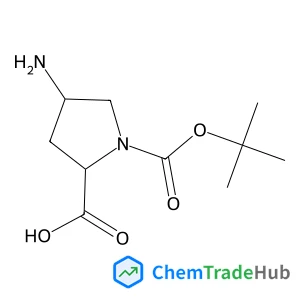
(2R,4R)-1-Boc-4-Aminopyrrolidine-2-carboxylic acid
CAS Number:
132622-98-1
Molecular Formula:
C10H18N2O4
![6-Bromo-2,3-dihydro-1H-pyrido[2,3-b][1,4]oxazine structure](https://static.chemtradehub.com/structs/120/1203499-17-5-b4d1.webp "6-Bromo-2,3-dihydro-1H-pyrido[2,3-b][1,4]oxazine structure")
6-Bromo-2,3-dihydro-1H-pyrido[2,3-b][1,4]oxazine
CAS Number:
1203499-17-5
Molecular Formula:
C7H7BrN2O
Recommended Suppliers






Disclaimer
This page provides academic journal information for reference and research purposes only. We are not affiliated with any journal publishers and do not handle publication submissions. For publication-related inquiries, please contact the respective journal publishers directly.
If you notice any inaccuracies in the information displayed, please contact us at support@chemtradehub.com. We will promptly review and address your concerns.