



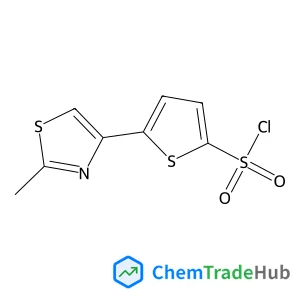
5-(2-Methyl-1,3-thiazol-4-yl)-2-thiophenesulfonyl chloride
CAS Number:
215434-25-6
Molecular Formula:
C8H6ClNO2S3
Lorenzo Carbone, Steve G. Greenbaum, Jusef Hassoun
Lithium sulfur and lithium oxygen batteries are predicted to be high-energy rechargeable systems of choice for emerging applications, such as modern electronics and electric vehicles. Despite the several issues hindering their diffusion, the two attractive systems are rapidly evolving, and achieving high performances and targets, which were only partially expected in the past few years. Lithium sulfur batteries have been recently introduced into the energy storage market, while practical prototypes of lithium oxygen cells are already emerging, thus indicating the high level achieved by these systems. Therefore, we report herein an overview of recent studies of the reaction mechanism which allowed the development of Li/S and Li/O2 batteries. We show and discuss the latest advances, in terms of electrochemical performances and characteristics, in order to shed light on the feasibility of the two important, cheap and environmentally compatible energy storage systems.

Chemical Communications

Journal of Natural Medicines

Chemistry Education Research and Practice

Nature Medicine

Drug Discovery Today

Russian Journal of Coordination Chemistry

Russian Journal of General Chemistry

Current Opinion in Solid State & Materials Science

Organic Process Research & Development

Journal of Saudi Chemical Society
Christian Spies, Björn Finkler, Nursel Acar, Gregor Jung
DOI: 10.1039/C3CP53082E
Hiroyasu Nishi, Takahito Nagano, Susumu Kuwabata, Tsukasa Torimoto
DOI: 10.1039/C3CP53946F
Tolga N. V. Karsili, Andreas M. Wenge, Barbara Marchetti, Michael N. R. Ashfold
DOI: 10.1039/C3CP53450B
Ji-eun Park, Yu Jin Jang, Yeo Jin Kim, Mi-sun Song, Seokhyun Yoon, Dong Ha Kim, Sung-Jin Kim
DOI: 10.1039/C3CP54311K
Simon de Leeuw, Marina V. Koudriachova, Jennifer M. Pringle, Patrick C. Howlett, Fangfang Chen, Maria Forsyth
DOI: 10.1039/C3CP53604A
Hui-Fang Li, Huai-Qian Wang
DOI: 10.1039/C3CP53292E
Paweł Tecmer, Katharina Boguslawski, Örs Legeza, Markus Reiher
DOI: 10.1039/C3CP53975J
Areum Jun, Jeeyoung Shin, Guntae Kim
DOI: 10.1039/C3CP53883D
Maria Francesca Ottaviani, Michela Cangiotti, Alberto Fattori, Concetta Coppola, Erik Laurini, Xiaoxuan Liu, Cheng Liu, Ling Peng
DOI: 10.1039/C3CP54005G
Waste containing 6-Chloro-5-(2'-hydroxy-3'-methoxy-4-biphenylyl)-3-(3-methoxyphe...
(3alpha,5alpha)-3-Hydroxypregnane-11,20-dione is primarily used in the pharmaceu...
The market for 4-Amino-6-chloro-2-pyridinecarboxylic acid (CAS: 546141-56-4) is ...
Alternatives to (2-Benzoylethyl)trimethylammonium chloride (CAS: 24472-88-6) in ...
N-[4-Nitro-3-(trifluoromethyl)phenyl]acetamide (CAS: 393-12-4) is generally safe...
Alternative reagents such as other phosphates or similar functional groups can b...
There are alternatives to N,N'-Bis(3-aminopropyl)-1,3-propanediamine (CAS: 4605-...
When handling Aluminium trihexadecanoate, it is important to use appropriate per...
(1,1-Dioxido-3-oxo-1,2-benzothiazol-2(3H)-yl)acetic acid is a chemical compound ...
Several alternatives to 5,5-dimethyloxolan-2-one (CAS: 3123-97-5) can be used in...

![2-morpholino-2-[2-(trifluoromethyl)pyrimidin-5-yl]ethanamine structure](https://static.chemtradehub.com/structs/119/1192570-20-9-2810.webp "2-morpholino-2-[2-(trifluoromethyl)pyrimidin-5-yl]ethanamine structure")
![4-{[4-(Trifluoromethoxy)benzyl]oxy}benzonitrile structure](https://static.chemtradehub.com/structs/103/1036629-63-6-2172.webp "4-{[4-(Trifluoromethoxy)benzyl]oxy}benzonitrile structure")




