












Symmetry matters: photodissociation dynamics of symmetrically versus asymmetrically substituted phenols
Literature Information
Publication Date
2013-10-28
DOI
10.1039/C3CP53450B
Impact Factor
3.676
Authors
Tolga N. V. Karsili, Andreas M. Wenge, Barbara Marchetti, Michael N. R. Ashfold
View Original
Abstract
We report a combined experimental (H (Rydberg) atom photofragment translational spectroscopy) and theoretical (ab initio electronic structure and vibronic coupling calculations) study of the effects of symmetry on the photodissociation dynamics of phenols. Ultraviolet photoexcitation to the bound S1(1ππ*) state of many phenols leads to some O–H bond fission by tunneling through the barrier under the conical intersection (CI) between the S1 and dissociative S2(1πσ*) potential energy surfaces in the RO–H stretch coordinate. Careful analysis of the total kinetic energy release spectra of the resulting products shows that the radicals formed following S1 ← S0 excitation of phenol and symmetrically substituted phenols like 4-fluorophenol all carry an odd number of quanta in vibrational mode ν16a, whereas those deriving from asymmetrically substituted systems like 3-fluorophenol or 4-methoxyphenol do not. This contrasting behavior can be traced back to symmetry. Symmetrically substituted phenols exist in two equivalent rotamers, which interconvert by tunneling through the barrier to OH torsional motion. Their states are thus best considered in the non-rigid G4 molecular symmetry group, wherein radiationless transfer from the S1 to S2 state requires a coupling mode of a2 symmetry. Of the three a2 symmetry parent modes, the out-of-plane ring puckering mode ν16a shows much the largest interstate coupling constant in the vicinity of the S1/S2 CI. The nuclear motions associated with ν16a are orthogonal to the dissociation coordinate, and are thus retained in the radical products. Introducing asymmetry (even a non-linear substituent in the 4-position) lifts the degeneracy of the rotamers, and lowers the molecular symmetry to Cs. Many more parent motions satisfy the reduced (a′′) symmetry requirement to enable S1/S2 coupling, the most effective of which is OH torsion. This motion ‘disappears’ on O–H bond fission; symmetry thus imposes no restriction to forming radical products with vibrational quantum number v = 0. The present work yields values for the O–H bond strengths in 3-FPhOH and 4-MeOPhOH, and recommends modest revisions to the previously reported O–H bond strengths in other asymmetrically substituted phenols like 3- and 2-methylphenol and 4-hydroxyindole.
Related Literature
Internal conversion outcompetes autodetachment from resonances in the deprotonated tetracene anion continuum
James N. Bull, Christopher W. West, Jan R. R. Verlet
2015-11-18
Paper
DOI: 10.1039/C5CP05388A
Adsorption studies of divalent, dinuclear coordination complexes as molecular spacers on SWCNTs
Jeffrey R. Alston, David J. Banks, Chauncey X. McNeill, James B. Mitchell, Leonid D. Popov, Igor N. Shcherbakov, J. C. Poler
2015-10-08
Paper
DOI: 10.1039/C5CP05419B
The influence of cations on lithium ion coordination and transport in ionic liquid electrolytes: a MD simulation study
Zhe Li, Dmitry Bedrov, Oleg Borodin, Andreas Heuer
2015-11-16
Paper
DOI: 10.1039/C5CP05111H
DOS and electron attachment effects in the electron-induced vibrational excitation of terphenylthiol SAMs
2015-10-26
Paper
DOI: 10.1039/C5CP04067A
Structure–barrier property relationship of biodegradable poly(butylene succinate) and poly[(butylene succinate)-co-(butylene adipate)] nanocomposites: influence of the rigid amorphous fraction
J. Soulestin, M. Sclavons
2015-10-13
Paper
DOI: 10.1039/C5CP04969E
Manipulating the voltage drop in graphene nanojunctions using a gate potential
2015-12-10
Paper
DOI: 10.1039/C5CP04613K
Ab initio electronic structure study of a model water splitting dimer complex
Amendra Fernando, Christine M. Aikens
2015-11-17
Paper
DOI: 10.1039/C5CP04112K
New insights into the photodissociation of methyl iodide at 193 nm: stereodynamics and product branching ratios
Sonia Marggi Poullain, Marta G. González, Peter C. Samartzis, Luis Rubio-Lago, Luis Bañares
2015-10-05
Paper
DOI: 10.1039/C5CP04850H
Path-dependent variational effects and multidimensional tunneling in multi-path variational transition state theory: rate constants calculated for the reactions of HO2 with tert-butanol by including all 46 paths for abstraction at C and all six paths for abstraction at O
Junwei Lucas Bao, Pattrawan Sripa, Donald G. Truhlar
2015-11-23
Paper
DOI: 10.1039/C5CP05780A
You might also like
Compound Q&A
How should waste containing 6-Chloro-5-(2'-hydroxy-3'-methoxy-4-biphenylyl)-3-(3-methoxyphenyl)-1H-pyrrolo[3,2-d]pyrimidine-2,4(3H,5H)-dione (CAS: 1346607-05-3) be handled?
Waste containing 6-Chloro-5-(2'-hydroxy-3'-methoxy-4-biphenylyl)-3-(3-methoxyphe...
1346607-05-36-Chloro-5-(2'-hydro...
Compound Q&A
What are the main uses of (3alpha,5alpha)-3-Hydroxypregnane-11,20-dione (CAS: 23930-19-0)?
(3alpha,5alpha)-3-Hydroxypregnane-11,20-dione is primarily used in the pharmaceu...
23930-19-0(3alpha,5alpha)-3-Hy...
Compound Q&A
What is the market or research trend for 4-Amino-6-chloro-2-pyridinecarboxylic acid (CAS: 546141-56-4)?
The market for 4-Amino-6-chloro-2-pyridinecarboxylic acid (CAS: 546141-56-4) is ...
546141-56-44-Amino-6-chloro-2-p...
Compound Q&A
Are there alternatives to (2-Benzoylethyl)trimethylammonium chloride (CAS: 24472-88-6) in synthesis?
Alternatives to (2-Benzoylethyl)trimethylammonium chloride (CAS: 24472-88-6) in ...
24472-88-6(2-Benzoylethyl)trim...
Compound Q&A
Is N-[4-Nitro-3-(trifluoromethyl)phenyl]acetamide (CAS: 393-12-4) safe?
N-[4-Nitro-3-(trifluoromethyl)phenyl]acetamide (CAS: 393-12-4) is generally safe...
393-12-4N-[4-Nitro-3-(triflu...
Compound Q&A
Are there alternatives to [(4R,5R,6S)-5-hydroxy-10-imino-3,7-dioxa-1,9-diazatricyclo[6.4.0.02,6]dodeca-8,11-dien-4-yl]methyl dihydrogen phosphate (CAS: 39679-56-6) in synthesis?
Alternative reagents such as other phosphates or similar functional groups can b...
39679-56-6[(4R,5R,6S)-5-hydrox...
Compound Q&A
Are there alternatives to N,N'-Bis(3-aminopropyl)-1,3-propanediamine (CAS: 4605-14-5) in synthesis?
There are alternatives to N,N'-Bis(3-aminopropyl)-1,3-propanediamine (CAS: 4605-...
4605-14-5N,N'-Bis(3-aminoprop...
Compound Q&A
What precautions should be taken when handling Aluminium trihexadecanoate (CAS: 555-35-1)?
When handling Aluminium trihexadecanoate, it is important to use appropriate per...
555-35-1Aluminium trihexadec...
Compound Q&A
What is (1,1-Dioxido-3-oxo-1,2-benzothiazol-2(3H)-yl)acetic acid (CAS: 52188-11-1)?
(1,1-Dioxido-3-oxo-1,2-benzothiazol-2(3H)-yl)acetic acid is a chemical compound ...
52188-11-1(1,1-Dioxido-3-oxo-1...
Compound Q&A
Are there alternatives to 5,5-dimethyloxolan-2-one (CAS: 3123-97-5) in synthesis?
Several alternatives to 5,5-dimethyloxolan-2-one (CAS: 3123-97-5) can be used in...
3123-97-55,5-dimethyloxolan-2...
Source Journal
Physical Chemistry Chemical Physics

CiteScore:
5.5
Self-citation Rate:
10.3%
Articles per Year:
3036
Physical Chemistry Chemical Physics (PCCP) is an international journal co-owned by 19 physical chemistry and physics societies from around the world. This journal publishes original, cutting-edge research in physical chemistry, chemical physics and biophysical chemistry. To be suitable for publication in PCCP, articles must include significant innovation and/or insight into physical chemistry; this is the most important criterion that reviewers and Editors will judge against when evaluating submissions. The journal has a broad scope and welcomes contributions spanning experiment, theory, computation and data science. Topical coverage includes spectroscopy, dynamics, kinetics, statistical mechanics, thermodynamics, electrochemistry, catalysis, surface science, quantum mechanics, quantum computing and machine learning. Interdisciplinary research areas such as polymers and soft matter, materials, nanoscience, energy, surfaces/interfaces, and biophysical chemistry are welcomed if they demonstrate significant innovation and/or insight into physical chemistry. Joined experimental/theoretical studies are particularly appreciated when complementary and based on up-to-date approaches.
Recommended Compounds
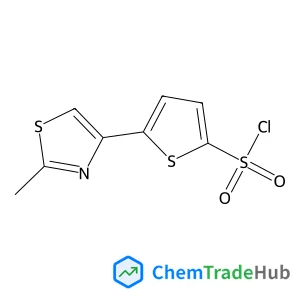
5-(2-Methyl-1,3-thiazol-4-yl)-2-thiophenesulfonyl chloride
CAS Number:
215434-25-6
Molecular Formula:
C8H6ClNO2S3
Recommended Suppliers






Disclaimer
This page provides academic journal information for reference and research purposes only. We are not affiliated with any journal publishers and do not handle publication submissions. For publication-related inquiries, please contact the respective journal publishers directly.
If you notice any inaccuracies in the information displayed, please contact us at support@chemtradehub.com. We will promptly review and address your concerns.