












Sulfur-doped graphene as a potential alternative metal-free electrocatalyst and Pt-catalyst supporting material for oxygen reduction reaction
Literature Information
Publication Date
2013-10-18
DOI
10.1039/C3CP54311K
Impact Factor
3.676
Authors
Ji-eun Park, Yu Jin Jang, Yeo Jin Kim, Mi-sun Song, Seokhyun Yoon, Dong Ha Kim, Sung-Jin Kim
View Original
Abstract
In this study, sulfur-doped graphene (S-graphene) was synthesized by thermal treatment of exfoliated graphene under CS2 gas flow. Its electrocatalytic activity as a metal-free catalyst was evaluated and compared with other doped-graphenes and commercial platinum nanoparticles loaded on carbon black (Pt/C) catalysts for oxygen reduction reaction (ORR) in fuel cell cathodes. The resultant S-graphene was shown to act as a viable catalyst for ORR and its limiting current density and durability were improved compared to those of the commercial Pt/C catalyst. The current density at −1.0 V for the commercial Pt/C catalyst, pristine graphene, nitrogen-doped graphene (N-graphene) and S-graphene was 4.7, 0.15, 6.26 and 6.99 mA cm−2, respectively. The durability of S-graphene (70.3%) was much better compared to commercial Pt/C (37.2%) and N-graphene (67.9%). When S-graphene was used as a supporting material for Pt nanoparticles, its catalytic performance was significantly higher than other Pt catalysts supported on different doped graphenes. Here, we demonstrate that S-graphene can be used as a novel graphene-based efficient metal-free ORR catalyst in fuel cells.
Related Literature
High-entropy alloys in electrocatalysis: from fundamentals to applications
Jin-Tao Ren, Lei Chen, Hao-Yu Wang
2023-11-03
Review Article
DOI: 10.1039/D3CS00557G
Electrocatalysis of nitrogen pollution: transforming nitrogen waste into high-value chemicals
Qilong Wu, Fangfang Zhu, Gordon Wallace, Xiangdong Yao, Jun Chen
2023-12-15
Viewpoint
DOI: 10.1039/D3CS00714F
Metallosupramolecular polymers: current status and future prospects
Rahul Dev Mukhopadhyay
2023-11-14
Review Article
DOI: 10.1039/D3CS00692A
Virus-mimicking nanosystems: from design to biomedical applications
Hao-Yang Liu, Xiao Li, Zhi-Gang Wang
2023-11-06
Tutorial Review
DOI: 10.1039/D3CS00138E
Stereoselective RNA reaction with chiral 2′-OH acylating agents
Ryuta Shioi, Lu Xiao, Sayantan Chatterjee
2023-11-07
Edge Article
DOI: 10.1039/D3SC03067A
Reactivity of metal–oxo clusters towards biomolecules: from discrete polyoxometalates to metal–organic frameworks
David E. Salazar Marcano, Nada D. Savić, Kilian Declerck, Shorok A. M. Abdelhameed, Tatjana N. Parac-Vogt
2023-11-28
Review Article
DOI: 10.1039/D3CS00195D
Nanotechnologies in ceramic electrochemical cells
Jiafeng Cao, Yuexia Ji, Zongping Shao
2023-12-15
Review Article
DOI: 10.1039/D3CS00303E
Heterogenization of molecular catalysts within porous solids: the case of Ni-catalyzed ethylene oligomerization from zeolites to metal–organic frameworks
Rémy Rajapaksha, Partha Samanta, Elsje Alessandra Quadrelli, Jérôme Canivet
2023-10-30
Review Article
DOI: 10.1039/D3CS00188A
You might also like
Compound Q&A
How should waste containing 6-Chloro-5-(2'-hydroxy-3'-methoxy-4-biphenylyl)-3-(3-methoxyphenyl)-1H-pyrrolo[3,2-d]pyrimidine-2,4(3H,5H)-dione (CAS: 1346607-05-3) be handled?
Waste containing 6-Chloro-5-(2'-hydroxy-3'-methoxy-4-biphenylyl)-3-(3-methoxyphe...
1346607-05-36-Chloro-5-(2'-hydro...
Compound Q&A
What are the main uses of (3alpha,5alpha)-3-Hydroxypregnane-11,20-dione (CAS: 23930-19-0)?
(3alpha,5alpha)-3-Hydroxypregnane-11,20-dione is primarily used in the pharmaceu...
23930-19-0(3alpha,5alpha)-3-Hy...
Compound Q&A
What is the market or research trend for 4-Amino-6-chloro-2-pyridinecarboxylic acid (CAS: 546141-56-4)?
The market for 4-Amino-6-chloro-2-pyridinecarboxylic acid (CAS: 546141-56-4) is ...
546141-56-44-Amino-6-chloro-2-p...
Compound Q&A
Are there alternatives to (2-Benzoylethyl)trimethylammonium chloride (CAS: 24472-88-6) in synthesis?
Alternatives to (2-Benzoylethyl)trimethylammonium chloride (CAS: 24472-88-6) in ...
24472-88-6(2-Benzoylethyl)trim...
Compound Q&A
Is N-[4-Nitro-3-(trifluoromethyl)phenyl]acetamide (CAS: 393-12-4) safe?
N-[4-Nitro-3-(trifluoromethyl)phenyl]acetamide (CAS: 393-12-4) is generally safe...
393-12-4N-[4-Nitro-3-(triflu...
Compound Q&A
Are there alternatives to [(4R,5R,6S)-5-hydroxy-10-imino-3,7-dioxa-1,9-diazatricyclo[6.4.0.02,6]dodeca-8,11-dien-4-yl]methyl dihydrogen phosphate (CAS: 39679-56-6) in synthesis?
Alternative reagents such as other phosphates or similar functional groups can b...
39679-56-6[(4R,5R,6S)-5-hydrox...
Compound Q&A
Are there alternatives to N,N'-Bis(3-aminopropyl)-1,3-propanediamine (CAS: 4605-14-5) in synthesis?
There are alternatives to N,N'-Bis(3-aminopropyl)-1,3-propanediamine (CAS: 4605-...
4605-14-5N,N'-Bis(3-aminoprop...
Compound Q&A
What precautions should be taken when handling Aluminium trihexadecanoate (CAS: 555-35-1)?
When handling Aluminium trihexadecanoate, it is important to use appropriate per...
555-35-1Aluminium trihexadec...
Compound Q&A
What is (1,1-Dioxido-3-oxo-1,2-benzothiazol-2(3H)-yl)acetic acid (CAS: 52188-11-1)?
(1,1-Dioxido-3-oxo-1,2-benzothiazol-2(3H)-yl)acetic acid is a chemical compound ...
52188-11-1(1,1-Dioxido-3-oxo-1...
Compound Q&A
Are there alternatives to 5,5-dimethyloxolan-2-one (CAS: 3123-97-5) in synthesis?
Several alternatives to 5,5-dimethyloxolan-2-one (CAS: 3123-97-5) can be used in...
3123-97-55,5-dimethyloxolan-2...
Source Journal
Physical Chemistry Chemical Physics

CiteScore:
5.5
Self-citation Rate:
10.3%
Articles per Year:
3036
Physical Chemistry Chemical Physics (PCCP) is an international journal co-owned by 19 physical chemistry and physics societies from around the world. This journal publishes original, cutting-edge research in physical chemistry, chemical physics and biophysical chemistry. To be suitable for publication in PCCP, articles must include significant innovation and/or insight into physical chemistry; this is the most important criterion that reviewers and Editors will judge against when evaluating submissions. The journal has a broad scope and welcomes contributions spanning experiment, theory, computation and data science. Topical coverage includes spectroscopy, dynamics, kinetics, statistical mechanics, thermodynamics, electrochemistry, catalysis, surface science, quantum mechanics, quantum computing and machine learning. Interdisciplinary research areas such as polymers and soft matter, materials, nanoscience, energy, surfaces/interfaces, and biophysical chemistry are welcomed if they demonstrate significant innovation and/or insight into physical chemistry. Joined experimental/theoretical studies are particularly appreciated when complementary and based on up-to-date approaches.
Recommended Compounds
![1-(2-Chlorophenyl)-6-[(2S)-3,3,3-trifluoro-2-methylpropyl]-1,7-dihydro-4H-pyrazolo[3,4-d]pyrimidin-4-one structure](https://static.chemtradehub.com/structs/794/794568-91-5-0c34.webp "1-(2-Chlorophenyl)-6-[(2S)-3,3,3-trifluoro-2-methylpropyl]-1,7-dihydro-4H-pyrazolo[3,4-d]pyrimidin-4-one structure")
1-(2-Chlorophenyl)-6-[(2S)-3,3,3-trifluoro-2-methylpropyl]-1,7-dihydro-4H-pyrazolo[3,4-d]pyrimidin-4-one
CAS Number:
794568-91-5
Molecular Formula:
C15H12ClF3N4O
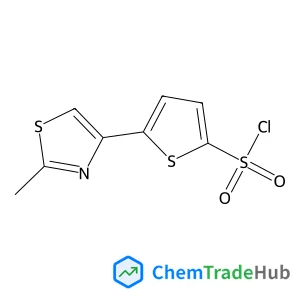
5-(2-Methyl-1,3-thiazol-4-yl)-2-thiophenesulfonyl chloride
CAS Number:
215434-25-6
Molecular Formula:
C8H6ClNO2S3
Recommended Suppliers





Disclaimer
This page provides academic journal information for reference and research purposes only. We are not affiliated with any journal publishers and do not handle publication submissions. For publication-related inquiries, please contact the respective journal publishers directly.
If you notice any inaccuracies in the information displayed, please contact us at support@chemtradehub.com. We will promptly review and address your concerns.