












Rhodium(iii)-catalyzed directed C–H benzylation and allylation of indoles with organosilicon reagents
Literature Information
Publication Date
2016-11-29
DOI
10.1039/C6QO00589F
Impact Factor
5.281
Authors
Ming-Zhu Lu, Cheng-Qiang Wang, Sheng-Jin Song
View Original
Abstract
Rhodium(III)-catalyzed C2-benzylation and allylation of indoles with organosilicon reagents via chelation-assisted C–H activation has been developed. This protocol demonstrates a board substrate scope, tolerates a broad range of synthetically useful functional groups, and enables a straightforward route to C2-benzyl- and allylindole derivatives.
Related Literature
Jet-cooled vibronic spectroscopy of potential intermediates along the pathway to PAH: phenylcyclopenta-1,3-diene
Josh J. Newby, Ching-Ping Liu, Christian W. Müller, Timothy S. Zwier
2009-07-07
Paper
DOI: 10.1039/B903827B
Reversible photoisomerization of an azobenzene-functionalized self-assembled monolayer probed by sum-frequency generation vibrational spectroscopy
Steffen Wagner, Felix Leyssner, Christian Kördel, Sebastian Zarwell, Roland Schmidt, Karola Rück-Braun, Petra Tegeder
2009-05-20
Paper
DOI: 10.1039/B823330F
Quantum coherence and its interplay with protein environments in photosynthetic electronic energy transfer
2010-06-12
Perspective
DOI: 10.1039/C003389H
The formation of colloidal coppernanoparticles stabilized by zinc stearate: one-pot single-step synthesis and characterization of the core–shell particles
André Rittermeier, Shaojun Miao, Xiaoning Zhang, Maurits W. E. van den Berg, Shankhamala Kundu, Yuemin Wang, Sabine Schimpf, Elke Löffler, Roland A. Fischer, Martin Muhler
2009-07-13
Paper
DOI: 10.1039/B908034A
Two-dimensional electronic spectra of an aggregating dye: simultaneous measurement of monomeric and dimeric line-shapes
Alexandra Nemeth, Vladimír Lukeš, Jaroslaw Sperling, Franz Milota, Tomáš Mančal
2009-05-18
Paper
DOI: 10.1039/B902477H
Jet-cooled vibronic spectroscopy and asymmetric torsional potentials of phenylcyclopentene
Josh J. Newby, Christian W. Müller, Ching-Ping Liu, Timothy S. Zwier
2009-07-07
Paper
DOI: 10.1039/B903830B
Methanol oxidation enhanced by the presence of O2 at novel Pt–C co-sputtered electrode
Minoru Umeda, Kazuhiro Nagai, Masahiko Shibamine, Mitsuhiro Inoue
2010-05-15
Paper
DOI: 10.1039/B926115J
Appraising the relative strengths of C–H⋯OC and N–H⋯OC interactions from cis-N-methylacetamide multimers
Simon Mathieu, Georges Trinquier
2009-06-30
Paper
DOI: 10.1039/B908152F
Characterizing industrial catalysts using in situ XAFS under identical conditions‡
Simon R. Bare, Shelly D. Kelly, Bruce Ravel, Nan Greenlay, Lisa King, George E. Mickelson
2010-05-26
Paper
DOI: 10.1039/B926621F
You might also like
Compound Q&A
What precautions should be taken when handling 2-Methyl-2-propanyl 5-amino-2-thiophenecarboxylate (CAS: 1498311-57-1)?
When handling 2-Methyl-2-propanyl 5-amino-2-thiophenecarboxylate (CAS: 1498311-5...
1498311-57-12-Methyl-2-propanyl ...
Compound Q&A
What are the physical and chemical properties of 5-Bromo-1,2-dichloro-3-fluorobenzene (CAS: 1000572-93-9)?
5-Bromo-1,2-dichloro-3-fluorobenzene (CAS: 1000572-93-9) is a crystalline solid ...
1000572-93-95-Bromo-1,2-dichloro...
Compound Q&A
How should (2R)-2-Amino-2-(4-bromophenyl)ethanol (CAS: 354153-64-3) be stored?
(2R)-2-Amino-2-(4-bromophenyl)ethanol (CAS: 354153-64-3) should be stored in a c...
354153-64-3(2R)-2-Amino-2-(4-br...
Compound Q&A
What regulatory guidelines apply to Methyl 4-(aminomethyl)tetrahydro-2H-pyran-4-carboxylate hydrochloride (CAS: 362707-24-2)?
Methyl 4-(aminomethyl)tetrahydro-2H-pyran-4-carboxylate hydrochloride (CAS: 3627...
362707-24-2Methyl 4-(aminomethy...
Compound Q&A
What are the main uses of 1,4-dimethyl-1H-pyrazole-5-sulfonyl chloride (CAS: 1174834-52-6)?
1,4-Dimethyl-1H-pyrazole-5-sulfonyl chloride is primarily used as an intermediat...
1174834-52-61,4-dimethyl-1H-pyra...
Compound Q&A
Is Dinaphtho[1,2-b:2',1'-d]furan (CAS: 239-69-0) safe?
Dinaphtho[1,2-b:2',1'-d]furan is generally safe when handled with appropriate pe...
239-69-0Dinaphtho[1,2-b:2',1...
Compound Q&A
What is the market or research trend for 7-Methyl-7,9-dihydro-1H-purine-2,6,8(3H)-trione (CAS: 612-37-3)?
The market for 7-Methyl-7,9-dihydro-1H-purine-2,6,8(3H)-trione (CAS: 612-37-3) i...
612-37-37-Methyl-7,9-dihydro...
Compound Q&A
What are the physical and chemical properties of 2-(4-Chlorophenyl)malonaldehyde (CAS: 205676-17-1)?
2-(4-Chlorophenyl)malonaldehyde (CAS: 205676-17-1) is a colorless or light yello...
205676-17-12-(4-Chlorophenyl)ma...
Compound Q&A
How is 2-Methylchrysene (CAS: 3351-32-4) typically synthesized?
2-Methylchrysene (CAS: 3351-32-4) is typically synthesized via the reaction of c...
3351-32-42-Methylchrysene
Compound Q&A
Is N-(6-aminopyrimidin-4-yl)acetamide (CAS: 89533-23-3) safe?
N-(6-aminopyrimidin-4-yl)acetamide (CAS: 89533-23-3) is generally considered saf...
89533-23-3N-(6-aminopyrimidin-...
Source Journal
Organic Chemistry Frontiers

CiteScore:
7.8
Self-citation Rate:
8.7%
Articles per Year:
724
Organic Chemistry Frontiers publishes high-quality research from across organic chemistry. Emphases are placed on studies that make significant contributions to the field of organic chemistry by reporting either new or significantly improved protocols or methodologies. Topics include, but are not limited to the following: Organic synthesis Development of synthetic methodologies Catalysis Natural products Functional organic materials Supramolecular and macromolecular chemistry Physical and computational organic chemistry
Recommended Compounds
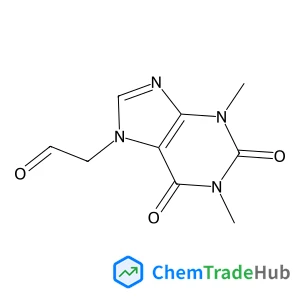
(1,3-Dimethyl-2,6-dioxo-1,2,3,6-tetrahydro-7H-purin-7-yl)acetaldehyde
CAS Number:
5614-53-9
Molecular Formula:
C9H10N4O3
![1-Oxa-8-azaspiro[4.5]decan-3-ol structure](https://static.chemtradehub.com/structs/757/757239-76-2-a0ec.webp "1-Oxa-8-azaspiro[4.5]decan-3-ol structure")
![2-[2-(2-Methoxyethoxy)ethoxy]-2-methylpropane structure](https://static.chemtradehub.com/structs/527/52788-79-1-71c1.webp "2-[2-(2-Methoxyethoxy)ethoxy]-2-methylpropane structure")
Recommended Suppliers






Disclaimer
This page provides academic journal information for reference and research purposes only. We are not affiliated with any journal publishers and do not handle publication submissions. For publication-related inquiries, please contact the respective journal publishers directly.
If you notice any inaccuracies in the information displayed, please contact us at support@chemtradehub.com. We will promptly review and address your concerns.