












Cyclic poly(l-lactide)s via ring-expansion polymerizations catalysed by 2,2-dibutyl-2-stanna-1,3-dithiolane
Literature Information
Publication Date
2017-01-31
DOI
10.1039/C6PY02166B
Impact Factor
5.582
Authors
H. R. Kricheldorf, S. M. Weidner, F. Scheliga
View Original
Abstract
L-Lactides were polymerized in bulk at 120 or 160 °C with cyclic dibutyltin catalysts derived from 1,2-dimercaptoethane or 2-mercaptoethanol. Only linear chains having one benzyl ester and one OH-end group were obtained when benzyl alcohol was added. When L-lactides were polymerized with neat dibutyl-2-stanna-1,3-dithiolane, exclusively cyclic polylactides were formed even at 120 °C. The temperature, time and monomer/catalyst ratio (M/C) were varied. These results are best explained by a combination of ring-expansion polymerization and ring-extrusion of cyclic oligo- or polylactides with elimination of the cyclic catalyst. Neither syntheses of linear polylactides nor of cyclic lactides involved racemization up to 20 h at 160 °C.
Recommended Journals
Related Literature
In situ formation of a ZnS/In interphase for reversible Zn metal anodes at ultrahigh currents and capacities
Chengwu Yang, Pattaraporn Woottapanit, Jin Cao, Yilei Yue, Dongdong Zhang, Jin Yi, Zhiyuan Zeng, Xinyu Zhang, Jiaqian Qin, Yonggang Wang
2023-10-31
Paper
DOI: 10.1039/D3TA05650C
A low-self-discharge high-loading polysulfide cathode design for lithium–sulfur cells
Cheng-Che Wu, Yun-Chung Ho
2023-11-01
Paper
DOI: 10.1039/D3TA05632E
Coke relocation and Mo immobilization in donut-shaped Mo/HZSM-5 catalysts for methane dehydroaromatization
Ming Cheng, Hugo Cruchade, Ludovic Pinard, Eddy Dib, Honghai Liu, Jiujiang Wang, Xinmei Liu, Zi-Feng Yan, Zhengxing Qin, Svetlana Mintova
2023-11-10
Paper
DOI: 10.1039/D3TA05418G
Construction of a hierarchical BiOBr/C3N4 S-scheme heterojunction for selective photocatalytic CO2 reduction towards CO
Wei Tao, Qiaoya Tang, Jianqiang Hu, Zhipeng Wang, Baojiang Jiang, Yuting Xiao, Renjie Song, Shien Guo
2023-11-02
Paper
DOI: 10.1039/D3TA05388A
siRNA-loaded DNA nanostructures restore endothelial leakiness
Arun Richard Chandrasekaran
2023-10-04
Editorial
DOI: 10.1039/D3NH90040A
Solar light selective-harvesting eco-friendly colloidal quantum dots for transparent luminescent solar concentrators
Ehsan Hamzehpoor, Jiabin Liu, Xin Liu, Gurpreet Singh Selopal, Dmytro F. Perepichka, Zhiming M. Wang
2023-10-13
Paper
DOI: 10.1039/D3TA05351B
Modulation of the assembly fashion among metal–organic frameworks for enantioretentive epoxide activation
Jun Guo, Xiaomin Xue, Fangfang Li, Meiting Zhao, Youcong Xing, Yanmin Song, Chang Long, Tingting Zhao, Zhiyong Tang
2023-11-19
Communication
DOI: 10.1039/D3NH00419H
You might also like
Compound Q&A
What precautions should be taken when handling lithium chloride hydrate (1:1:1) (CAS: 16712-20-2)?
When handling lithium chloride hydrate (1:1:1) (CAS: 16712-20-2), it is importan...
16712-20-2Lithium chloride hyd...
Compound Q&A
Is 4-(4H-1,2,4-Triazol-4-yl)piperidine (CAS: 690261-92-8) safe?
4-(4H-1,2,4-Triazol-4-yl)piperidine is generally considered safe for use in phar...
690261-92-84-(4H-1,2,4-Triazol-...
Compound Q&A
How should waste containing 1,3-Thiazole-2-carboxamide (CAS: 16733-85-0) be handled?
Waste containing 1,3-Thiazole-2-carboxamide (CAS: 16733-85-0) should be collecte...
16733-85-01,3-Thiazole-2-carbo...
Compound Q&A
What regulatory guidelines apply to 5-(Difluoromethyl)-2-fluorobenzonitrile (CAS: 934175-58-3)?
5-(Difluoromethyl)-2-fluorobenzonitrile (CAS: 934175-58-3) is subject to regulat...
934175-58-35-(Difluoromethyl)-2...
Compound Q&A
How is Methyl 3-acetamido-2-thiophenecarboxylate (CAS: 22288-79-5) typically synthesized?
Methyl 3-acetamido-2-thiophenecarboxylate can be synthesized by the reaction of ...
22288-79-5Methyl 3-acetamido-2...
Compound Q&A
What is 4-Isoquinolinecarbonitrile (CAS: 34846-65-6)?
4-Isoquinolinecarbonitrile is a chemical compound with the CAS number 34846-65-6...
34846-65-64-Isoquinolinecarbon...
Compound Q&A
How should Methyl 1H-1,2,3-triazole-4-carboxylate (CAS: 877309-59-6) be stored?
Store Methyl 1H-1,2,3-triazole-4-carboxylate (CAS: 877309-59-6) in a cool, dry p...
877309-59-6Methyl 1H-1,2,3-tria...
Compound Q&A
What regulatory guidelines apply to 6-Bromo[1,3]thiazolo[5,4-b]pyridin-2-amine (CAS: 1160791-13-8)?
6-Bromo[1,3]thiazolo[5,4-b]pyridin-2-amine (CAS: 1160791-13-8) is subject to the...
1160791-13-86-Bromo[1,3]thiazolo...
Compound Q&A
Is (2S,3S)-2-Ammonio-3-(3,4-dihydroxyphenyl)-3-hydroxypropanoate (CAS: 23651-95-8) safe?
(2S,3S)-2-Ammonio-3-(3,4-dihydroxyphenyl)-3-hydroxypropanoate (CAS: 23651-95-8) ...
23651-95-8(2S,3S)-2-Ammonio-3-...
Compound Q&A
What are the physical and chemical properties of 7-bromo-3-methyl-3,4-dihydroquinazolin-4-one (CAS: 1293987-84-4)?
7-Bromo-3-methyl-3,4-dihydroquinazolin-4-one is a solid with a crystalline form....
1293987-84-47-bromo-3-methyl-3,4...
Source Journal
Polymer Chemistry

CiteScore:
8.6
Self-citation Rate:
7.3%
Articles per Year:
457
Polymer Chemistry welcomes submissions in all areas of polymer science that have a strong focus on macromolecular chemistry. Manuscripts may cover a broad range of fields, yet no direct application focus is required.
Recommended Compounds
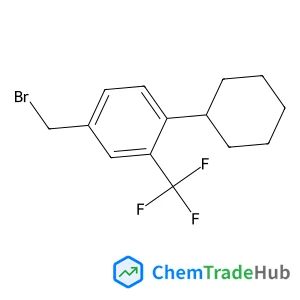
4-(Bromomethyl)-1-cyclohexyl-2-(trifluoromethyl)benzene
CAS Number:
800381-60-6
Molecular Formula:
C14H16BrF3
Recommended Suppliers



Disclaimer
This page provides academic journal information for reference and research purposes only. We are not affiliated with any journal publishers and do not handle publication submissions. For publication-related inquiries, please contact the respective journal publishers directly.
If you notice any inaccuracies in the information displayed, please contact us at support@chemtradehub.com. We will promptly review and address your concerns.