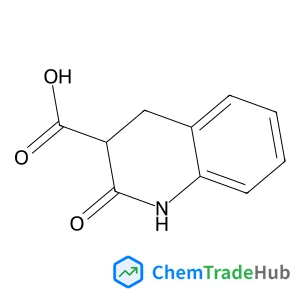
2-Oxo-1,2,3,4-tetrahydro-3-quinolinecarboxylic acid
CAS Number:
246867-17-4
Molecular Formula:
C10H9NO3
Alper Cankaya, Mark Steinmann, Yagmur Bülbül, Ingo Lieberwirth, Frederik R. Wurm
Poly(phosphoester)s (PPEs) are interesting degradable multi-functional polymers. Here, we present the first synthesis of poly(phosphoramidate)s (PPAs) via acyclic diene metathesis (ADMET) polycondensation with amidate linkages in side chains. In contrast to conventional polyamides, the P–N-bond in phosphoramidates is more labile than the corresponding esters. Unsaturated PPAs were compared with structural analogues of PPEs: two novel α,ω-dienes, i.e. bis-(undecen-10-yl)-n-butyl-phosphoramidate (1) and bis-(undecen-10-yl)-n-butyl-phosphate (2) have been polymerized by Grubbs-type catalysts to polymers with molecular weights up to ca. 20 000 g mol−1. After hydrogenation polyethylene-like structures were obtained with the phosphoramidate or -ester representing a precisely placed defect. PPAs were compared to their PPE analogues with respect to their thermal behavior and stability by differential scanning calorimetry (DSC) and thermogravimetric analysis (TGA), showing similar crystallization behavior for the saturated materials, but significant differences for unsaturated PPA vs. PPE. This synthesis of PPAs via ADMET polymerization offers an interesting approach to various PPAs. The hydrolytically labile pendant phosphoramidate further offers the possibility for the development of hydrolytically degradable materials or as processable intermediates for poly(phosphodiester)s which often show limited solubility.
Fred J. P. Feuillet, Diane E. J. E. Robinson, Steven D. Bull
DOI: 10.1039/B304213H
Andrew J. Matthews, Punit K. Bhardwaj, Andrea Vasella
DOI: 10.1039/B300932G
Qiao-Hua Wei, Gang-Qiang Yin, Zhen Ma, Lin-Xi Shi
DOI: 10.1039/B305284B
Victorio Cadierno, Salvador Conejero, Josefina Díez, M. Pilar Gamasa, José Gimeno, Santiago García-Granda
DOI: 10.1039/B212406H
T. M. Rajendiran, Martin L. Kirk, Ika A. Setyawati, M. Tyler Caudle, Jeff W. Kampf, Vincent L. Pecoraro
DOI: 10.1039/B212684M
S. Jo Ling Foo, Nathan D. Jones, Brian O. Patrick, Brian R. James
DOI: 10.1039/B300177F
Christopher A. Hunter, Caroline M. R. Low, Carmen Rotger, Jeremy G. Vinter, Cristiano Zonta
DOI: 10.1039/B300693J
Colin N. Warriner, Philip A. Gale, Mark E. Light, Michael B. Hursthouse
DOI: 10.1039/B303959E
DOI: 10.1039/B211298C
Laura Santagostini, Michele Gullotti, Roberto Pagliarin, Enrico Monzani, Luigi Casella
DOI: 10.1039/B307349A
When handling 2-Methyl-2-propanyl 5-amino-2-thiophenecarboxylate (CAS: 1498311-5...
5-Bromo-1,2-dichloro-3-fluorobenzene (CAS: 1000572-93-9) is a crystalline solid ...
(2R)-2-Amino-2-(4-bromophenyl)ethanol (CAS: 354153-64-3) should be stored in a c...
Methyl 4-(aminomethyl)tetrahydro-2H-pyran-4-carboxylate hydrochloride (CAS: 3627...
1,4-Dimethyl-1H-pyrazole-5-sulfonyl chloride is primarily used as an intermediat...
Dinaphtho[1,2-b:2',1'-d]furan is generally safe when handled with appropriate pe...
The market for 7-Methyl-7,9-dihydro-1H-purine-2,6,8(3H)-trione (CAS: 612-37-3) i...
2-(4-Chlorophenyl)malonaldehyde (CAS: 205676-17-1) is a colorless or light yello...
2-Methylchrysene (CAS: 3351-32-4) is typically synthesized via the reaction of c...
N-(6-aminopyrimidin-4-yl)acetamide (CAS: 89533-23-3) is generally considered saf...

Polymer Chemistry welcomes submissions in all areas of polymer science that have a strong focus on macromolecular chemistry. Manuscripts may cover a broad range of fields, yet no direct application focus is required.
![1-Oxa-8-azaspiro[4.5]decan-3-ol structure](https://static.chemtradehub.com/structs/757/757239-76-2-a0ec.webp "1-Oxa-8-azaspiro[4.5]decan-3-ol structure")
![methyl 6-amino-1H-pyrrolo[2,3-b]pyridine-4-carboxylate structure](https://static.chemtradehub.com/structs/119/1190315-60-6-9d9a.webp "methyl 6-amino-1H-pyrrolo[2,3-b]pyridine-4-carboxylate structure")