












Catechol/boronic acid chemistry for the creation of block copolymers with a multi-stimuli responsive junction
Literature Information
Publication Date
2016-06-17
DOI
10.1039/C6PY00738D
Impact Factor
5.582
Authors
Fanny Coumes, Aurélie Malfait, Marc Bria, Joël Lyskawa, Patrice Woisel, David Fournier
View Original
Abstract
Two original Chain Transfer Agents (CTAs) integrating either a nitrocatechol or a boronic acid moiety were synthesized allowing the conception of a wide library of end-functionalized well-defined homopolymers via the Reversible Addition–Fragmentation chain Transfer (RAFT) process. Kinetic studies using NMR spectroscopy and Size Exclusion Chromatography (SEC) were carried out, revealing good control of polymerizations of various monomers. Then, a coupling reaction between the complementary nitrocatechol and boronic acid end-chain polymers was optimized to create a dynamic boronate ester junction between the polymer blocks. The effectiveness of the reaction was demonstrated by means of NMR (1H, DOSY), SEC and cyclic voltammetry. The ability of the covalent bond, and thus the block copolymers, to be disrupted on demand was assessed using a competitive molecule (2-naphthylboronic acid) and UV irradiation as stimuli.
Recommended Journals
Related Literature
Electrophoretic silica-coating process on a nano-structured copper electrode
Laurent Bazin, Marie Gressier, Pierre-Louis Taberna, Marie-Joëlle Menu, Patrice Simon
2008-08-18
Communication
DOI: 10.1039/B807837H
Recognition of lectin with a high signal to noise ratio: carbohydrate-tri(ethylene glycol)-alkanethiol co-adsorbed monolayer
Yukari Sato, Kyoko Yoshioka, Mutsuo Tanaka, Teiichi Murakami, Miho Neide Ishida, Osamu Niwa
2008-09-09
Communication
DOI: 10.1039/B809481K
A stable enol in small ring systems: clear differentiation between penta- and tri-valency of phosphorus atoms
Alex S. Ionkin, William J. Marshall, Brian M. Fish, Matthew F. Schiffhauer, Charles N. McEwen
2008-09-22
Communication
DOI: 10.1039/B809877H
Novel low-melting salts with donor–acceptor substituents as targets for second-order nonlinear optical applications
Zhi-Qiang Zhu, Shaoji Xiang, Qing-Yun Chen, Chaosen Chen, Zhuo Zeng, Yi-Ping Cui, Ji-Chang Xiao
2008-09-01
Communication
DOI: 10.1039/B810671A
Formation of a stable dicarbenoid and an unsaturated C2P2S2 ring from two-electron oxidation of the [C(PPh2S)2]2− dianion
Jari Konu, Tristram Chivers
2008-09-12
Communication
DOI: 10.1039/B810796C
Three-dimensional AlN microroses and their enhanced photoluminescence properties
Weiwei Lei, Jian Zhang, Dan Liu, Pinwen Zhu, Qiliang Cui, Guangtian Zou
2008-09-12
Communication
DOI: 10.1039/B809380F
Facile synthesis, assembly, and immobilization of ordered arrays of monodisperse magnetic nanoparticles on silicon substrates
Gyu Leem, Andrew C. Jamison, Shishan Zhang, Dmitri Litvinov, T. Randall Lee
2008-09-10
Communication
DOI: 10.1039/B804633F
Encapsulation of charge-diffuse peralkylated onium cations in the cavity of cucurbit[7]uril
Antony D. St-Jacques, Ian W. Wyman, Donal H. Macartney
2008-09-16
Communication
DOI: 10.1039/B811823J
Palladium-catalyzed carboboration of alkynes using chloroborane and organozirconium reagents
Masaki Daini, Michinori Suginome
2008-09-12
Communication
DOI: 10.1039/B809433K
Heterogeneous ultrathin films fabricated by alternate assembly of exfoliated layered double hydroxides and polyanion
Jing Bin Han, Jun Lu, Min Wei, Zhong Lin Wang, Xue Duan
2008-09-12
Communication
DOI: 10.1039/B807479H
You might also like
Compound Q&A
What are the main uses of 1-(3-Aminophenyl)-3-[(3R)-1-(3,3-dimethyl-2-oxobutyl)-2-oxo-5-(2-pyridinyl)-2,3-dihydro-1H-1,4-benzodiazepin-3-yl]urea (CAS: 155412-88-7)?
This compound is mainly used as an intermediate in the synthesis of antipsychoti...
155412-88-71-(3-Aminophenyl)-3-...
Compound Q&A
How should waste containing 1-(D-Ribofuranosyl)-1,4-dihydro-3-pyridinecarboxamide (CAS: 19132-12-8) be handled?
Waste containing 1-(D-Ribofuranosyl)-1,4-dihydro-3-pyridinecarboxamide (CAS: 191...
19132-12-81-(D-Ribofuranosyl)-...
Compound Q&A
What regulatory guidelines apply to 2-Methyl-2-propanyl 3-bromo-3-(hydroxymethyl)-1-azetidinecarboxylate (CAS: 2007919-81-3)?
2-Methyl-2-propanyl 3-bromo-3-(hydroxymethyl)-1-azetidinecarboxylate (CAS: 20079...
2007919-81-32-Methyl-2-propanyl ...
Compound Q&A
What is N-(4-Chloro-2-pyridinyl)acetamide (CAS: 245056-66-0)?
N-(4-Chloro-2-pyridinyl)acetamide (CAS: 245056-66-0) is a chemical compound with...
245056-66-0N-(4-Chloro-2-pyridi...
Compound Q&A
What is 5-Chloro-2-hydroxybenzoic acid (CAS: 321-14-2)?
5-Chloro-2-hydroxybenzoic acid, also known as 5-chlorosalicylic acid, is an arom...
321-14-25-Chloro-2-hydroxybe...
Compound Q&A
What precautions should be taken when handling 1,1-Dichloro-1-fluoroethane (CAS: 1717-00-6)?
When handling 1,1-Dichloro-1-fluoroethane (CAS: 1717-00-6), it is important to u...
1717-00-61,1-Dichloro-1-fluor...
Compound Q&A
What are the physical and chemical properties of Fmoc-(2S,3R)-3-phenylpyrrolidine-2-carboxylic acid (CAS: 281655-32-1)?
Fmoc-(2S,3R)-3-phenylpyrrolidine-2-carboxylic acid is a white crystalline solid ...
281655-32-1Fmoc-(2S,3R)-3-pheny...
Compound Q&A
What are the main uses of 4-Amino-5-bromo-2-pyridinecarboxylic acid (CAS: 1363381-01-4)?
4-Amino-5-bromo-2-pyridinecarboxylic acid is primarily used as a precursor in th...
1363381-01-44-Amino-5-bromo-2-py...
Compound Q&A
What precautions should be taken when handling (S)-tert-butyl 2-((2-(4-bromophenyl)-2-oxoethyl)carbamoyl)pyrrolidine-1-carboxylate (CAS: 1007881-98-2)?
Handling this compound should be done with personal protective equipment (PPE) i...
1007881-98-2(S)-tert-butyl 2-((2...
Compound Q&A
What precautions should be taken when handling 8-bromo-2,2-dimethyl-3,4-dihydro-2H-1,4-benzoxazin-3-one (CAS: 688363-73-7)?
When handling 8-bromo-2,2-dimethyl-3,4-dihydro-2H-1,4-benzoxazin-3-one, use prop...
688363-73-78-bromo-2,2-dimethyl...
Source Journal
Polymer Chemistry

CiteScore:
8.6
Self-citation Rate:
7.3%
Articles per Year:
457
Polymer Chemistry welcomes submissions in all areas of polymer science that have a strong focus on macromolecular chemistry. Manuscripts may cover a broad range of fields, yet no direct application focus is required.
Recommended Compounds
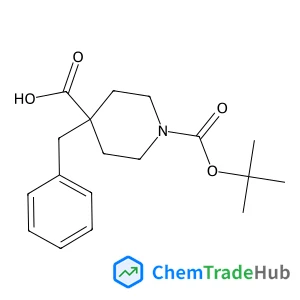
4-Benzyl-1-(tert-butoxycarbonyl)piperidine-4-carboxylic acid
CAS Number:
170838-87-6
Molecular Formula:
C18H25NO4


Recommended Suppliers



Disclaimer
This page provides academic journal information for reference and research purposes only. We are not affiliated with any journal publishers and do not handle publication submissions. For publication-related inquiries, please contact the respective journal publishers directly.
If you notice any inaccuracies in the information displayed, please contact us at support@chemtradehub.com. We will promptly review and address your concerns.