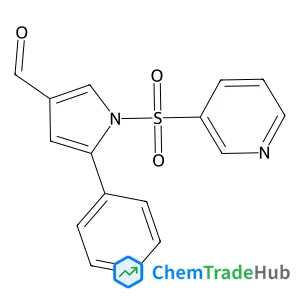
5-Phenyl-1-(pyridin-3-ylsulfonyl)-1H-pyrrole-3-carbaldehyde
CAS Number:
881676-90-0
Molecular Formula:
C16H12N2O3S
Owing to the great advances in the automated synthesis and programmed self-assembly of nucleic acids, these are readily used for advances in nanoscience, polymer science, supramolecular chemistry, and for elaborating complex chemical systems connected with the origin of life. In this minireview, we report on the recent advances of the utilization of nucleobases, nucleotides, and nucleic acids as templates to achieve well-defined supramolecular polymers, synthetic polymers, and sequence-controlled polymers. We particularly emphasize the aspects of supramolecular organization, self-assembly, chirality effects, and information transfer, going from nucleobase templating to DNA-templated polymerizations. Some recent developments of supramolecular hybrids involving nucleic acids are underlined for prospective biological applications.

Current Opinion in Solid State & Materials Science

Current Opinion in Colloid & Interface Science

Nature Medicine

Russian Journal of Applied Chemistry

Journal of Natural Medicines

Drug Discovery Today

Chemistry Education Research and Practice

Journal of Peptide Science

Organic Process Research & Development

Russian Chemical Bulletin
Min Zhou, Fan Pu, Zhao Wang, Tingwei Cai, Hao Chen, Haiyong Zhang, Shiyou Guan
DOI: 10.1039/C3CP51276B
Rocio Esquembre, Jesus M. Sanz, J. Gerard Wall, Francisco del Monte, C. Reyes Mateo, M. Luisa Ferrer
DOI: 10.1039/C3CP44299C
G. Ramos-Sanchez, P. B. Balbuena
DOI: 10.1039/C3CP51791H
Yilei Wu, Agnieszka Olzyńska, Martin Hof, Gokhan Yahioglu, Duncan R. Casey, Oscar Ces, Jana Humpolíčková, Marina K. Kuimova
DOI: 10.1039/C3CP51953H
Vincenzo Barone, Ivo Cacelli, Alessandro Ferretti
DOI: 10.1039/C3CP50974E
Yuqi Zhang, Loujun Gao, Liping Wen, Liping Heng, Yanlin Song
DOI: 10.1039/C3CP51324F
Li-Lin Tan, Hong-Yan Chen, Li-Feng Hao, Yong Shen, Li-Min Xiao, Jun-Min Liu, Dai-Bin Kuang, Cheng-Yong Su
DOI: 10.1039/C3CP51633D
Juraj Sibik, Evgenyi Y. Shalaev, J. Axel Zeitler
DOI: 10.1039/C3CP51936H
When considering alternatives to 1-(4-Chlorophenyl)-N-hydroxymethanimine (CAS: 3...
This compound should be stored in a cool, dry place away from direct sunlight. I...
3-(4-Bromophenyl)-5-(2-fluorophenyl)-1,2,4-oxadiazole is synthesized through a m...
5-Chloro-2-(4-chlorophenyl)-4-methyl-6-[3-(1-piperidinyl)propoxy]pyrimidine (CAS...
2-Chloro-4-(difluoromethoxy)pyridine is used in the pharmaceutical industry for ...
3-Chloro-6-methylpyridazine (CAS: 1121-79-5) is classified under the Globally Ha...
Several alternatives can be used in the synthesis of Methyl 4,5-dimethyl-2-nitro...
Alternatives to (2E,2'E)-3,3'-(1,4-Phenylene)bisacrylaldehyde include other acry...
3-Amino-5-chloropyridin-2-ol hydrochloride is an organic compound with the CAS n...
When handling 6,7-Difluoro-2,3-dihydro-4H-chromen-4-one, it is essential to wear...

Polymer Chemistry welcomes submissions in all areas of polymer science that have a strong focus on macromolecular chemistry. Manuscripts may cover a broad range of fields, yet no direct application focus is required.
![4-[(3-Chloro-2-fluorophenyl)amino]-7-methoxy-6-quinazolinyl acetate structure](https://static.chemtradehub.com/structs/740/740081-22-5-f58f.webp "4-[(3-Chloro-2-fluorophenyl)amino]-7-methoxy-6-quinazolinyl acetate structure")