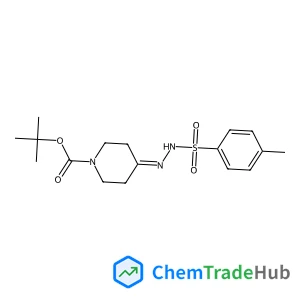
tert-Butyl 4-(2-(p-Tolylsulfonyl)hydrazono)piperidine-1-carboxylate
CAS Number:
1046478-89-0
Molecular Formula:
C17H25N3O4S
Rocio Esquembre, Jesus M. Sanz, J. Gerard Wall, Francisco del Monte, C. Reyes Mateo, M. Luisa Ferrer
The stability of hen's egg white lysozyme in different choline chloride-based pseudo-concentrated and neat deep eutectic solvents (DESs) has been studied by means of intrinsic fluorescence and CD spectroscopy. Thermal unfolding experiments carried out in non-diluted urea:choline chloride and glycerol:choline chloride eutectic solvents (UCCl-DES and GCCl-DES, respectively) showed the accumulation at certain temperatures of discrete, partially folded intermediates that displayed a high content of secondary structure and a disrupted tertiary structure. Reversibility of the unfolding process was incomplete in these circumstances, with the urea-based DES showing higher protein structure destabilization upon thermal treatment. On the other hand, aqueous dilution of the eutectic mixtures allowed the recovery of a reversible, two-state denaturation process. Lysozyme activity was also affected in neat and pseudo-concentrated GCCl-DES, with an increasing recovery of activity upon aqueous dilution, and full restoration after DES removal through extensive dialysis. These results suggest that protein interactions at room temperature are reversible and depend on the DES components and on the aqueous content of the original DES dilution.
JianHua Wang, LiHen Feng, JianBin Chao, Yu Wang, ShaoMin Shuang
DOI: 10.1039/C9AY01438A
Weijia Leng, Kimberly Evans, Michael G. Roper
DOI: 10.1039/C9AY01758E
Lina Zou, Ying Xu, Peili Luo, Shusheng Zhang, Baoxian Ye
DOI: 10.1039/C1AN15720E
Masoumeh Sarabaegi, Mahmoud Roushani
DOI: 10.1039/C9AY01509D
Guanghui Cheng, Jiangli Fan, Wen Sun, Kun Sui, Xin Jin, Jingyun Wang, Xiaojun Peng
DOI: 10.1039/C3AN01152F
DOI: 10.1039/D0AN00142B
Siyu Xu, Quan Yu
DOI: 10.1039/C9AY01669D
Jia-Ju Fu, Tingting Zheng, Jun-Jie Zhu
DOI: 10.1039/C3AN01255G
Jiajing Zhu, Yanling Tian, Xianping Liu
DOI: 10.1039/D1AY00649E
When considering alternatives to 1-(4-Chlorophenyl)-N-hydroxymethanimine (CAS: 3...
This compound should be stored in a cool, dry place away from direct sunlight. I...
3-(4-Bromophenyl)-5-(2-fluorophenyl)-1,2,4-oxadiazole is synthesized through a m...
5-Chloro-2-(4-chlorophenyl)-4-methyl-6-[3-(1-piperidinyl)propoxy]pyrimidine (CAS...
2-Chloro-4-(difluoromethoxy)pyridine is used in the pharmaceutical industry for ...
3-Chloro-6-methylpyridazine (CAS: 1121-79-5) is classified under the Globally Ha...
Several alternatives can be used in the synthesis of Methyl 4,5-dimethyl-2-nitro...
Alternatives to (2E,2'E)-3,3'-(1,4-Phenylene)bisacrylaldehyde include other acry...
3-Amino-5-chloropyridin-2-ol hydrochloride is an organic compound with the CAS n...
When handling 6,7-Difluoro-2,3-dihydro-4H-chromen-4-one, it is essential to wear...

Physical Chemistry Chemical Physics (PCCP) is an international journal co-owned by 19 physical chemistry and physics societies from around the world. This journal publishes original, cutting-edge research in physical chemistry, chemical physics and biophysical chemistry. To be suitable for publication in PCCP, articles must include significant innovation and/or insight into physical chemistry; this is the most important criterion that reviewers and Editors will judge against when evaluating submissions. The journal has a broad scope and welcomes contributions spanning experiment, theory, computation and data science. Topical coverage includes spectroscopy, dynamics, kinetics, statistical mechanics, thermodynamics, electrochemistry, catalysis, surface science, quantum mechanics, quantum computing and machine learning. Interdisciplinary research areas such as polymers and soft matter, materials, nanoscience, energy, surfaces/interfaces, and biophysical chemistry are welcomed if they demonstrate significant innovation and/or insight into physical chemistry. Joined experimental/theoretical studies are particularly appreciated when complementary and based on up-to-date approaches.