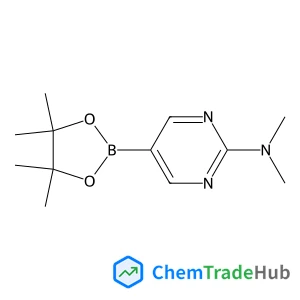
N,N-Dimethyl-5-(4,4,5,5-tetramethyl-1,3,2-dioxaborolan-2-yl)-2-pyrimidinamine
CAS Number:
1032759-30-0
Molecular Formula:
C12H20BN3O2
A graphical abstract is available for this content
Zheng Wan, Yanan Liu, Shifan Wang, Yu Zhong, Cheng Li, Zhiguo Zhang, Guichuan Xing, Sven Huettner, Youtian Tao, Yongfang Li
DOI: 10.1039/C7PY00924K
Yueyan Zhang, Katrina M. Konopka, Richard S. Glass, Kookheon Char
DOI: 10.1039/C7PY00587C
Yilin Li, Wesley K. Tatum, Jonathan W. Onorato, Sierra D. Barajas, Yun Young Yang
DOI: 10.1039/C7PY00435D
Yuanyuan Ju, Mingming Zhang, Hanying Zhao
DOI: 10.1039/C7PY01012E
K. Wolski, A. Gruszkiewicz, M. Wytrwal-Sarna, S. Zapotoczny
DOI: 10.1039/C7PY01418J
G. Bartocci, G. Galiazzo, U. Mazzucato, A. Spalletti
DOI: 10.1039/B009107N
Hidefumi Amano, Satoshi Sato, Ryoji Takahashi, Toshiaki Sodesawa
DOI: 10.1039/B008895L
Fang Qu, Beihong Yang, Qun He, Weifeng Bu
DOI: 10.1039/C7PY00993C
Min He, Qian Wang, Weifeng Zhao, Jianshu Li, Changsheng Zhao
DOI: 10.1039/C7PY00967D
When considering alternatives to 1-(4-Chlorophenyl)-N-hydroxymethanimine (CAS: 3...
This compound should be stored in a cool, dry place away from direct sunlight. I...
3-(4-Bromophenyl)-5-(2-fluorophenyl)-1,2,4-oxadiazole is synthesized through a m...
5-Chloro-2-(4-chlorophenyl)-4-methyl-6-[3-(1-piperidinyl)propoxy]pyrimidine (CAS...
2-Chloro-4-(difluoromethoxy)pyridine is used in the pharmaceutical industry for ...
3-Chloro-6-methylpyridazine (CAS: 1121-79-5) is classified under the Globally Ha...
Several alternatives can be used in the synthesis of Methyl 4,5-dimethyl-2-nitro...
Alternatives to (2E,2'E)-3,3'-(1,4-Phenylene)bisacrylaldehyde include other acry...
3-Amino-5-chloropyridin-2-ol hydrochloride is an organic compound with the CAS n...
When handling 6,7-Difluoro-2,3-dihydro-4H-chromen-4-one, it is essential to wear...

Physical Chemistry Chemical Physics (PCCP) is an international journal co-owned by 19 physical chemistry and physics societies from around the world. This journal publishes original, cutting-edge research in physical chemistry, chemical physics and biophysical chemistry. To be suitable for publication in PCCP, articles must include significant innovation and/or insight into physical chemistry; this is the most important criterion that reviewers and Editors will judge against when evaluating submissions. The journal has a broad scope and welcomes contributions spanning experiment, theory, computation and data science. Topical coverage includes spectroscopy, dynamics, kinetics, statistical mechanics, thermodynamics, electrochemistry, catalysis, surface science, quantum mechanics, quantum computing and machine learning. Interdisciplinary research areas such as polymers and soft matter, materials, nanoscience, energy, surfaces/interfaces, and biophysical chemistry are welcomed if they demonstrate significant innovation and/or insight into physical chemistry. Joined experimental/theoretical studies are particularly appreciated when complementary and based on up-to-date approaches.