












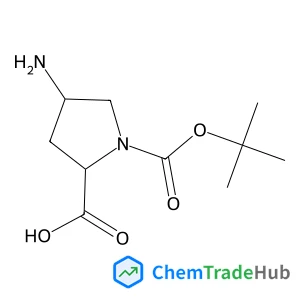
(2R,4R)-1-Boc-4-Aminopyrrolidine-2-carboxylic acid
CAS Number:
132622-98-1
Molecular Formula:
C10H18N2O4
Vincenzo Barone, Ivo Cacelli, Alessandro Ferretti
We report on a theoretical study of the electronic transport properties of binuclear complexes of metals of the VIII group bridged by pyrazine. Metal–porphyrazine units have been combined in order to investigate symmetric and non-symmetric species with particular focus on their current rectification properties. Transmission functions and I–V characteristics of the various species have been computed using a Non-Equilibrium Green Function with a simplified treatment of the molecule–lead interaction. The results obtained show an overall moderate asymmetry in the current along the molecules, which is of the donor–σ–acceptor type and follow the trend of the ionization potential of the metals in the binuclear system. The bias-dependent rectification ratio, which is significant in a limited voltage window, can be explained in terms of the alignment of the occupied orbitals of the metallic fragments that contribute to the HOMO and HOMO − 1 of the supermolecule. The possible improvement of the rectification performance of such a class of molecules has also been investigated exploiting suitable substitution by electron-withdrawing groups.
Ryan P. Dias, Marella H. Schammel, Keith P. Reber
DOI: 10.1039/C9AY01443H
Yanli Zhu, Yiyang Sun, Qingyun Cai
DOI: 10.1039/D0AN00816H
Anna Kisiel, Honorata Marcisz, Agata Michalska, Krzysztof Maksymiuk
DOI: 10.1039/B510868C
Siyu Xu, Quan Yu
DOI: 10.1039/C9AY01669D
Shazzad Rassel, Chao Xu, Steven Zhang, Dayan Ban
DOI: 10.1039/C9AN02354B
Meena Adhikari, Sagar Dhamane, Anna E. V. Hagström, Gavin Garvey, Wen-Hsiang Chen, Katerina Kourentzi, Ulrich Strych
DOI: 10.1039/C3AN00891F
When considering alternatives to 1-(4-Chlorophenyl)-N-hydroxymethanimine (CAS: 3...
This compound should be stored in a cool, dry place away from direct sunlight. I...
3-(4-Bromophenyl)-5-(2-fluorophenyl)-1,2,4-oxadiazole is synthesized through a m...
5-Chloro-2-(4-chlorophenyl)-4-methyl-6-[3-(1-piperidinyl)propoxy]pyrimidine (CAS...
2-Chloro-4-(difluoromethoxy)pyridine is used in the pharmaceutical industry for ...
3-Chloro-6-methylpyridazine (CAS: 1121-79-5) is classified under the Globally Ha...
Several alternatives can be used in the synthesis of Methyl 4,5-dimethyl-2-nitro...
Alternatives to (2E,2'E)-3,3'-(1,4-Phenylene)bisacrylaldehyde include other acry...
3-Amino-5-chloropyridin-2-ol hydrochloride is an organic compound with the CAS n...
When handling 6,7-Difluoro-2,3-dihydro-4H-chromen-4-one, it is essential to wear...

Physical Chemistry Chemical Physics (PCCP) is an international journal co-owned by 19 physical chemistry and physics societies from around the world. This journal publishes original, cutting-edge research in physical chemistry, chemical physics and biophysical chemistry. To be suitable for publication in PCCP, articles must include significant innovation and/or insight into physical chemistry; this is the most important criterion that reviewers and Editors will judge against when evaluating submissions. The journal has a broad scope and welcomes contributions spanning experiment, theory, computation and data science. Topical coverage includes spectroscopy, dynamics, kinetics, statistical mechanics, thermodynamics, electrochemistry, catalysis, surface science, quantum mechanics, quantum computing and machine learning. Interdisciplinary research areas such as polymers and soft matter, materials, nanoscience, energy, surfaces/interfaces, and biophysical chemistry are welcomed if they demonstrate significant innovation and/or insight into physical chemistry. Joined experimental/theoretical studies are particularly appreciated when complementary and based on up-to-date approaches.
![[4-(Isobutyrylamino)phenyl]boronic acid structure](https://static.chemtradehub.com/structs/874/874219-50-8-6ab5.webp "[4-(Isobutyrylamino)phenyl]boronic acid structure")




